


Ayao Komatsu warns against "knee-jerk" reactions to Oliver Bearman-Franco Colapinto incident
Closing speeds have been a big talking point of the 2026 F1 regulations, even more so after the Bearman-Colapinto incident at Suzuka


Oliver Bearman, Haas F1 Team car after his crash
Photo by: Kym Illman / Getty Images
Haas Formula 1 boss Ayao Komatsu has warned against any “knee-jerk” reactions to the incident between Oliver Bearman and Franco Colapinto at the Japanese Grand Prix.
Bearman was around one second behind the Alpine through Suzuka’s sector two, but suddenly closed at Spoon as Colapinto harvested energy causing a 45km/h speed difference.
The Haas driver was therefore forced into evasive action, and after taking to the grass, he spun into the barriers at 50G, prompting more questions about the contentious 2026 regulations.
This time it was in relation to the closing speeds, which had already been a talking point through pre-season, that have become more severe due to how drivers opt for different battery management strategies.

Colapinto claimed it can become “really dangerous”, Carlos Sainz said “it was only a matter of time” before such a collision occurred, whereas Lando Norris thinks a driver is at the “mercy” of the power unit.
So there have been calls for changes, something that’s already occurred with the energy recovery limit in qualifying, ahead of a meeting between F1, its teams, power unit manufacturers and governing body the FIA on 9 April.
But Komatsu is eager to not see changes for the sake of it, as he told Sky Sports: “We’re looking at it from all dimensions because, when we make changes, we’ve got to make the correct ones.
“We cannot be making knee-jerk reaction changes and then a few races later be saying, ‘that was the wrong option’.
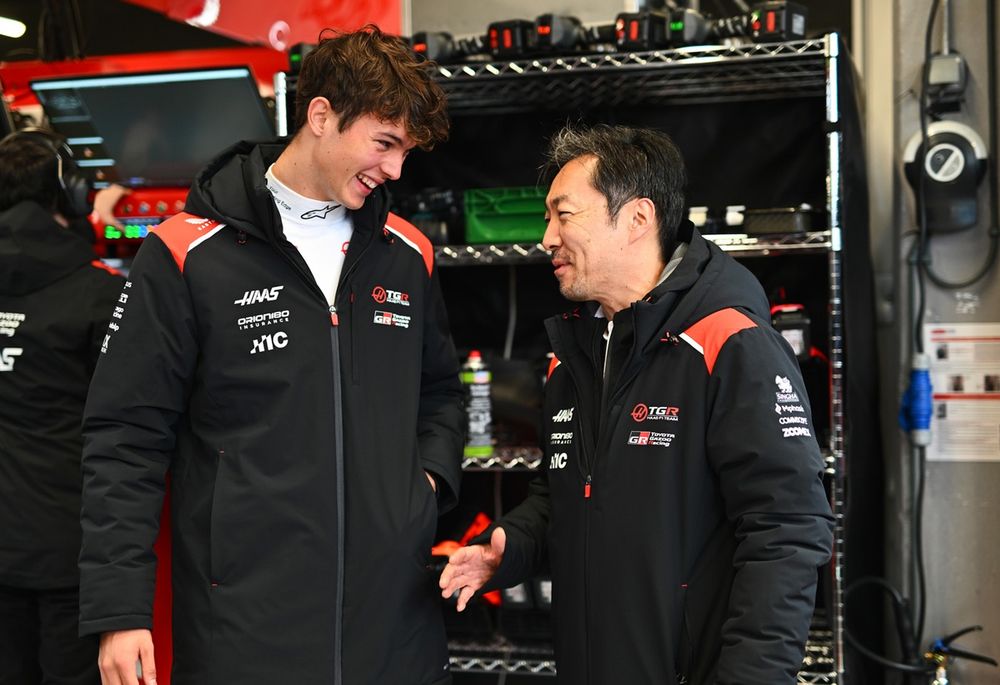
Oliver Bearman, Haas F1 Team, Ayao Komatsu, Haas F1 Team
Photo by: Haas F1 Team
“The good thing is that the F1 community, all the teams, the FIA, F1, we’re all working together in a really open and transparent manner, which I don't think I’ve seen to this extent before.
“I’m pretty confident that F1, as a community, we’ll find the right solution to whatever things we need to improve.”
This comes amid a set of regulations which have certainly divided opinion due to their increased reliance on electrical energy – with Max Verstappen, for example, saying drastic changes are needed.
But Komatsu doesn’t think the situation is as severe, believing only tweaks are needed, citing the qualifying change because it allowed drivers to lift off later into corners at Suzuka.
“Already taking action, a small step for qualifying by reducing the amount of energy you can recover, so that was one good step,” Komatsu told print media in Suzuka.
“But we already identified several areas. The small differences – doesn't have to be wholesale changes – that can improve some of the issues we saw in Melbourne and Shanghai, and then this is another example.
“So we are collectively learning so many things, but I'm sure if we put those, let's say, relatively even minor improvements, I think you can drastically improve the show as well as the safety.
“So again, sitting here, I don't know exactly what mechanism we should do for that particular incident, but for instance, things happen in Melbourne and Shanghai, at least in my eyes, there's a pretty clear solution we can take, and which is not big.”
Additional reporting by Ronald Vording

Share Or Save This Story


McLaren launches Google Gemini livery for F1 British GP

Kimi Antonelli frustrated by horror start to F1 Austrian GP

How Max Verstappen's Nurburgring adventure marked the next phase of his legacy


The story behind the viral, awkward encounter between Pedro Acosta and Franco Colapinto

Franco Colapinto demoted after 10-second penalty for yellow flag breach in F1 Barcelona GP

Forget the terrible luck; Colapinto's tenacious Shanghai drive deserves credit


How Silverstone played its part in Bearman’s learning curve

Esteban Ocon doesn't "give a s***" about those doubting his F1 future

Oliver Bearman explains why Haas targets have boosted his F1 motivation

Dennis Hauger is done playing the patient rookie: “I don’t want to fight midfield”

Vasser Sullivan honors late Dennis Reinbold with emotional Watkins Glen Victory

Filipe Albuquerque doesn’t see Acura’s exit as “downfall” for IMSA’s GTP class

How Silverstone played its part in Bearman’s learning curve
How Silverstone played its part in Bearman’s learning curve

Five takeaways from Newey's revealing interview on Aston Martin’s F1 2026 woes

Why F1 should stop considering a return to refuelling in 2031

How Arvid Lindblad has shown that he's found his feet in F1
Subscribe and access Motorsport.com with your ad-blocker.
From Formula 1 to MotoGP we report straight from the paddock because we love our sport, just like you. In order to keep delivering our expert journalism, our website uses advertising. Still, we want to give you the opportunity to enjoy an ad-free and tracker-free website and to continue using your adblocker.


Top Comments