


How 2026 F1 rule changes to improve safety could also remove "unintended overtaking"
Tweaks to how much electrical boost can be applied, as well as where and when, aim to avoid a scenario such as Oliver Bearman's accident in Suzuka. They may also solve another problem that's been vexing F1 drivers – if not completely

Charles Leclerc, Ferrari, Lewis Hamilton, Ferrari, George Russell, Mercedes
Photo by: Andy Hone/ LAT Images via Getty Images
In the package of changes to the 2026 Formula 1 regulations agreed last week, if not yet ratified by the FIA's world motor sport council, one of the key aims was to get a grip on the problem of closing speeds. The dangers of one car approaching another at an unexpectedly high velocity were illustrated most recently in Suzuka, where Oliver Bearman had to take evasive action to avoid Franco Colapinto's Alpine, and spun off into a heavy impact with the wall.
Despite Bearman subsequently blaming Colapinto, the trigger for the incident and major magnifying factor was the difference in electrical boost between the two cars at that point, causing Bearman to arrive on Colapinto's rear wing much faster than expected.
It's hoped that the measures to change the regime of electrical deployment will not only remove some safety risks, but also go some way to eliminating so-called "unintended overtakes". During the Japanese Grand Prix, Lando Norris had to back off the throttle to avoid hitting the back of Lewis Hamilton's Ferrari at 130R, then got far more power than he expected when he hit the accelerator again. This quickly depleted his battery so, having passed Hamilton, he immediately lost the position owing to the difference in charge levels.
"The unintended overtaking is also related to the closing speeds," FIA single-seater director Nikolas Tombazis said in a call with select media including Motorsport.com.
"And we believe that the measures we've taken to address the level of boost and the level of power in certain parts of circuit goes to some extent towards addressing this issue."
While the headline changes were a rise in the amount of energy which can be harvested through super clipping, and a reduction to the harvesting limit during qualifying, the primary aim of these was to improve the spectacle in qualifying – though there are safety benefits to maintaining a more natural speed profile and reducing the need to lift and coast.
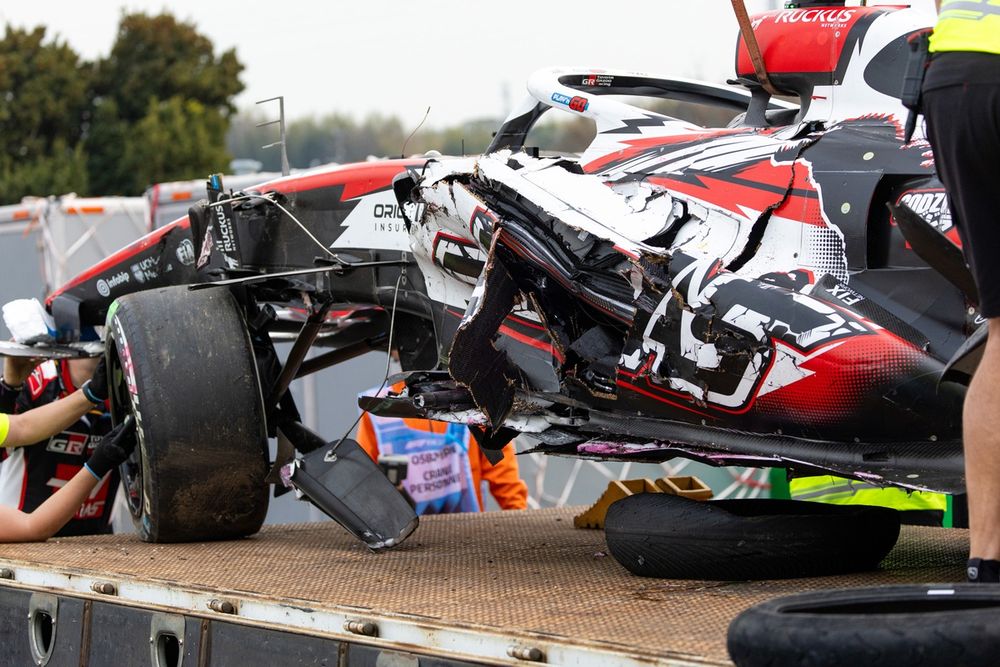
Oliver Bearman, Haas F1 Team car after his crash
Photo by: Kym Illman / Getty Images
More detailed changes included a remapping of how much energy can be deployed outside what the FIA describes as "key acceleration zones". 350 kilowatts remains the limit for these, but elsewhere it will be limited to 250 kW. Maximum additional power in boost mode in race conditions is now capped at 15 kW.
There have also been changes to the implementation of the so-called power-limited and power-limited-pending modes which govern the electrical deployment in the areas outside those key acceleration zones.
Some of the peculiarities such as unintended overtaking have been a result of the measures taken to avoid the scenario of cars running out of charge on the straights, causing potential safety issues when following one another. Among these sticking-plaster solutions is the process of the electrical power ramping down by a prescribed amount rather than being allowed to run out suddenly.
Another has been the division of the circuits into areas where electrical boost is more beneficial to laptime – mostly out of corners – and others where it is less beneficial, such as later on straights. Teams use machine-learning algorithms to effectively ‘train' the car to be prepared to enter these so-called power-limited areas. The trigger is the driver being at 98% throttle or above for one second.
What caught Norris out in Japan, and also scuppered Charles Leclerc's qualifying in China, was backing off the throttle at a point which deviated from the ‘script', causing the system to reset when they reapplied it. Motorsport.com understands it has been agreed that the cars will now enter power-limited mode regardless of whether the driver lifts off or not.
While this will help, it is the amount of power which exerts most effect on closing speeds and unintended overtakes, so the next few races will provide a case study in whether the levels chosen have the right effect – or whether they will need to be changed again. Tombazis was emphatic that this is a gradual and data-driven adjustment of the dial.
"We believe, we are quite certain, these changes will be a step in the right direction and a reasonably significant one," he said.
"Whether there will be enough or whether we will need to take an extra step at some point, that is something we're going to assess over the next few races. So we are open to continue this discussion, we clearly engage with the teams, with FOM, with the drivers.
"We also listen to the fans. All of that put together is what helps us form our strategy.
"The fact we had a break meant we could concentrate on these discussions while we didn't have to go racing every other weekend. It doesn't mean that these discussions cannot continue."


Share Or Save This Story


How F1 let a golden opportunity slip at Sepang

How the Bahrain GP in Malaysia exposed Red Bull’s hidden resurgence

LIVE: F1 Bahrain GP in Malaysia - Max Verstappen wins as George Russell retires

Denny Hamlin had 'no idea' that he gave Kyle Larson the wave-around by pitting

German Formula 4: 14 teams confirmed - DTM outfit and F1 star's team join grid

Corvette Racing by Pratt Miller locks in two-car GTD Pro lineup for 2027 IMSA campaign

Inside Corvette’s new Z06 GT3.R Evo for 2027

No denying it now – the one reason why F1’s ‘horrible’ start in Malaysia could be a good thing

The greatest F1 campaigns with no wins

Three kings: F1's generational stars shone at Sepang

How F1 let a golden opportunity slip at Sepang
Subscribe and access Motorsport.com with your ad-blocker.
From Formula 1 to MotoGP we report straight from the paddock because we love our sport, just like you. In order to keep delivering our expert journalism, our website uses advertising. Still, we want to give you the opportunity to enjoy an ad-free and tracker-free website and to continue using your adblocker.


Top Comments