Analysis
Formula 1
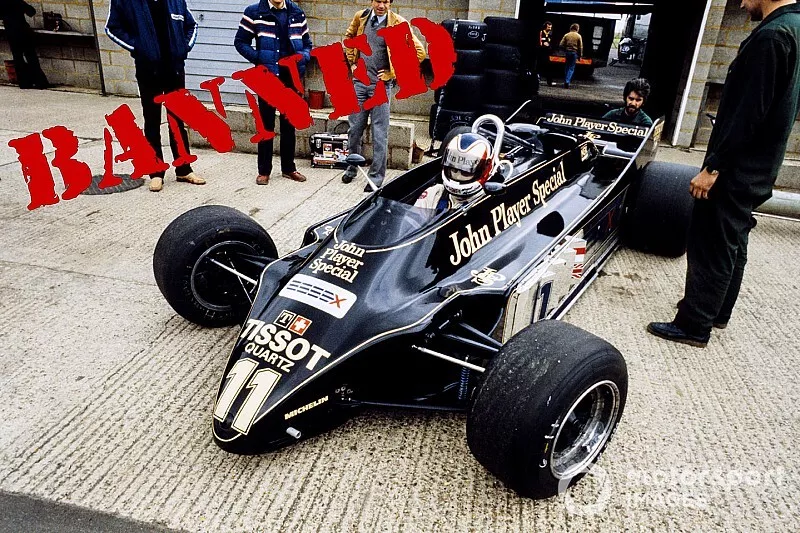
Banned: Why Lotus' twin-chassis concept was outlawed
Colin Chapman enjoyed massive success throughout the 1960s and 1970s with his Lotus team, going on to maximise the advantage it earned by being first to introduce and develop cars that took advantage of ground effect.

Matt Somerfield
Edited: Feb 23, 2022, 6:31 AM
Copy link
Share on Viber
Giorgio Piola's F1 technical analysis
Giorgio Piola is the preeminent Formula 1 technical journalist. View our full selection of Giorgio's technical illustrative content
Ground effect is a catch-all term used to describe the aerodynamic principle applied to the cars designed during that era.
The designs, also known as 'wing cars', included large Venturi tunnels housed under the sidepods that reached the back of the car.
To take maximum advantage of the Venturis, Lotus pioneered a skirt solution too, which was hung from the edge of the sidepod and touched the track's surface. This closed off the tunnels, improving flow through them and reducing airflow egress, resulting in much more downforce.
As we saw, ever-more complex skirts arrived as teams developed the solution and re-engineered their cars to find more performance.
Lotus 79 1978 ground effect comparison
Photo by: Giorgio Piola
This illustration of the Lotus 79 shows the effort made by the team to create as narrow a body as possible in order to have wider and longer Venturi tunnels.
Lotus 80 bottom
Photo by: Giorgio Piola
The Lotus 80 with its even longer Venturi Tunnels.
Lotus 79 and Lotus 80 comparsion
Photo by: Giorgio Piola
A comparison of the Lotus 79 and 80 shows just how much further the concept was developed by Lotus
Arrows A2 1979
Photo by: Giorgio Piola
Arrows even went as far as to try to incline its engine on the A2 to increase the width of their Venturi tunnels.
However, by the end of the 70's, with speeds climbing and safety diminishing, the governing body stepped in and gradually regulated its demise by banning skirts.
Chapman, unable to let go of the knowledge his team had gained, set about finding ways to circumvent the ban.
Lotus had already worked on a car that utilized the twin-chassis concept - the Lotus 86. But, with skirts a viable option, it was never pressed into service as it wasn't as effective as its single chassis counterpart.
However, the skirt ban and the introduction of a minimum ride height changed this, and Lotus once again pressed on with the twin-chassis concept. This time with a mock carbon monocoque, having seen the potential in John Barnard's design when the MP4/1 was unveiled.
Short on time and the affiliation that McLaren had with Hercules, Lotus was forced to build its own version in-house.
Although likely better than its aluminium counterpart, the monocoque used entirely different techniques to Barnard's in its construction, favouring a Nomex honeycomb centre over the aluminium honeycomb used by McLaren. A wet lay up procedure that wasn't cured in an autoclave reduced the overall strength further still.
Lotus 88 1981 twin chassis concept
Photo by: Giorgio Piola
The idea of the twin-chassis concept was to have two sprung bodies, the inner body responsible for the mechanical forces exerted on the car and the outer taking care of the aerodynamic forces.
Think then of the outer body as a floating one. As speed built, it would be sucked down to the track and the force would be exerted onto the inner chassis.
To prevent the use of such designs, the regulators cited the rulebook that: 'aerodynamic parts must remain immobile in relation to the sprung part of the car'.
The specific wording has been tailored to suit the prevailing regulations over the years but can still be found in article 1.4 of the technical regulations.
Chapman was outraged by the decision and made several attempts to race the '88. But, with staunch opposition at every turn, he was eventually forced to abandon the design and run a conventional one instead.
We want your opinion!
What would you like to see on Motorsport.com?
Take our 5 minute survey.
- The Motorsport.com Team
Read and post comments
Read also :
Share Or Save This Story
Copy link
Share on Viber
Previous article How lost races are already hitting F1 teams
Next article Sir Stirling Moss death: Racing legend dies aged 90
Top Comments
There are no comments at the moment. Would you like to write one?
View More & Comment

More from
Matt Somerfield

Gallery: How F1 tech evolved during the 2024 season
Formula 1
Formula 1 Dec 31, 2024
Gallery: How F1 tech evolved during the 2024 season
How McLaren’s rear wing push changed the game in F1
Formula 1
Formula 1 Dec 20, 2024
How McLaren’s rear wing push changed the game in F1

How 2026 F1 rules will help avoid identikit designs
Formula 1
Formula 1 Dec 16, 2024
How 2026 F1 rules will help avoid identikit designs
Latest news

Carson Hocevar and Cleetus McFarland win LeMullets 2026 in epic finish
General
Misc General 50 min
Carson Hocevar and Cleetus McFarland win LeMullets 2026 in epic finish

TV ratings released for NASCAR Cup season finale
NASCAR Cup
NAS NASCAR Cup
Homestead-Miami
7 h
TV ratings released for NASCAR Cup season finale

Chase Elliott's car chief leaves Hendrick for NASCAR Truck crew chief role
NASCAR Truck
NSTR NASCAR Truck
Homestead
7 h
Chase Elliott's car chief leaves Hendrick for NASCAR Truck crew chief role

Feature
Discover prime content



Top 10 F1 cars of the 1970s
Formula 1
By Kevin Turner
Top 10 F1 cars of the 1970s


Subscribe and access Motorsport.com with your ad-blocker.
From Formula 1 to MotoGP we report straight from the paddock because we love our sport, just like you. In order to keep delivering our expert journalism, our website uses advertising. Still, we want to give you the opportunity to enjoy an ad-free and tracker-free website and to continue using your adblocker.
You have 2 options:
- Become a subscriber.
- Disable your adblocker.
Subscribe now Already subscribed? Sign in here
Already disabled your adblocker?
Reload page
Manage Alerts
Subscribe