


Tech analysis: The low downforce battle begins
Giorgio Piola looks at the recent low-downforce updates introduced by Formula 1 teams after Spa and ahead of the Italian Grand Prix.

Giorgio Piola's F1 technical analysis
Giorgio Piola is the preeminent Formula 1 technical journalist. View our full selection of Giorgio's technical illustrative content
Formula 1 returned from its summer break to a Spa-Francorchamps track that has totally different demands from the Hungarian race before it.
While out-and-out downforce is the name of the game at the Hungaroring, Spa demands medium downforce levels, low drag – and a tricky balance between top speed for the straights and grip for the tricky middle sector.
It was interesting that teams took very different routes, with some opting for all new solutions, some tweaking what they already had and some even going back to old solutions
Mercedes
The most eye-grabbing development was the new Mercedes 'spoon' rear wing that both Lewis Hamilton and Nico Rosberg ran.
Such a design concept is nothing new in F1, with McLaren having first used this style as long ago as 2006 and sticking with it for the following season.
Mercedes' push to ensure it keeps bringing developments is unrelenting, and it said much about the faith they had in this design (perfect for high-speed tracks) that it committed to it from the start with no back-to-back testing of a Canada-specification wing.
The team also used a monkey seat, that had been tested at Silverstone ahead of the British Grand Prix but not raced at the time.
Red Bull
Red Bull knows a thing or two about running in low-downforce configuration, having had to compensate for its lack of power over the past two seasons.
On the Friday at Spa, it ran a rear wing that is likely to only be used at the next race in Italy. It featured no gills on the endplate, and with a very low profile main plane cord.
Despite being tested extensively on Friday by Daniel Ricciardo, in the end he opted for the same version that Daniil Kvyat had run with all day and that delivered slightly more downforce.
That wing had two horizontal gills at the top, and a long vertical gap at the start of the endplates.
Ferrari
Ferrari introduced a low-downforce front wing at Spa, whose main difference was that it did not feature the usual upper flap, and was also without the extra deck towards the endplate.
Elsewhere, Ferrari reverted to the bodywork solution that it had used prior to the Spanish Grand Prix, when it had overhauled its concept.
That was not because it had gone in the wrong direction but simply because it was better suited to a lower downforce and lower drag track.

Toro Rosso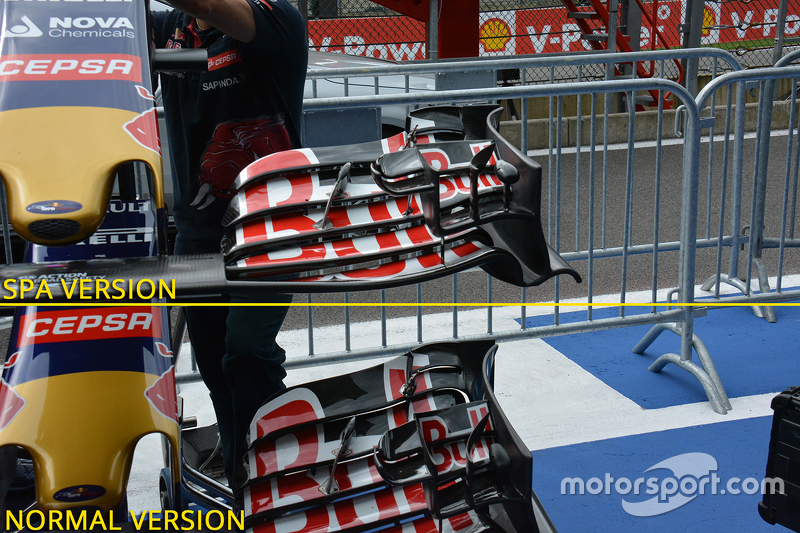
Toro Rosso introduced a low downforce configuration rear wing, which had a very low profile. There was also a horizontal slit in the upper part of the endplate, as well as the vertical gills further down.
The team also made tweaks to the front wing – where the main difference was in cutting away the top flap to have less drag – and therefore better top speed.
Williams
Williams decided to go a different route to everybody else with a higher downforce approach – which was evident because the team rarely featured at the top of the speed trap figures.
The team used quite a high downforce rear wing, with five gills on the endplate and quite a high angle of attack with the main plane.
A concession to reducing drag was the V-shape in the top flap too.
The team retained the monkey seat too, which it is known to have used to prevent its rear wing stalling as happened earlier this year.
Share Or Save This Story


Fred Vasseur shuts down claims Ferrari split Spanish GP strategy to separate drivers

Lewis Hamilton denies claims he is pushing Ferrari to replace key staff

Lewis Hamilton and Fred Vasseur recall GP2 title and 'most impressive race ever', 20 years on

Fighting through 'tough year,' Kaulig RAM earns first-ever top five finish

New Daniel Suarez documentary follows his emotional and historic homecoming in Mexico

2026 MotoGP Austrian Grand Prix – How to watch, session times & more

Jake Garcia earns first NASCAR Truck win after nightmare race for Front Row Motorsports

What's behind the talks between the FIA president and Fernando Alonso over ADUO?

Fernando Alonso is right to sound the alarm about F1 - but history seems to be repeating itself

F1 doesn't need to change its VSC rules despite Lando Norris' Spain loss

Why Lando Norris doesn’t buy George Russell’s driving style theory
Subscribe and access Motorsport.com with your ad-blocker.
From Formula 1 to MotoGP we report straight from the paddock because we love our sport, just like you. In order to keep delivering our expert journalism, our website uses advertising. Still, we want to give you the opportunity to enjoy an ad-free and tracker-free website and to continue using your adblocker.


Top Comments