


Tech analysis: How Force India became a giant killer
Force India's VJM09 was one of the standout success stories of the 2016 Formula 1 season, with the team's performance going from strength to strength after an update package was introduced at the Spanish Grand Prix.

Giorgio Piola's F1 technical analysis
Giorgio Piola is the preeminent Formula 1 technical journalist. View our full selection of Giorgio's technical illustrative content
Its ascendancy through the ranks cannot merely be apportioned to decisions made this year though, as the team made the commitment to abandon its own wind tunnel facilities in 2015, making the switch to the Toyota facility in Cologne.
It was a decisive move, given its own tunnel was in need of refurbishment and operates at 50 percent scale rather than the full 60 percent scale the regulations permit and is available at the Toyota facility.
However, the team knew it would take time to attain tangible results: with the VJM08 designed and initially developed on the smaller scale, there would be a period of crossover and refinement of its procedures, in order to maximise the new tool.
To coincide with its switch to the Toyota wind tunnel, the team also extended its CFD operation to match, improving the correlation between the different simulation tools available and the real world car.
While the VJM08 was optimised at 60 percent scale, this year's challenger was an evolution of last year's machine, allowing the team to hone in on areas of the car's design that have previously been unattainable, while allowing them to push in new development directions too.
Crucially, it seems that with this extra power and fidelity, Force India has been able to create, harness and manage the aerodynamic inconsistencies created by the deformation of the tyres even more than it has in the past.

This began with changes made to the front brake assembly, coinciding with the 2015 Spanish GP and which had not only mechanical but aerodynamic consequences.
The caliper, previously mounted at the front end of the assembly, was moved to the rear, changing how the car behaves under braking and perhaps most importantly leaving space for aerodynamic ducting to occupy the space previously reserved for the caliper.
This ducting, or crossover pipework as we often refer to it, uses airflow taken in by the main brake duct inlet and ejects it through the wheel face, smoothing the disturbance caused by the wheel's surfaces and spokes.

In a related move, the designers settled on the use of a blown axle for the 2016 challenger, an aero device we've seen the likes of Red Bull exploit in several guises down the years, as they look to take further control of the wake created by the tyre and pull it away from the floor.
Once again, airflow taken in by the main inlet is channelled through the front assembly and ejected into the airflow passing by the tyre.

The VJM09 also retained the 'cobra' nose, introduced as part of its predecessor's update package at the British GP, with air channelled through the apertures in the upper surface energising the underside of the nose.
Meanwhile, the 'S' duct, a solution widely incorporated in designs up and down the grid, was also retained, in order to overcome the aerodynamic inefficiencies created by the team's aggressive approach to the nose and chassis regulations.

The update wheeled out at the Spanish GP centered around a new front wing design philosophy, mimicking the outwash tunnel seen on the Mercedes. The tunnel [1] starts around 50mm from the endplate and increases in size to shape the airflow, breaking up pressure on the front face of the tyre and moving it around the tyre.
A footplate [2] is created alongside the tunnel, with the slot gap created by the flaps continuing across its span right up until the juncture with the endplate. These slots help to energise the tunnel and maintain flow stability across the various speed and yaw angles that the car operates.
The single vertical vane mounted within the cascade was replaced by two elements [3], with two L-shaped canards placed just behind [4] both of which mirror designs used by Red Bull.
While Force India was clearly satisfied with the performance that the front wing brought, F1 is a prototype series, and so iterational design is part and parcel of progress.
At the British GP the team introduced a mild change to the inner footplate (large inset), raising the innermost edge and connection point to the tunnel to create a drooped section (highlighted in yellow and compared with the previous specification in the smaller inset).
This almost imperceptible change had a wide reaching effect on both the wing's performance and that of other flow structures it affects downstream. The change not only affects the shape of the tunnel's nozzle but also how airflow circulates around the slot gaps in the inner footplate, changing the direction and ferocity of the various vortices being created.
The front wing has such an important task in not only generating front end downforce, but also delivering the right aero structures for the rest of the car, making it the focal point of the update. But there were other areas of the car that changed too, balancing things out.

The floor ahead of the rear tyre has become an area of intense development over the last few years, with slots placed on the floor's edge helping to mitigate the effects of tyre squirt, a phenomenon caused by airflow that is spilt by the tyre into the diffuser's path, destabilising it and reducing consistency and performance.
The slots inject high pressure from the upper surface of the floor into the low pressure below, changing the direction and intensity of the airflow coming off the rear tyre.
The number, orientation and shape of these slots can therefore have a huge bearing on performance, and so Force India looked to improve things with the update.
The single L-shaped slot used in the opening four rounds was cast aside for the Spanish GP, making way for a much more complex array of slots similar in design to the solution used by McLaren during 2015.
However, the slots introduced in Spain were short-lived. In fact, it was the only race the design was used in, with another design introduced at the next round in Monaco that would see out the rest of the season.
It's a solution many of the other teams had honed in on, placing many more simple slots further down the floor. In Force India's case, it turned out to be 16.
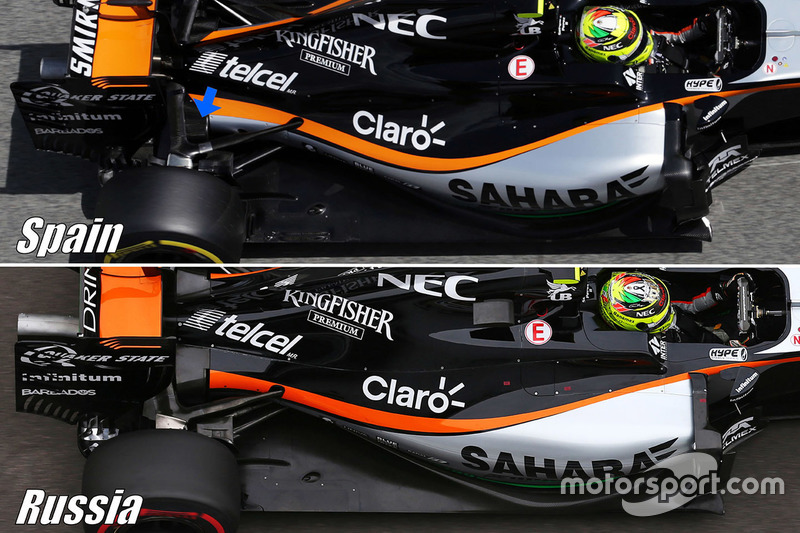
Perhaps one of the more understated and lesser covered parts of the Spanish update was a change to the car's rear suspension. These changes had both a mechanical and aerodynamic impact, with the latter not isolated to just the suspension itself.
Force India purchases its gearbox from Mercedes rather than manufacturing its own. This isn't something new for the Silverstone-based outfit, as before its deal with Mercedes it purchased McLaren and Ferrari solutions, depending on prevailing engine supply deals.
While on the surface this may seem like a shrewd cost-saving exercise, it does have some downsides, as the team is forced to run similar suspension pick-up points to the Silver Arrows.
Again, some would argue that, on the face of it, as the lead team you'd want some familiarity. However, from a kinematics point of view it can be a limiting factor.
This is magnified by the two differing aero philosophies, with Mercedes running a very soft suspension and almost zero rake attitude, whilst Force India favour a less compliant suspension configuration with a significant rake attitude.
The changes made in Spain surrounded the reshaping of the wishbones, which as we know are used to infer a given aerodynamic effect. In changing their shape, it has the knock-on effect of allowing surrounding bodywork to be re-tailored too, something that was taken advantage of in the update, with Force India adopting a slimmer cooling outlet and the detached hoops (blue arrow) that the last few Mercedes cars have featured.

The hoops, highlighted in green, take advantage of the airflow moving around the coke bottle region, shaping it and improving hot air extraction from the cooling outlet. The engine cover's cooling outlet was changed frequently depending on the cooling parameters of the circuit it was visiting, with its size changed to match their requirements.

The rear wing was also revised, changing the geometry of the mainplane and upper flap in order to maximise the amount of downforce that can be achieved, while keeping a keen eye on the drag that is generated too.
Force India's season has been a triumph, taking the team to its best result in the constructors' championship - fourth - since its inception eight years ago. It took a calculated risk in moving the bulk of its aerodynamic operation to the Toyota facility and used ideas already successfully implemented by others up and down the grid, meshing them with the evolution of last year's car.
From a resource point of view this was a sound plan, given the need to concentrate a large portion of this year's effort towards next year's car too, as designing and forging its own path would have been wasteful, given how little the two generations of cars will share.
This is where its season has unfolded very differently to Williams, who it usurped, with the team from Grove apportioning more of its resources toward the 2017 car much earlier in the season.
It'll be interesting to see how the two shake out come next season, but for the time being Force India has earned the upper hand.
We identify the key features of the VJM09 in this animation, including some of the updates that filtered through for the Spanish GP and beyond.
Share Or Save This Story

The fascinating story behind McLaren's most iconic F1 car

Emilia Romagna GP: F1 technical images from Imola's pitlane

The F1 downforce choices that proved key at the Saudi GP


Otmar Szafnauer reveals failed Kimi Raikkonen bid involving "Angry Birds" founders

Esteban Ocon explains why he collided with Sergio Perez so often at Force India

Former Force India F1 boss Fernley dies aged 70

NASCAR Cup stars react to Days of Thunder sequel and meeting Tom Cruise at Daytona

The new Chase for the Championship is different but the same

Legacy Motor Club to part ways with John Hunter Nemechek

Christopher Bell: New format brings "more pressure" and believes he has to start winning

Top 10 greatest F1 qualifiers

Making sense of Wolff's claim that Mercedes "haven't got the money" for car development

Why "mega difficult" ADUO upgrades haven't been a game changer in F1

Why F1's 2027 'silly season' has been so static
Subscribe and access Motorsport.com with your ad-blocker.
From Formula 1 to MotoGP we report straight from the paddock because we love our sport, just like you. In order to keep delivering our expert journalism, our website uses advertising. Still, we want to give you the opportunity to enjoy an ad-free and tracker-free website and to continue using your adblocker.


Top Comments