


Tech analysis: Dissecting the new Haas VF17
Haas faces a task similar to that of a music artist - the difficult second album.

Giorgio Piola's F1 technical analysis
Giorgio Piola is the preeminent Formula 1 technical journalist. View our full selection of Giorgio's technical illustrative content
A technical partnership with Ferrari that gave it access to a chassis design that was then constructed by Dallara and supplemented by a supply of rear suspension, gearbox and power unit gave the American team a foothold from which to gather momentum in 2016.
And gather it it did, achieving results it could have only dreamed of heading into the season.
Born outside of the restrictions that come from being part of the championship, the VF16 served the team well.
The VF17 looks to be another solid design, albeit nowhere near the cutting edge that the likes of Mercedes and Ferrari have already presented.
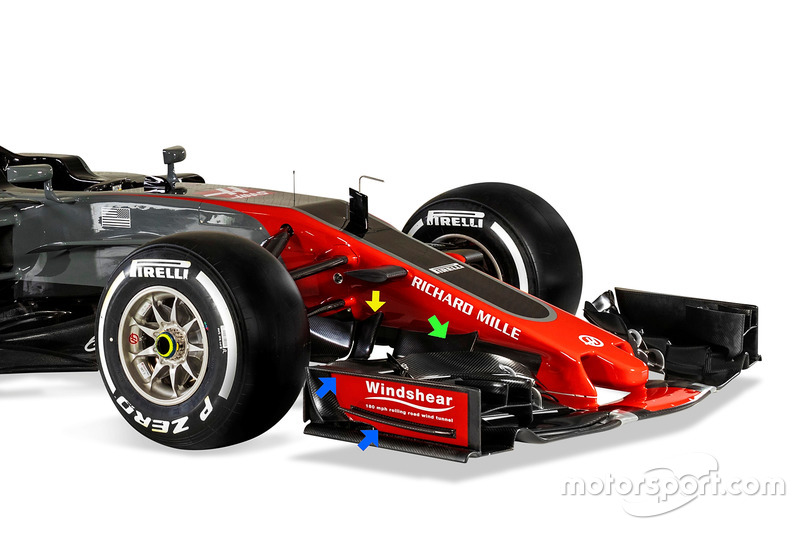
The front wing is similar to last year's design, although it has an exaggerated outwash tunnel but doesn't feature the inner cascades used last season. The endplate has been freshened up and now features both a canard and a Ferrari-inspired triangular topper (blue arrows).
These should help the wing to interact with the flow structure being generated by the blown axle, which the team has chosen to retain for 2017.
The nose has been revised as the team adopts the familiar thumb style seen on numerous cars in 2016. That will maximise flow under the nose, where a new set of vanes hang from the side of it (green arrow). These appear to be angled to drive air toward the centre of the car.
Meanwhile, a more conventional placed set of turning vanes accompany them, although the first element which is mounted to the nose (yellow arrow) starts higher up than usual, collecting airflow that may ordinarily follow a more neutral path.
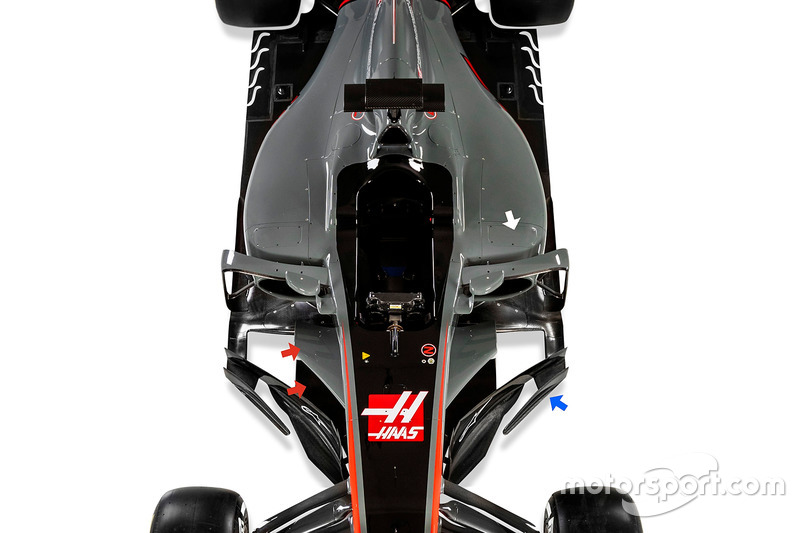
The bargeboards are obviously much larger than last year to take advantage of the new regulatory dimensions but they lack the detail we've seen from some of the other challengers.
The main bargeboard has a taller section at the front, with a slot in just behind the leading edge before the surface gradually falls away to a point where it meets with the floor's extended axehead.
A smaller wedge-shaped vertical fence (blue) is also mounted at the rear of the main bargeboard as the designers look to carefully control how airflow moves down the car.
A large delta-shaped winglet can be found on the side of the chassis to help drive airflow at the sidepod and sidepod inlet in order to improve cooling and aerodynamic performance. This is mirrored at floor level to have a similar effect with the airflow that passes down under the car (red arrows).
The sidepods and their main inlet are reminiscent of last year's car, with their width maintained rather than increased as the regulations allow. This is easy to spot given the blister that protrudes out of the sidepod's shoulder is there as it covers the side impact protection spar.
The sidepod is framed by a leading edge slat and combined airflow conditioner that stops a little way above the floor and is held in place by a diagonal spar.
On the images leaked ahead of the car's launch a small inlet could be seen just behind this region. It appears this may have just been opened up while the team was shaking down the car to control temperatures as in these images released by the team it is merely an access panel (white arrow).

The floor is as wide as the regulations permit and features a large detached scroll (red arrow) toward the middle of the car, with Haas the first to try such a large detachment to take advantage of the increased radius rules of 2017.
Ahead of the rear tyre, the floor has four dogleg-shaped slots (blue arrows) as the team looks to mitigate the effects of tyre squirt as the tyre deforms under load.
Like most of the field, the VF17 features a shark fin to help improve airflow stability to the rear wing, although it features a triangular cutout in order to meet the normal engine cover spine.
The rear wing isn't overly complex at this stage and is supported by a single centreline support pillar which envelopes the exhaust at its base and creates a swan neck-style shape to merge with the mainplane and DRS actuator pod at the top.
Share Or Save This Story


Gallery: How F1 tech evolved during the 2024 season

How McLaren’s rear wing push changed the game in F1

How 2026 F1 rules will help avoid identikit designs


Dropped Esteban Ocon defiant: Formula 1 is “where I belong”

Five contenders to replace Esteban Ocon at Haas for F1 2027

You Ask The Questions: Esteban Ocon

MotoGP Indonesian GP: Raul Fernandez claims pole, Marc Marquez outqualifies Jorge Martin

Samantha Busch complete speech from emotional Kyle Busch Celebration of Life

Joe Gibbs remembers Kyle Busch with humorous story at Celebration of Life

Brexton Busch drives NASCAR Cup RCR No. 8 in touching tribute to father Kyle

Why Red Bull's 'crazy' power unit success matters so much for F1

No denying it now – the one reason why F1’s ‘horrible’ start in Malaysia could be a good thing

The greatest F1 campaigns with no wins

Three kings: F1's generational stars shone at Sepang
Subscribe and access Motorsport.com with your ad-blocker.
From Formula 1 to MotoGP we report straight from the paddock because we love our sport, just like you. In order to keep delivering our expert journalism, our website uses advertising. Still, we want to give you the opportunity to enjoy an ad-free and tracker-free website and to continue using your adblocker.


Top Comments