


How T-wings could still return on F1's 2018 cars
Formula 1 teams are set to engage in a new design battleground over low T-wings in 2018, as part of their push to regain downforce lost at the rear of cars.

A loophole in last year's technical regulations opened the door for teams to run high T-wings on the shark fin engine covers in a bid to improve performance.
But their addition to the cars caused an outcry among fans and teams because they were ugly, and this led to an outright ban being introduced for this year.
However, with F1 teams well aware of the benefits that the small wings delivered in terms of managing airflow and increasing downforce, it is almost certain that this concept will not have been ignored completely when it comes to finalising the 2018 challengers.
As teams claw to recover the loss of downforce caused by the high T-wing ban, plus the outlawing of monkey seats, it is looking almost certain that T-wing development will open up in a new area of the car instead.
That is because the wording of the 2018 regulations that outlawed shark fins and high T-wings still leaves room for another area to be exploited.
Article 3.5.1 of F1's technical regulations outlawed high T-wings by making it clear that no bodywork could appear in a specified triangular area above the defined engine cover.
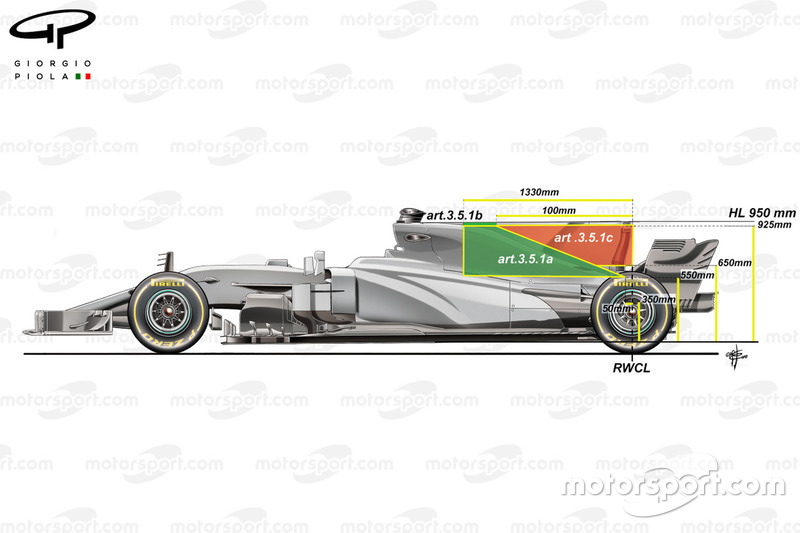
It stated: "When viewed from the side, no bodywork forward of the rear wheel centre line may lie above a line parallel to the diagonal boundary defined in a) [a rule that defines the dimension of the engine cover] and intersecting the rear wheel centre line 650mm above the reference plane."
However, there remains a small area below this triangle that is still available for teams to exploit – and importantly this was exactly where Williams ran elaborate T-wing concepts last year.

For as well as developing a high T-wing like other teams, the FW40 featured a second lower down T-wing element to help manage airflow in this area.
As well as channelling air to the lower element of the rear wing, this airflow can also prove important in helping maximise the efficiency of the diffuser.
F1 teams are expecting big gains in downforce this year thanks to a much better understanding of the performance aspects of the new aero rules that were introduced last year.
McLaren technical director Tim Goss told Motorsport.com: "You would expect there to be a step, and given the cars are relatively immature, you would expect it to be a bigger step than in previous seasons."
Share Or Save This Story


Brundle awarded OBE in King’s New Year’s honours

The new rules dilemma that will define the 2025 F1 season

Verstappen issues Red Bull title warning in push for RB21 progress

What was "weird" about McLaren's poor performance at rough Sepang

Spire’s Jeff Dickerson about Joe Gibbs Racing lawsuit: ‘Where is the proof?’

Charles Leclerc explains why Bahrain GP chaos has reinforced F1 driver fears

Redemption at Road Atlanta: Kevin Estre breaks IMSA victory curse in thrilling Petit Le Mans finish

How F1 let a golden opportunity slip at Sepang

How the Bahrain GP in Malaysia exposed Red Bull’s hidden resurgence

You Ask The Questions: Emerson Fittipaldi

The wide world of strategy options expected in F1's Bahrain GP in Malaysia
Subscribe and access Motorsport.com with your ad-blocker.
From Formula 1 to MotoGP we report straight from the paddock because we love our sport, just like you. In order to keep delivering our expert journalism, our website uses advertising. Still, we want to give you the opportunity to enjoy an ad-free and tracker-free website and to continue using your adblocker.


Top Comments