Formula 1
Why do F1 cars run flow-vis paint and aero rakes in testing?
You’ll often see F1 cars testing with bright paint streaks down the sides and big metal grates on the back, but what are these and what do they do?

Ed Hardy
Edited: Feb 21, 2024, 11:34 AM
Copy link
Share on Viber
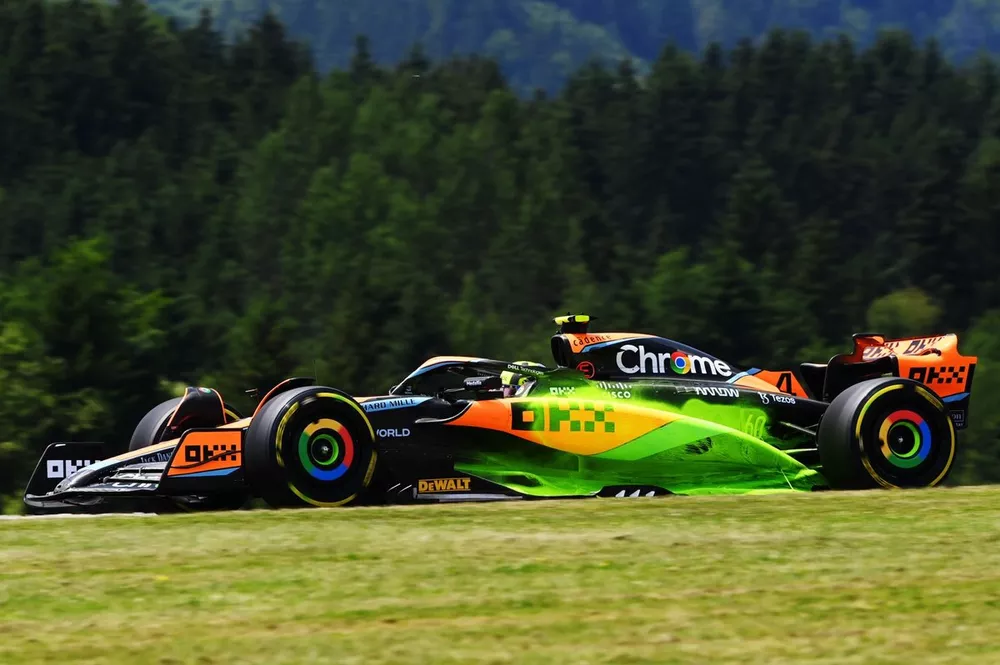
Formula 1 teams use pre-season testing to extract as much data as possible via various methods -including flow-visualisation paint and aerodynamic rakes.
Both play a key role in every pre-season test – plus some in-season free practice sessions – as teams attempt to learn more about aerodynamic performance.
This year will be no different with F1’s 2024 pre-season test on 21-23 February at the Bahrain International Circuit, which also hosts the year’s opening grand prix on 2 March.
Valtteri Bottas, Alfa Romeo C43, with aero paint applied
Photo by: Mark Sutton / Motorsport Images
What is flow-vis paint on an F1 car?
Flow-vis is the brightly-coloured paint spread across an F1 car’s body part used in pre-season testing or in free practice sessions.
The paint is formed by mixing a fluorescent powder with what’s usually paraffin oil and gets applied to a certain car part when a driver is set to leave the garage. Flow-vis could be applied to a car’s front wing, its sidepod or even all over, but it is especially useful when a new body part has been applied.
Some teams may use a fluorescent paint that can only be seen under an ultraviolet light so rivals cannot look at their data, while another way to do that is by covering the car as soon as it enters the pit-lane. F1 teams must also be careful with how much flow-vis it applies because too much will cause puddles, whereas too little makes it hard for valuable data to be gathered.
Flow-vis is used to determine aerodynamic performance because, when a car is travelling at high speeds, the paint moves across the body in accordance with the airflow. This leaves lines as the paint begins to dry, meaning it is essentially a wind tunnel but with 'real-world' air.
Sergio Perez, Red Bull Racing RB19, rear wing detail
Photo by: Mark Sutton
How does F1 flow-vis paint get analysed?
The lines which get left behind are incredibly important because they provide greater understanding into a car’s real-world surface flow and the air’s direction, meaning teams can very clearly visualise the kind of structure that they have.
So, for example, if flow-vis is applied to the bottom of the nose then lines usually appear further up showing how air has reacted to it and the direction the nose causes air to travel.
Once the car has returned to the garage, aerodynamicists will then take photographs before the flow-vis gets wiped off. What’s important is that the flow-vis lines are not usually visible to the naked eye and can only be analysed through images.
When it comes down to the analysis, what teams mainly look for are any outliers in the data such as where the airflow has separated.
Airflow separation refers to when the flow of air deviates from a car’s surface and becomes turbulent leading to increased drag – as a low-pressure region has been created behind the vehicle – decreased stability and reduced downforce. This can all be observed through the flow-vis lines and that helps aerodynamicists to identify any problems, its cause and how to rectify them.
Flow-vis paint is arguably of more importance in the modern-day F1 after the series imposed a restriction on wind-tunnel testing for 2021. So, flow-vis paint gives teams a chance to test with real air and gain greater understanding into how their car cuts through the air and where aerodynamic improvements can be made.
McLaren MCL60 detail
Photo by: Giorgio Piola
What are aero rakes on an F1 car?
F1 teams also use aero rakes throughout the season which are metal fence-like structures fitted onto a car during testing. Aero rakes actually come in various sizes and sometimes it’s not obvious when a team is using one, but the big ones are hard to miss as they are usually placed behind the front axle or near the rear axle.
Aero rakes are made up of an array of Kiel probes, which paint the picture of how airflow comes off car body parts like the front wing or wheels. So, aero rakes are similar to flow-vis, except that it shows how airflow is structured on the car rather than how it comes off or around it.
Teams are mainly looking for how the data gathered from aero rakes, which can be done almost instantaneously, measures up against what they saw in the wind tunnel.
When a car is going around the circuit, the team will measure how the metal fence bends due to the force of the air and that is used to calculate the air pressure and velocity at various points around it.
Yuki Tsunoda, AlphaTauri AT04
Photo by: Mark Sutton / Motorsport Images
Data gathered from an aero rake then helps teams to decide on its most optimal aerodynamic setup, as it helps to create a map of the airflow around the car and shows how different setups affect the car’s performance.
F1 teams are also looking for separation in the data, so where the flow’s separating and where the car is not getting decent flow structures - for example, if the front wing was not generating the downforce it needs to.
So, without aero rakes, F1 teams would find it incredibly difficult to judge what the optimal state is for downforce levels.
Other key terms to know for pre-season testing
Glory run
A glory run is when an F1 team from lower down the order shoots up the testing timesheet after setting a lap with a lower fuel load or softer tyres. This usually happens because other teams, particularly those at the top, are trying different setups so their lap times aren’t as quick as they could be, so midfield teams often go for a glory run just for a bit of a morale booster and to see what the car is actually like in qualification-spec.
Sandbagging
Sandbagging refers to when F1 teams hide their own potential in pre-season testing, so that they don’t show their full pace until the opening grand prix. F1 teams sandbag so that they don’t draw attention to themselves or, particularly, a new car part because rivals might then notice it and attach it before the season starts.
Read Also:
Formula 1F1 pre-season testing 2024: When it starts, how to watch and more
Formula 1Why F1 Bahrain and Saudi Arabia GPs are being held on Saturdays
Formula 1The major change Hamilton's Ferrari move could have on his F1 legacy
We want your opinion!
What would you like to see on Motorsport.com?
Take our 5 minute survey.
- The Motorsport.com Team
Read and post comments
Read also :
Share Or Save This Story
Copy link
Share on Viber
Previous article Albon: New Williams F1 car feels "very different" in the simulator
Next article Gasly: New F1 sprint format will free up “genius guys” to change cars
Top Comments
There are no comments at the moment. Would you like to write one?
View More & Comment

More from
Ed Hardy
George Russell launches karting academy
Formula 1
Formula 1
Sao Paulo GP
6 d
George Russell launches karting academy
Formula E postpones Jeddah E-Prix with Mexico now the season opener
Formula E
Formula E 6 d
Formula E postpones Jeddah E-Prix with Mexico now the season opener

Latest news
Pedro Acosta: It is "too early" to think about winning 2027 MotoGP title
MotoGP
MGP MotoGP 19 min
Pedro Acosta: It is "too early" to think about winning 2027 MotoGP title
Speed, trust, controlled aggression - What really led to Liam Lawson's career-saving F1 2026
Formula 1
F1 Formula 1
Las Vegas GP
56 min
Speed, trust, controlled aggression - What really led to Liam Lawson's career-saving F1 2026

United Autosports USA retains Sebring-winning LMP2 trio for 2027 IMSA campaign
IMSA
IMSA IMSA 1 h
United Autosports USA retains Sebring-winning LMP2 trio for 2027 IMSA campaign
Honda calls up Jake Dixon again as Joan Mir withdraws from Portuguese GP
MotoGP
MGP MotoGP
Portuguese GP
1 h
Honda calls up Jake Dixon again as Joan Mir withdraws from Portuguese GP
Feature
Discover prime content
Top 10 F1 cars of the 1980s
Formula 1
By Kevin Turner
Top 10 F1 cars of the 1980s


Subscribe and access Motorsport.com with your ad-blocker.
From Formula 1 to MotoGP we report straight from the paddock because we love our sport, just like you. In order to keep delivering our expert journalism, our website uses advertising. Still, we want to give you the opportunity to enjoy an ad-free and tracker-free website and to continue using your adblocker.
You have 2 options:
- Become a subscriber.
- Disable your adblocker.
Subscribe now Already subscribed? Sign in here
Already disabled your adblocker?
Reload page
Manage Alerts
Subscribe