


Bite-size tech: Haas VF-16 front wing
Haas has a number of new parts for the VF-16 in Singapore, looking to have a decent run-in to the end of the team's first season.

Giorgio Piola's F1 technical analysis
Giorgio Piola is the preeminent Formula 1 technical journalist. View our full selection of Giorgio's technical illustrative content
These are all parts that were scheduled by the team at the start of the season, to coincide with the flyaways and, bar some minor updates that may filter through to cater for track specifics, this will be all Haas has due to the development cycle of next year's car.
The front wing is a major focus of this package of parts, with the team improving several key areas of the design that may have been seen as weaknesses before.
Moreover it should help to redress any issues Haas was having with keeping the tyres in their operating window given the recent changes in protocol.
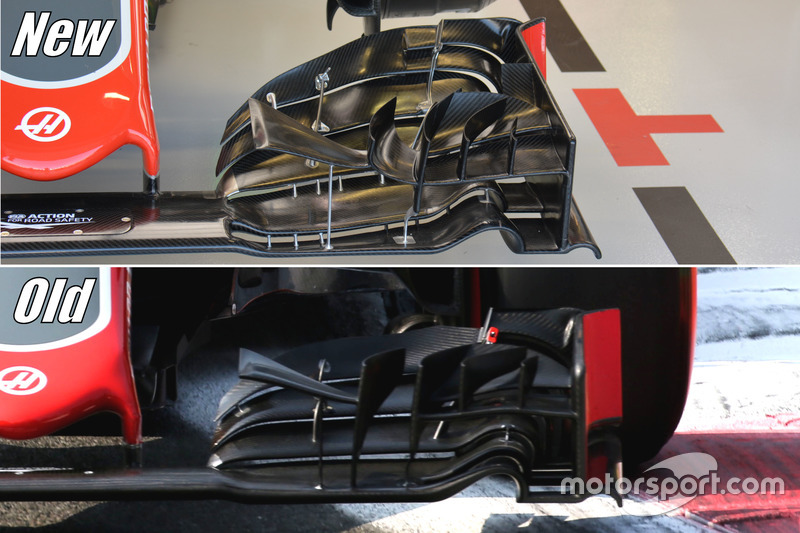
The new design is simply an evolution of the wing already being used by the team with the concept being refined and elements that have been seen on other cars adopted.

The mainplane now features a full-length slot (highlighted in yellow), changing the wing's operating window and limiting the chance of flow detachment if more angle of attack is required.
To maintain the slot height under aero load and also to reduce the chance of debris collecting within it, Haas has added small separator fins (highlighted in light blue). These also serve another purpose, aligning the oncoming airflow so that when it moves between the slot it performs better.
The upper flap now has additional slot near the section that allows the flap's angle to be adjusted (highlighted in green) improving flow around this section. The mechanical adjusters have also been moved further inboard in order to make way for this change.
To improve how air moves across the front face of the tyre and out around it, the team has made several changes various surfaces.
The main cascade is relatively unchanged but does feature a revised shape to the flaps, altering how the air moves aft of it. Meanwhile, the ‘r’ cascade that was mounted on the mainplane is replaced by a curved vane (highlighted in red), similar to McLaren’s solution that hangs from the side of the main cascade, directing airflow outward. This frees up the surface of the mainplane in order that it's not disturbed by the structure that used to occupy the space..
In a similar vein to what we’ve seen from other teams, canards are then placed either side of the endplate (inner one highlighted in purple, outer arrowed and inset) to upwash the airflow and direct it around the front tyre.
Share Or Save This Story

The fascinating story behind McLaren's most iconic F1 car

Emilia Romagna GP: F1 technical images from Imola's pitlane

The F1 downforce choices that proved key at the Saudi GP


Haas F1 boss Ayao Komatsu gets behind wheel of historic F1 car ahead of Italian GP

Why only Oliver Bearman has the new Ferrari F1 engine at Haas

You Ask The Questions: Esteban Ocon

LIVE: F1 Italian Grand Prix updates - Yuki Tsunoda and Alex Albon join Aston Martin, Cadillac in Q1 exit

Don't expect new Oscar Piastri deal after Lando Norris' extension: "I'm good for now"

"I kept forgetting SM!" – Yuki Tsunoda reveals amusing Monza challenge with F1's 2026 cars

Fabio di Giannantonio has “major chances” of solving recent MotoGP issues in Misano

What makes Lewis Hamilton's 'barn find' Ferrari F40 so important

Explaining the complicated art of F1 braking

What next after Briatore’s explosive McLaren rant?

What we learned from Friday practice at the 2026 F1 Italian GP
Subscribe and access Motorsport.com with your ad-blocker.
From Formula 1 to MotoGP we report straight from the paddock because we love our sport, just like you. In order to keep delivering our expert journalism, our website uses advertising. Still, we want to give you the opportunity to enjoy an ad-free and tracker-free website and to continue using your adblocker.


Top Comments