


Analysis: Ferrari mileage proves 2017 F1 progress
Formula 1's second pre-season test kicked off at Barcelona this morning – with interest this week likely to revolve around whether or not Ferrari can build on the strong momentum it gained last week.


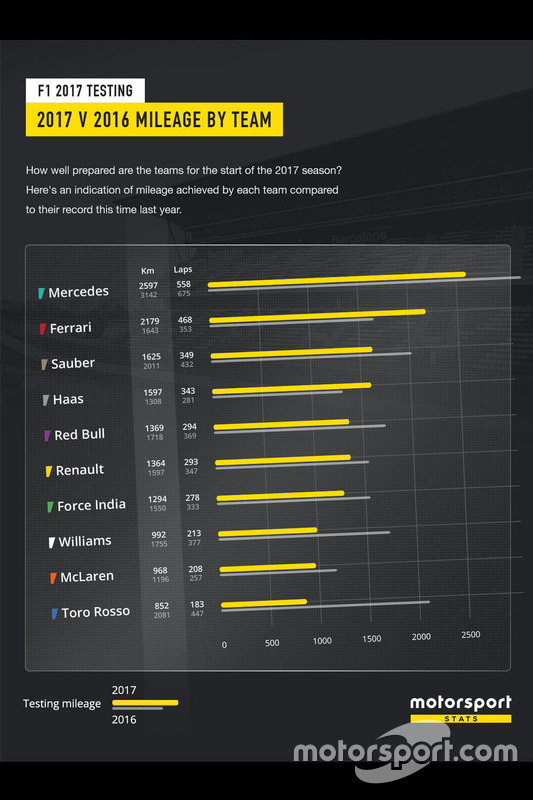
Beyond the headline times, with Mercedes and Ferrari sharing the top spots throughout the first test, a deeper look at the testing progress shows just how big a step Maranello has made with its 2017 contender compared to 12 months ago.
For while Mercedes completed the most mileage – with 558 laps – the Brackley-based team is actually down on what it managed in the first test 12 months ago, when it got through a mighty 675 laps.
Last week Ferrari managed 468 laps, which is up on the 353 laps it had delivered in the first test last year.
Further proof of the reliability progress of Ferrari's power unit was shown by Haas, whose 343 laps were a leap over the 281 laps it did last season.
While Ferrari will be looking to keep up its form, teams like Toro Rosso and McLaren will be eager to deliver a complete turnaround this week.
Scuderia Toro Rosso's integration of new Renault power has had a significant impact on its year-on-year mileage achievements, as it completed the fewest laps out of all the teams.
It's in stark contrast to last season when its 447 laps was the second highest tally behind Mercedes.
How much faster?

This week's second test will give us a better indication of how much faster 2017's Formula 1 cars.
The opening week was more about systems and reliability checking – with ultimate performance not really a priority until the next few days.
So far, the five fastest F1 cars had shown a performance increase of 3.86 percent, something that is expected to grow.
No new car niggles

Despite the heavily revised cars that have appeared, the first test showed that reliability does not appear to be a big issue.
The red flag count was down by 20 percent compared to this time last year. The 2017 field is somewhat different, with fewer rookies and reduced accident flag potential perhaps.
New regs might be expected to push the number of mechanical stoppages out on track higher, but in fact the mechanical failures generating red flags are so far down by 50 percent.
Share Or Save This Story


Brundle awarded OBE in King’s New Year’s honours

The new rules dilemma that will define the 2025 F1 season

Verstappen issues Red Bull title warning in push for RB21 progress


Guenther Steiner jokes Christian Horner Ferrari talk is good book publicity

The problem with Ferrari’s endless team principal speculation

Lewis Hamilton honours Roscoe with touching tribute one year after his death

Guenther Steiner jokes Christian Horner Ferrari talk is good book publicity

Joey Logano down but not out of NASCAR Chase after Kansas flat tire

Kimi Antonelli has "spooked himself" amid F1 title pressure, says Naomi Schiff

George Russell details F1 drivers' Langkawi boys' trip ahead of Bahrain GP in Malaysia

As Mercedes looks to deal F1 2026 knockout blow, will its driver fight reignite?

Top 10 F1 results changed by backmarkers – the passes

The problem with Ferrari’s endless team principal speculation

Why Mercedes is still quicker than McLaren
Subscribe and access Motorsport.com with your ad-blocker.
From Formula 1 to MotoGP we report straight from the paddock because we love our sport, just like you. In order to keep delivering our expert journalism, our website uses advertising. Still, we want to give you the opportunity to enjoy an ad-free and tracker-free website and to continue using your adblocker.


Top Comments