


The changes that helped Ferrari grab pole in Canada
Ferrari's return to form at the Canadian Grand Prix, with Sebastian Vettel grabbing pole position, has come on the back of the team introducing some significant updates to its car in Montreal.

Giorgio Piola's F1 technical analysis
Giorgio Piola is the preeminent Formula 1 technical journalist. View our full selection of Giorgio's technical illustrative content
Armed with a new floor and bargeboards, Ferrari has also made a number of track specific modifications to its existing package as it looks to maximise aerodynamic efficiency.
New bargeboards

The bargeboards are a refinement of the concept that has already been in use this season, with the shape of the main elements and their slots revised. Three smaller slots can now be found in the sloped section that follows.
The footplate has also been treated to a modification, with the forwardmost of the two elements now reaching right the way across to the serrated elements.

Working in conjunction with the bargeboard’s lower elements and the floor’s leading edge is the wider splitter extension facilitated by the change in rules for 2017 (highlighted in blue), which now has three well defined L-shaped elements.
Low drag means no T-wing
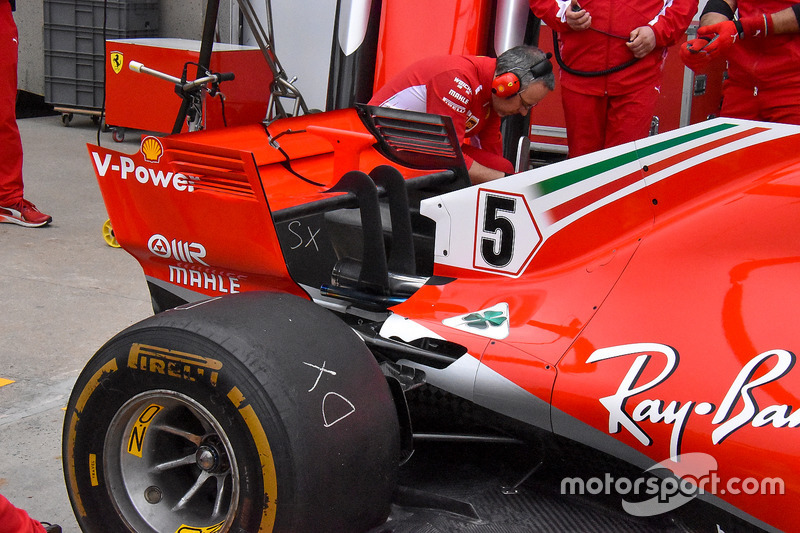
Having utilised the space left over when the regulations were changed for 2018, Ferrari has, up until this point, been using an arched T-Wing.
Even though the appendage has a relatively low drag impact, the team has removed it in Canada, as it goes in search of more straight line speed.
Brake challenge
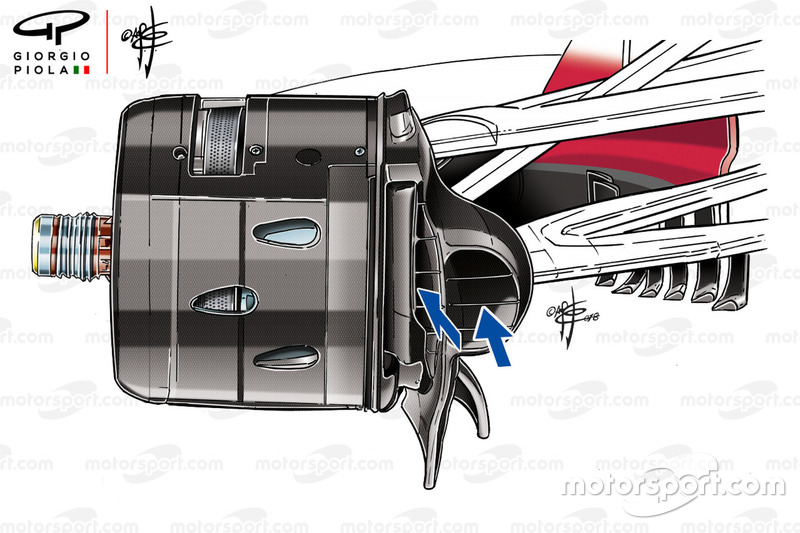
Almost a quarter of the lap time around the Circuit Gilles Villeneuve is spent slowing the car, with Brembo classifying turns 6, 8, 10 and 13 as ‘hard’, making it not only a challenge for the driver but also for the engineers.
This year Ferrari has continued the recent trend of proportioning some of the brake duct’s design to power a blown axle, improving the aerodynamic footprint around the wheel rim and tyre.
However, this doesn’t mean that brake cooling is forsaken, with the designers carefully attributing cooled airflow to the brake discs and calipers.
The brake drum also features numerous apertures from which heat being generated by the brakes can be released. This can be carefully placed in order to maximise how the heat is rejected so it also interacts with the wheel rim and consequently the tyre in the most effective manner too.
Share Or Save This Story

The fascinating story behind McLaren's most iconic F1 car

Emilia Romagna GP: F1 technical images from Imola's pitlane

The F1 downforce choices that proved key at the Saudi GP


Lewis Hamilton "entirely justified" in tense Dutch GP radio exchange, says Alex Brundle

What Ferrari actually meant to do when Lewis Hamilton felt like a "guinea pig"

Why Charles Leclerc’s battle of the brakes has left him trailing Lewis Hamilton

Richard Childress Racing announces Austin Hill as full-time NASCAR Cup driver for 2027

Dudu Barrichello questions "harsh" penalty after VIR clash costs Heart of Racing shot at win

Lundgaard ‘happy to not see Palou win for once’ en route to runner-up in Freedom 250 GP

Netflix renews "Formula 1: Drive to Survive" for season 9

Lando Norris made his own life difficult again - but his recovery was stunning in Zandvoort's swansong

Why Lando Norris was “surprised” to claim Dutch GP pole position

What we learned from the 2026 F1 Dutch GP sprint race and qualifying

Why Williams problems are worse than previously known
Subscribe and access Motorsport.com with your ad-blocker.
From Formula 1 to MotoGP we report straight from the paddock because we love our sport, just like you. In order to keep delivering our expert journalism, our website uses advertising. Still, we want to give you the opportunity to enjoy an ad-free and tracker-free website and to continue using your adblocker.


Top Comments