


Analysis: Red Bull’s 2026 F1 pace is its slowest since 2015
Qualifying data shows Red Bull hadn’t been as slow in Formula 1 for 11 years

Isack Hadjar, Red Bull Racing
Photo by: Mark Thompson / Getty Images
Red Bull’s start to the new Formula 1 regulations has been anything but encouraging.
Internally, it was already clear that the project could get off to a bumpy start – after all, it is the first time in the team’s history that it is building its own engine – but the scale of the current struggles likely has taken many by surprise.
With just 16 points from the first three race weekends, the team currently sits only sixth in the constructors’ championship. In terms of outright performance, Red Bull has clearly slipped into the midfield: on average, it is currently 0.97 seconds off the pace in qualifying, and as much as 1.26 seconds per lap behind Mercedes in race trim.
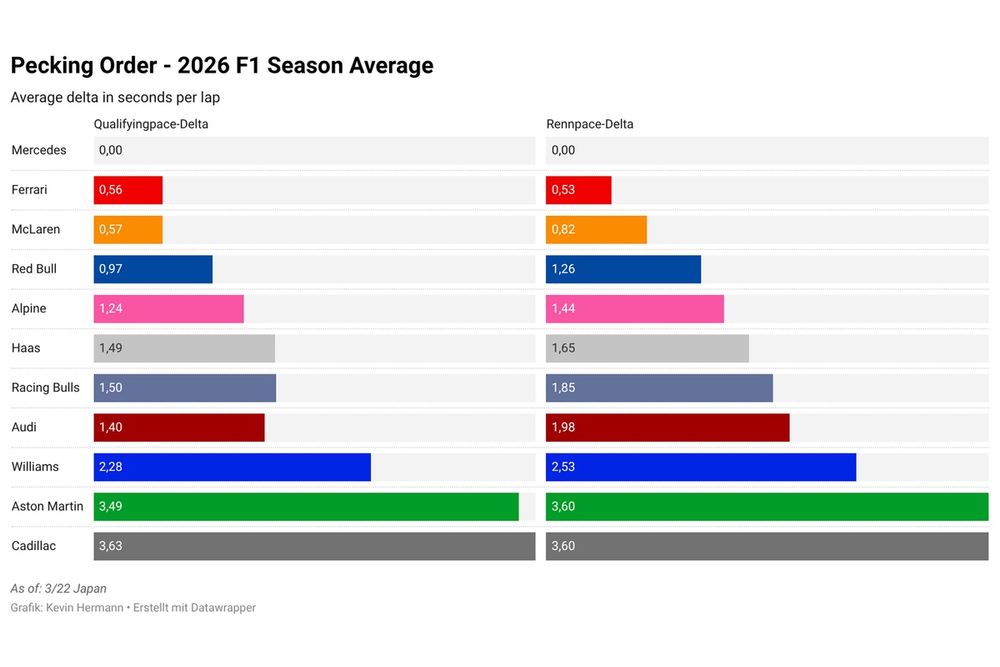
Packing order season average
Photo by: Kevin Hermann
This places Red Bull in a direct battle with Alpine and Haas for the upper midfield. The gap to the next best team, McLaren, stands at around four tenths – both in qualifying and in the race. This makes the RB22 the slowest Red Bull car in 11 years.
The success-laden team didn’t just dominate the ground-effect era from 2022 to 2025, it has effectively been a top team since 2009.
Its last major setback dates back to 2015, when Daniel Ricciardo and Daniil Kvyat drove for Red Bull. At the time, the team trailed the leaders by an average of 1.18 seconds in qualifying. The benchmark – just as today – was Mercedes, then in the second season of the hybrid era.

Daniil Kvyat, Red Bull Racing RB11 locks up
Photo by: Red Bull Content Pool
Interestingly, Red Bull was actually closer in the first hybrid season in 2014. Back then, the deficit to Mercedes averaged 0.83 seconds per lap, which was still enough to make it the clear second force in the field.
Red Bull’s recovery could take years
A look at the past illustrates how long Red Bull’s recovery can take: following the introduction of the hybrid era in 2014, it took a full seven seasons for the team to re-emerge as a dominant force.
It was not until 2019 that Red Bull managed to reduce the qualifying gap to Mercedes to under half a second. These historical parallels suggest that a return to the front is unlikely to be a short-term project.

Red bull qualifying pace gap to the lead
Photo by: Kevin Hermann
That said, the situations are not entirely comparable. The engine regulation change from 2013 to 2014 was significantly more drastic than the current shift from 2025 to 2026. Moreover, Red Bull was tied to Renault in the early hybrid years, whereas today it has full control over its power unit through Red Bull Powertrains.
In fact, much suggests that the engine is not the primary issue at all. At all circuits so far – Australia, China, and Japan – top speed has been competitive and even above Ferrari’s level. Instead, time loss occurs mainly in the corners. This was particularly evident in the second sector in China and through the high-speed Esses in Japan.
A comparison with sister team Racing Bulls is also revealing: despite using the same engine, the two teams achieve their lap times in very different ways. While the works team ranks among the leaders in top speed, Racing Bulls sits in the midfield in this area.

This points to an overall lack of downforce on the RB22 and a car concept that is too heavily geared toward low drag. It is a philosophy Red Bull already pursued at the start of the hybrid era in an attempt to compensate for the underpowered Renault engine.
Ultimately, the conclusion remains: the road back to the front will take time for Red Bull. Perhaps not as long as at the beginning of the hybrid era, but once again, fundamental issues must be resolved before wins can realistically be expected.
Share Or Save This Story

Kimi Antonelli leads Austrian GP long runs as Ferrari upgrade falls flat

Ferrari may have found a surprise F1 Barcelona-Catalunya GP advantage

Williams blockade: Should F1 team tactics be banned in Monaco?


Red Bull's Austrian GP upgrade package compared to "B-spec" F1 car by former mechanic

Why Max Verstappen burst out laughing during Silverstone F1 simulator runs
George Russell claimed a much-needed win in Austria, but could Max Verstappen - or Kimi Antonelli - have won?

Video: Noah Gragson retaliates against Cody Ware; Todd Gilliland vs. 23XI at Sonoma

Trackhouse crew chief says they were 'lucky' to have Van Gisbergen against faster JGR car

Susie Wolff explains why F1 Academy cannot be a "charity project" as series grows

Red Bull's Austrian GP upgrade package compared to "B-spec" F1 car by former mechanic

How Arvid Lindblad has shown that he's found his feet in F1

Why F1's engine-upgrade picture is becoming ever more ludicrous

George Russell claimed a much-needed win in Austria, but could Max Verstappen - or Kimi Antonelli - have won?

What were Antonelli’s chances of starting on the front row in Austria without his yellow-flag blunder?
Subscribe and access Motorsport.com with your ad-blocker.
From Formula 1 to MotoGP we report straight from the paddock because we love our sport, just like you. In order to keep delivering our expert journalism, our website uses advertising. Still, we want to give you the opportunity to enjoy an ad-free and tracker-free website and to continue using your adblocker.


Top Comments