Formula 1 Emilia Romagna GP
How Imola tyre trial could offer path to better racing in F1
Formula 1’s trial of a new tyre allocation at this weekend’s Emilia Romagna Grand Prix has triggered plenty of intrigue about the impact it will make to qualifying.

Jonathan Noble
Edited: May 16, 2023, 3:16 PM
Copy link
Share on Viber
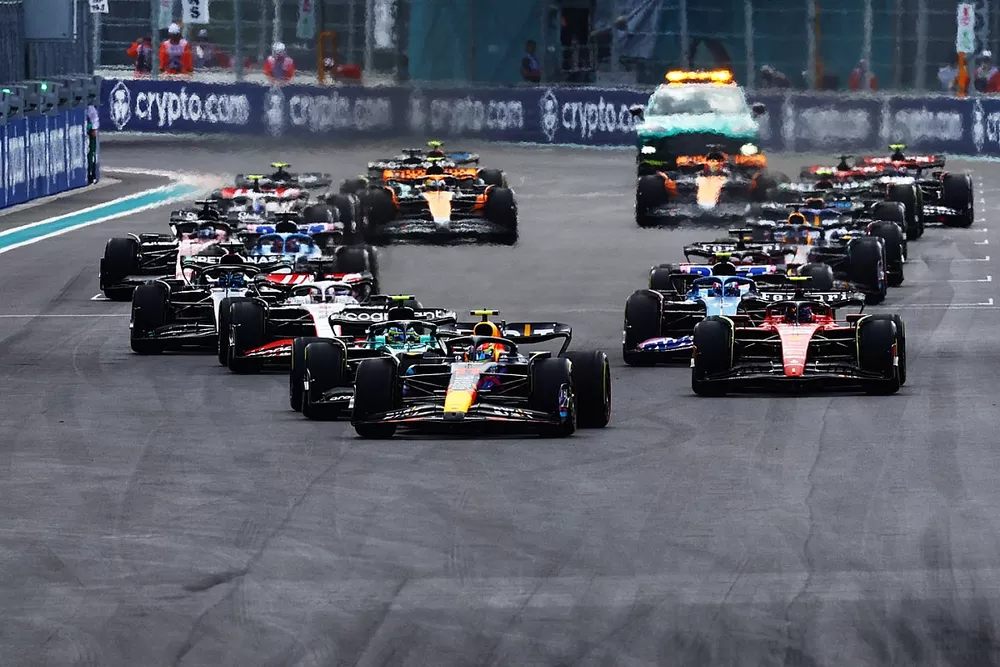
With drivers forced to use the hard (Q1), medium (Q2) and soft (Q3) compounds in the three sessions on Saturday, rather than having complete free choice, it could serve to shake things up in terms of the fight for grid positions.
However, perhaps the biggest impact of the way the new tyre experiment works may be felt on Sunday, as it could produce an interesting case study about one way of making the racing more exciting in F1.
In a season where the spectacle has suffered from predictable one-stop strategies, the trial could actually help open the door for two-stops to be back on the table in the future.
Improving the show
The reasons for the racing not being as good this year as it has been in the past are wide and varied, and there is no single factor that has caused it.
The increased outwash of the cars, the ramping up of downforce being generated, the bigger difficulty in overtaking, and shorter DRS zones, plus the preference for one-stop races, have all whipped up a perfect storm in a season where one team is totally dominant.
With car designs pretty set for the season, the only variability throughout the campaign that could shake things up from now on are Pirelli’s tyre compound choices – as the softer the rubber the more chance there is of multi-stop races.
However, Pirelli also has to be careful in not pushing things too extreme and turning grands prix in to three or four-stop races, which equally can be unpopular because they end up being chaotic affairs that are quite hard for fans to follow.
Pirelli tyres
Photo by: Zak Mauger / Motorsport Images
Also, tyres that degrade too fast prove to be unpopular with drivers and teams as they force them to take things too easy, rather than feeling that they can push hard on more consistent rubber.
What has always been difficult, though, is pushing teams towards a two-stop strategy rather than automatically favouring the one-stop.
Time loss in the pits, the risks of getting dropped into traffic when overtaking is difficult, and not having enough of the right compounds available, are all factors that contribute to teams taking the conservative route.
Pirelli’s head of car racing Mario Isola says that turning races into two-stop strategy affairs goes far beyond just making tyres degrade more.
And there is almost a chicken and egg scenario where it comes to a lack of overtaking and boring strategies, as it is hard to decipher which comes first to trigger the other.
“What we have learned in previous years is that if we go too soft or too aggressive, there is a general tendency to manage the pace in order to have a one-stop race,” he told Motorsport.com.
“But one important element is how difficult it is to overtake. You can take the risk to go back into traffic if you know you can overtake. But if you cannot overtake, then you don't take the risk, you stay in front and you protect the position.
“So, I believe that only by [looking at changing] the tyres, we will not be in a position to find the proper solution, and we will continue to go in a circle with higher degradation, then lower degradation, then higher degradation, and then lower degradation. That is not making anybody happy.”
Forcing the issue not an answer
Sergio Perez, Red Bull Racing RB19 leads at the start
Photo by: Red Bull Content Pool
One suggestion that has cropped up in a bid to encourage more two-stop races is to make them mandatory.
So just as one-stops are the minimum now because drivers have to use two different types of tyre compounds, so a two-stop race could be forced on teams by making them run the soft, medium and hard in the race.
The switch makes plenty of sense and should in theory throw up the possibility of strategy variety, as teams would have to pick the right moment to run on the tyre that is not good for the race – either the soft because it degrades so much, or the hard because it is not competitive.
But Isola has poured cold water on the idea of this working. He says discussions about imposing this very rule have taken place in the past – and concluded that it would not succeed in delivering a better show with more variety.
“We made some analysis on that together with the sporting directors many years ago,” he said. “We ended up with the conclusion that the more you make new constraints, then the more teams will come to the same strategy.
“So, if you give them the constraint to use all three compounds, probably at the beginning they will have different strategies, because they have to adapt to the new situation.
“But in the end, they will eventually choose the same. So, we will have the same pitstop times, the same choices and so on. We have to accept that.”
Key, says Isola, is offering a natural selection where teams are not forced to run a set number of stops, but instead have a strategy option where it makes sense to be more aggressive on pure competitive grounds. The two-stop has to be at least equal to the one-stop on the stopwatch.
“We can try to encourage different strategies, but at the end that there is one that is the quickest,” added Isola.
This very possibility of giving teams an alternative route to the chequered flag is what could emerge from the new tyre allocation that is being tried for the first time in Imola.
New rule test
Charles Leclerc, Ferrari F1-75,Max Verstappen, Red Bull Racing RB18,Sergio Perez, Red Bull Racing RB18
Photo by: Erik Junius
The Imola trial is taking place to help F1 and tyre supplier Pirelli better understand the impact of a more sustainable approach to F1 weekends, with the aim being fewer wasted sets on Sunday night.
The normal allocation of 13 sets per race weekend is being reduced to 11, with a clear shift in the numbers of each compound available.
At normal weekends, the 13 sets are divided into eight softs, three mediums and two hards. For the Imola trial (and the other venues where the experiment will take place), the 11 sets are split as four softs, four mediums and three hards.
Forcing drivers to use the hard in Q1 and the medium in Q2 will mean a very different approach to qualifying, but the consequence could well be seen more in Sunday’s race.
That is because the way the tyres are allocated over the weekend means that drivers should now end up in the race with at least two sets of hards and two sets of mediums.
Up until now, more often than not, drivers end up with either one medium or one hard for the race – and sometimes just those two tyres alone.
It has meant that, with the soft rarely good enough for a race stint, teams are automatically pushed towards a conservative one-stop strategy that rarely provides great entertainment.
The change in allocation for Imola, and the fact there should be at least two sets of hard and medium available, has allowed Pirelli to be more aggressive with its tyre choice for the Imola weekend – because it is safe in the knowledge that teams are not going to run out of rubber on Sunday.
For this year’s Emilia Romagna GP, Pirelli has opted to go one step softer than last year, having picked the softest allocation it can.
As Isola explained: “We need to find a way not to end up at the race with one set of medium, and one set of hard, as they [the teams] keep all the softs for qualifying and they are useless for the race. So, thanks to this [new allocation] approach, we decided to move one step softer at Imola.
“The original allocation was C2, C3,and C4, but now it is C3, C4 and C5. With the alternative tyre allocation, all the teams will have two sets of hards, two sets of medium and two sets of soft for the race.
“So, we can go one step softer, and even if that increases the number of stops, they have enough tyres.
“With the current system, I don't want to say it's risky, because it's just they have to do more pit stops, but if they come to the race with only one set of hard, one set to medium, and all the rest is soft, and the soft is too soft, it's not ideal for the race. Then we have a situation that is not natural and not what we want.”
How Imola plays out is hard to predict right now, and could yet be derailed by bad weather throwing a curveball in to the tyre choices.
But Isola thinks that F1 is on the right path in allowing such trials to take place so everyone can better understand what works and what doesn’t.
And even if Imola does not throw up a two-stop thriller, the other event that will run similar allocations later in the year (potentially the Hungarian GP) should help provide a clearer picture.
As Isola said: “If things work, we keep them, if it doesn't work, we come back to the previous one. The approach is the right one because unfortunately, even if you try to predict any possible detail, there is always something that is not predictable.”
Read Also:
- Russell: Imola F1 upgrades "won't change the world" for Mercedes
- AlphaTauri says new F1 floor for Imola will be a "significant" step
- Coulthard: New York’s F1 ‘Eau Rouge rival’ would be “perfect”
We want your opinion!
What would you like to see on Motorsport.com?
Take our 5 minute survey.
- The Motorsport.com Team
Read and post comments
Read also :
Share Or Save This Story
Copy link
Share on Viber
Previous article FIA must consider simplification of F1 regulations – McLaren
Next article Bottas: Alfa Romeo "definitely needs" Imola F1 upgrade package
Top Comments
There are no comments at the moment. Would you like to write one?
View More & Comment

More from
Jonathan Noble

Brundle awarded OBE in King’s New Year’s honours
Formula 1
Formula 1 Dec 31, 2024
Brundle awarded OBE in King’s New Year’s honours
The new rules dilemma that will define the 2025 F1 season
Formula 1
Formula 1 Dec 31, 2024
The new rules dilemma that will define the 2025 F1 season
Verstappen issues Red Bull title warning in push for RB21 progress
Formula 1
Formula 1
Australian GP
Dec 28, 2024
Verstappen issues Red Bull title warning in push for RB21 progress
Latest news
F1 Qatar GP practice analysis: Kimi Antonelli nearly a second clear of Max Verstappen on long runs
Formula 1
F1 Formula 1
Qatar GP
4 min
F1 Qatar GP practice analysis: Kimi Antonelli nearly a second clear of Max Verstappen on long runs
Charles Leclerc explains Qatar GP practice spin after painfully "slow" day for Ferrari
Formula 1
F1 Formula 1
Qatar GP
1 h
Charles Leclerc explains Qatar GP practice spin after painfully "slow" day for Ferrari
Max Verstappen feels a “disconnect” as Red Bull looks to solve “massive limitation” in Qatar GP practice
Formula 1
F1 Formula 1
Qatar GP
2 h
Max Verstappen feels a “disconnect” as Red Bull looks to solve “massive limitation” in Qatar GP practice
Feature
Discover prime content

Top 10 F1 cars of the 1990s
Formula 1
By Kevin Turner
Top 10 F1 cars of the 1990s
Subscribe and access Motorsport.com with your ad-blocker.
From Formula 1 to MotoGP we report straight from the paddock because we love our sport, just like you. In order to keep delivering our expert journalism, our website uses advertising. Still, we want to give you the opportunity to enjoy an ad-free and tracker-free website and to continue using your adblocker.
You have 2 options:
- Become a subscriber.
- Disable your adblocker.
Subscribe now Already subscribed? Sign in here
Already disabled your adblocker?
Reload page
Manage Alerts
Subscribe