Feature
WEC Fuji
Opinion
Why there’s no perfect solution to the WEC safety car conundrum
Lando Norris is not the only driver to have recently lost a sure-fire victory through cautionary periods

Gary Watkins
Published: Sep 29, 2026, 3:00 PM
Copy link

Share on Viber
Lando Norris had a pop at the Virtual Safety Car rules in Formula 1 after the Spanish Grand Prix on the new Madring street circuit earlier this month. The brief neutralisation, he insisted, cost him the victory, and the race hadn’t even reached a third of the way through.
So spare a thought for Alpine after last weekend’s World Endurance Championship round at Fuji was interrupted by the safety car in its final hour. The French manufacturer dominated for much of the race and, in all likelihood, would have gone on to finish 1-2, though, of course, there aren’t too many certainties in motorsport. But one thing we can say without equivocation, however, is that Toyota wasn’t going to win its home race this time.
The safety car, coupled with a calculated gamble on Toyota’s part, dramatically changed the course of the Fuji 6 Hours. The win for Sebastien Buemi, Brendon Hartley and Ryo Hirakawa counted as a shock result. The only thing that wasn’t a surprise was the Cologne-based Toyota Racing team’s ability to make the most of an unusual set of circumstances. It played the table better than anyone else.
Read Also:
Alpine kind of grinned and bore it; there was no criticism of the safety car nor its application, no one shouting, ‘It’s not fair’. Dealing with cautions is part of the game in endurance racing, and has been for a long time even in what can be described as European-style racing. The first use of the safety car - then known as a pace car - at the Le Mans 24 Hours came in 1981. (There’ll be no mention of safety cars in the IMSA SportsCar Championship here because the philosophy underpinning cautions in North America is entirely different.)
There’s been a twiddling and a tweaking of the rules in WEC over the years to try to minimise the effect of a neutralisation on the racing over the years. To make it fairer, if you like. The Full Course Yellow in WEC is the equivalent of the VSC in F1 (and pre-dated its 2014 introduction at the pinnacle of our sport by nearly a full season) and one of the solutions for the problem against which Norris railed in Madrid was addressed for the 2023 season: the pits have been closed at the point at which an FCY is called by the officials from that point on.
In the WEC we now have FCYs, VSCs and full-blown safety cars and various combinations thereof. That’s not forgetting Slow Zones at Le Mans, local neutralisations where speed is limited, like in FCYs and VSCs, to 80km/h (50mph). VSC meaning something slightly different in WEC to F1 only adds to the confusion: a VSC in WEC leads into a safety car proper.
Alpine lost victory in Japan due to factors outside of its control
Photo by: JEP
That procedure was introduced in 2024 for reasons that were two-fold. It means that the cars are slowed to 80 klicks straight away rather than racing up to the back of the safety car queue, which undoubtedly is an improvement in terms of safety, and also gives everyone the opportunity to duck into the pits for service. The pitlane only closes when the safety car comes out, and remains so for three laps.
The rules governing caution periods today are a far cry from the old days. When the yellow flags flew, the pits remained open and cars could barrel in for fuel and tyres as and when. Where you were on the track the moment the safety car was called could be the difference between winning and losing. That really did make it a lottery.
But there can be no perfect system and there is an acceptance in sportscars that there will always be winners and losers. Look at Le Mans, and compare the old safety car rules with the new. Three safety cars were involved because the Circuit de la Sarthe measures eight and a half miles. The latest procedure still begins with three of the things but ends with the field bunched up behind a single course vehicle.
Both Alpine’s loss of victory in Japan on Sunday and, ironically, its win in the corresponding fixture 12 months previously resulted from quirks of the system
That is surely less equitable as far as the teams and drivers competing at the sharp end of the field in Hypercar are concerned. A driver crew can work its butt off to build a gap, perhaps as much as three and a bit minutes, only to see it wiped out at a stroke by the safety car.
But the previous rule didn’t really work for the classes down the field. There was more than one instance in GTE Pro, for example, when a car or two got away from the rest of the field because they were picked up by one safety car ahead of the chasing pack. The year the ‘Pink Pig’ factory Porsche 911 RSR triumphed in 2018 is one example.
If you need an extreme example of how a race neutralisation can throw up the truly bizarre for which there can be no legislation in the rulebook, I’m going to scroll back to the internecine battle at Toyota during the 2018 Shanghai 6 Hours. Fernando Alonso had built a handy lead of 20 or so seconds over the chasing Kamui Kobayashi in wet conditions before the safety car was deployed when the ByKolles team’s Nissan-engined ENSO CLM P1/01 stopped on the start-finish straight and dumped oil on the track.
Buemi, Hartley and Hirakawa took the championship lead with victory in Fuji
Photo by: JEP
The resulting clean-up operation meant the safety car took the cars through the pitlane. Kobayashi, who needed fuel for his Toyota TS050 HYBRID before his team-mate, was able to jink out of the crocodile and into his pit stall for a scheduled service. Next time around, Alonso required fuel, but the safety car was now leading the cars down the straight. The resulting time loss to the sister car was massive and meant victory went to the Japanese driver and team-mates Mike Conway and Jose Maria Lopez, and there was one very upset two-time F1 world champion ranting and raving in the Toyota garage.
Both Alpine’s loss of victory in Japan on Sunday and, ironically, its win in the corresponding fixture 12 months previously resulted from quirks of the system. A fortuitously timed stop moments before an FCY that led into a safety car was instrumental for the win in 2025. Going straight to the safety car without a VSC first undid its chances this time when Alpine opted for what can only be described as an ultra-conservative strategy.
It’s not always easy to understand the decisions emanating from race control. The first safety car at Austin earlier this month appeared from where I was sitting to be highly unnecessary, though I wasn’t quite as cynical as some of my colleagues in the media. One dubbed it a 'competition caution' or similar.
Yet no criticism can be levelled for the calls at Fuji, either this year or last. A year ago, it appeared that getting the #007 Aston Martin to a safe place after an incident would be the work of not much more than a moment and that an FCY would suffice. It didn’t turn out that way, and WEC race director Eduardo Freitas had to turn it into a full-blown safety car.
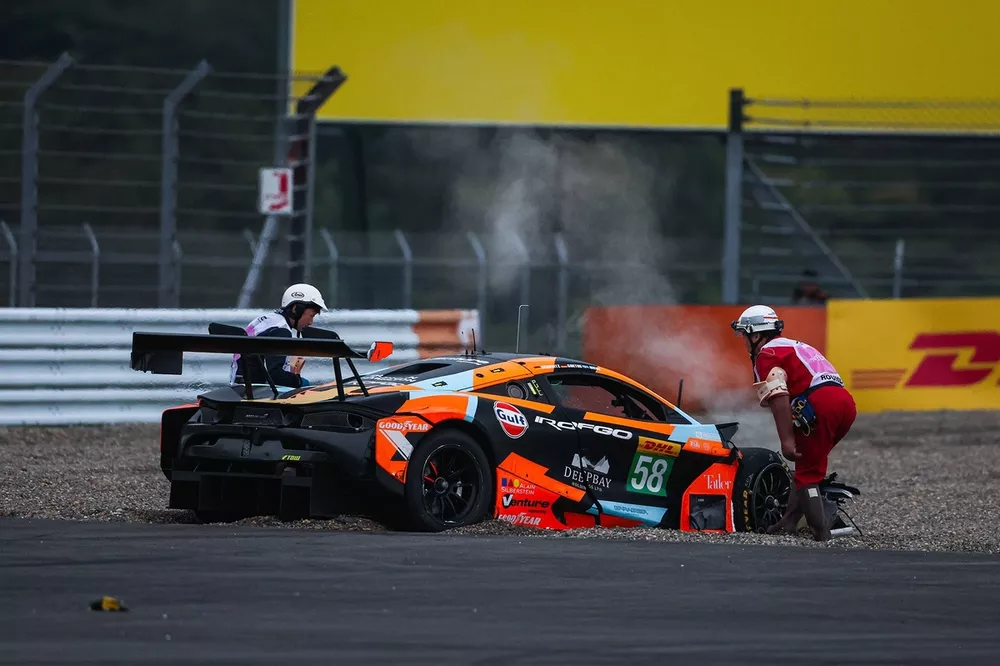
This time, the severity of the impact when the #58 McLaren 720S GT3 EVO turned sharply left into the barriers - and the fact that the braking zone for Turn 1 was littered with debris - meant going straight to the safety car was again the correct call. Freitas was within his rights to make both of those decisions, because safety is always paramount.
Norris pointed out that there have been times when he has gained courtesy of the VSC and suggested that over the course of a season things maybe equal themselves out. In the case of the WEC with only eight, rather than 20-plus races, it probably takes a bit longer.
It certainly looks that way for Alpine. Back in 2025, it didn’t have the fastest car, yet it ended up winning the race. Last weekend, it had a pace advantage, yet didn’t come out on top. Quirks, or what I like to call the vagaries of the safety car and its associate rules, played a massive part in both results.
There’s no point complaining. It is what it is.
Alpine is still searching for its first win of WEC 2026 with two rounds left
Photo by: JEP
We want to hear from you!
Let us know what you would like to see from us in the future.
Take our survey
- The Autosport.com Team
Read and post comments
Read also :

Author Gary Watkins
Gary Watkins has, for reasons best known to himself, devoted all his working life to covering sportscar racing. This season is his 33rd as a motorsport journalist, during which time he has reported on major long-distance events on four continents and approaching 80 24-hour races. He reckons a degree in political philosophy makes him well qualified for covering the sometimes Machiavellian world of international sportscars.
Gary, who also writes for Motor Sport, Autocourse, RACER and others, lives in Surbiton close to the former workshops of the Cooper Formula 1 team but spends more time on the road than at home for most of the year.
Read more
Previous article How an “informed gamble” enabled Toyota to beat Alpine in the Fuji 6 Hours
Next article FIA and ACO announce 10-year WEC deal after rumours about possible split
Top Comments
There are no comments at the moment. Would you like to write one?
View More & Comment
More from Gary Watkins

A fond farewell to a few WEC favourites
WEC
WEC WEC
Monza
15 d
A fond farewell to a few WEC favourites
How Cadillac triumphed in the WEC Monza 6 Hours without the fastest car
WEC
WEC WEC
Monza
16 d
How Cadillac triumphed in the WEC Monza 6 Hours without the fastest car
WEC Monza: Fuoco takes pole for Ferrari
WEC
WEC WEC
Monza
18 d
WEC Monza: Fuoco takes pole for Ferrari
The McLaren recruit chasing his Le Mans 24 Hours dream
WEC
WEC WEC 26 d
The McLaren recruit chasing his Le Mans 24 Hours dream

Why Toyota’s 2026 WEC triumphs have put it into the all-time greatest endurance racing team debate
WEC
WEC WEC
Barcelona
1 mo
Why Toyota’s 2026 WEC triumphs have put it into the all-time greatest endurance racing team debate

How Toyota destroyed the competition to seal the WEC crowns
WEC
WEC WEC
Barcelona
1 mo
How Toyota destroyed the competition to seal the WEC crowns
When Can-Am made its controversial comeback
General
MISC General 1 mo
When Can-Am made its controversial comeback
WEC Barcelona: Genesis secures maiden series pole from Toyota
WEC
WEC WEC
Barcelona
1 mo
WEC Barcelona: Genesis secures maiden series pole from Toyota
Latest news
F1 2027 grid: Who will be racing and where?
Formula 1
F1 Formula 1 5 min
F1 2027 grid: Who will be racing and where?
Alonso to not let his age determine F1 retirement
Formula 1
F1 Formula 1
Las Vegas GP
1 h
Alonso to not let his age determine F1 retirement
This is a golden opportunity for F1 and the FIA to nail its 2030 rules
Formula 1
F1 Formula 1
Qatar GP
1 h
This is a golden opportunity for F1 and the FIA to nail its 2030 rules
Excelr8 goes for customer BTCC engine for 2027
BTCC
BTCC BTCC 2 h
Excelr8 goes for customer BTCC engine for 2027
Subscribe and access Autosport.com with your ad-blocker.
From Formula 1 to MotoGP we report straight from the paddock because we love our sport, just like you. In order to keep delivering our expert journalism, our website uses advertising. Still, we want to give you the opportunity to enjoy an ad-free and tracker-free website and to continue using your adblocker.
You have 2 options:
- Become a subscriber.
- Disable your adblocker.
Subscribe now Already subscribed? Sign in here
Already disabled your adblocker?
Reload page
Manage Alerts
Subscribe