Analysis
IndyCar
Why drivers must sharpen up their skills to master 2018 IndyCar
Getting the best out of the 2018 IndyCar will be a huge challenge, and while this should allow Sebastien Bourdais a chance to shine, he and Dale Coyne Racing engineer Craig Hampson are acutely aware of their monumental task. By David Malsher.

David Malsher-Lopez
Edited: Dec 4, 2017, 11:58 PM
Copy link
Share on Viber

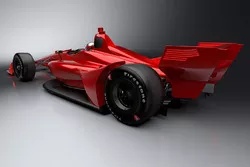


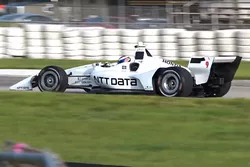


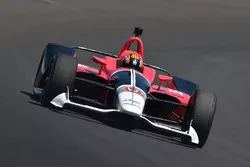

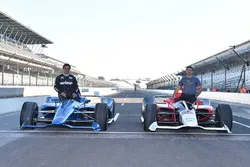


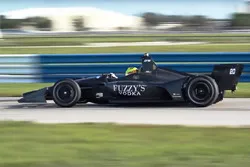
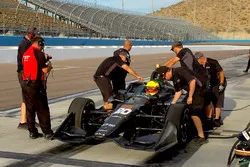
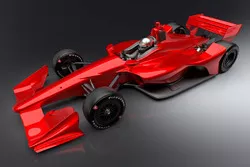


One of the messages emerging from roadcourse testing of the 2018 IndyCar is that lead-footed drivers will get ‘found out,’ and they’ll either have to broaden their skillset or become obsolete. Those who have artificially thrived in downforce-drenched manufacturer aerokit-equipped cars, and tend to apply only full throttle or maximum braking force, are going to have to learn how to find the points in between.
The spec 2018 Dallara’s reduction in downforce and slight but significant move forward in weight distribution has produced a car that is – relative to its predecessor – unstable at the rear under braking and inclined to break away under power on corner exits, which sounds immensely promising for trackside and TV spectators. From behind the wheel, a driver will have to gain more ‘feel’ through fingertips and backside, rediscover throttle control, figure out how to tame the car under braking and force himself to anticipate rather than just react. In short, the art of wheeling a fast open-wheel car is coming back; bravery and faith will not be enough.
Several drivers have expressed the hope that Firestone will modify its tire compounds to make their breakaway under lateral load more progressive. But is that really necessary? Or do drivers just need to fine-tune their perception?
Rick Mears once described the switch to ground effect cars in the early 1980s, when tires with barely flexible sidewalls, stiffer suspension and the increased load created by a car’s bodywork ‘skirts’ and shaped underside all combined to numb the feedback to the drivers.
“Those cars didn’t communicate as well as the flat-bottomed cars,” he said, “but you move with the times; you learn to refine your feel. You turn up the sensitivity, so you know that this small movement that you feel through your backside means you’ve reached the limit…”
And that’s describing the switch to a less communicative car. A car with heavily reduced downforce should send more signals to the driver, thereby negating the need for radical changes from Firestone, aside from making more compliant sidewalls and (hopefully) creating a wider gap between the primary and alternate compounds.
Still, to quote Mears again, “Whatever the new rules each year, the best drivers adapt best. That’s how it’s always been.” And here’s how one of IndyCar’s current best aims to adapt.
Bourdais happy to make the switch
Four (Champ) Indy car titles and 36 race wins are proof that Dale Coyne Racing’s Sebastien Bourdais is in the top echelon of drivers. But there’s no question he’ll have to adapt his driving style to the 2018 car – and more so than some of his fellow aces. No, Seb is not one of the aforementioned lead-foots, but he’s a driver known to prefer a well-planted rear-end on his racecars. In his Formula 1 foray with Scuderia Toro Rosso, he was initially a match for teammate Sebastian Vettel, but following the team’s midseason upgrade from the neutral-handling STR2B to the more pointy, on-the-nose STR3, the two Sebs were separated by a common car.
So is he worried that his talent might be neutered by the new-spec IndyCar’s basic handling traits?
“Well if you want to talk about the Formula 1 car, that particular problem was that there were no adjustments to make to it!” he says. “The aero map was the way it was and there was nothing we could do about it. To have a limited amount of understeer at high speed, you had to run a setup that made the car massively loose at low speed and I’d never had to make that absolute ‘it’s-this-or-that’ choice about handling before. Actually, I haven’t had to do it since, either. In Champ Car or IndyCar, you can make a lot of compromises; you can throw something different at it engineering-wise, change all sorts of geometries, make a lot of big adjustments. So I don’t think the 2018 car will be that much different from the DW12 without the aerokit that we ran 2012 to 2014.”
Another reason why Bourdais welcomes the arrival of Dallara’s spec kit, whatever its handling characteristics, is because by switching from KV Racing to DCR last winter, he exchanged Chevrolet’s simpler and more broadly effective manufacturer aerokit for the Honda one, which was too complex and had a narrower operating window.
“Yeah, it was a struggle,” he admits. “With the Honda kit, the hole in the underwing and their front wing setup was such that the car was very sensitive to front ride-height variations. Well, any time you come off the brakes approaching the apex, the front goes up and the weight transfers to the rear, so to keep some kind of balance and keep the front end consistent, we had to make the car very stiff which I’m not a big fan of, and that cost us mechanical grip.
“But we found ways to make it work and at the Indy GP we hit a sweeter spot, so I was first or second in class [Honda cars], we were in a little battle with Scott Dixon and we made the Firestone Fast Six.
“Then there were other places where we didn’t really find what we were looking for – and missing eight races [due to the shunt in Indy 500 practice] didn’t help our understanding, obviously.”
Hampson realistic but optimistic
Craig Hampson was Bourdais’ race engineer at Newman/Haas Racing in the final five years of the Champ Car World Series, and was therefore instrumental in helping Seb win his four CCWS titles. The prospect of renewing their partnership is what lured Hampson to Coyne last off-season, and after a total of six years together, he is well aware of his driver’s strengths and weaknesses… But like Bourdais, he also wants to correct any misconceptions.
“From what we are hearing, the new car’s rear is not secure,” he says. “But although it’s true that Sebastien doesn’t like it if the car is insecure at the rear, that’s not to say he can’t drive a loose or neutral car. His big hang up, I suppose you’d call it, is if the car is inconsistent – and by that I mean it does one thing on corner entry, another thing in the middle, and another thing on the exit.
“We will do our best to give him some security at the rear of the car, but if it doesn’t have a stable rear, then OK, he will adapt to it and he’s proven he can do that. But the most important thing for us to do is give him a car that maintains the same balance through all phases of the corner.”
Hampson takes an interesting and quite positive perspective on Honda’s aerokit struggles, suggesting they were forced to learn some hard lessons that could yet prove beneficial in the new era.
“We know the Honda cars suffered from a basic lack of aero efficiency,” he says. “If we wanted the same downforce as Chevy in the corners, we had to carry a lot of drag; if we wanted the same straightaway speed, we were way down on downforce. And then it was also too pitch- and ride-height-sensitive, as I’m sure every Honda driver has told you for three years!
“But because of that, Honda teams had to scratch really hard for mechanical grip and that’s going to be important for the new car when we’ve lost so much aero downforce. So once we understand the best rates for springs and dampers and so on now that we’ve shed all this downforce, we hope to be back on the pace. Come January, the race is on to figure everything out quicker than the others.”
Tire management, time management
One of Bourdais’ ace cards has always been applying his intelligence to technical issues, which is why he and Hampson meld so well: they are demanding of each other, and finicky about details. And according to the engineer, his driver is particularly adept at rapidly figuring out on any given weekend how to adjust his car and driving to get the most out of his Firestones each stint.
“Sebastien is very perceptive about the tires,” says Hampson, “how and when they’ll switch on, how quickly they’ll wear, and how to delay and then compensate for the degradation. He knows what the car needs to feel like to get the absolute most out of it until the next pitstop.
“So he’ll feel what the car’s doing after a couple of laps in practice and extrapolate from that how the tires will behave across, say, 30 laps. That’s incredibly useful for an engineer.”
Bourdais grudgingly accepts the compliment.
“Sure, most of the time I can work out where our setup needs to be and how it will evolve, although I don’t know if you’d call it an advantage. There are a few others who can do that too.”
However, he adds that to rely on this ability and great raceday pace to get canny with strategies is not an efficient way to compensate for a poor qualifying session.
“Remember, we have fewer yellows now,” he explains, “so generally, you can’t afford to get stuck behind someone who’s slower than you in the race and then jump them in the pitstops and then catch up to the leaders. It will take too much out of that set of tires. So the goal will always be to start as high up the grid as possible.
“So the important thing is to use the practice sessions in an efficient way, and quickly find a setup to make the option tires work for us in qualifying. Basically, we need to get it right pretty much straight away, or correct any errors fast, if we’re going to fight with the big boys.”
Track time at a premium
If we assume that one of the best Indy car drivers of the past couple of decades and one of the most detail-oriented workaholic engineers in our sport will ultimately make the most of what they have, their limiting factor is track time compared with some of their biggest rivals. The introduction of a new car theoretically puts all teams/drivers on the same level, but it’s naïve to think that the four teams that have already run the new car won’t now be a step ahead of the others. Team Penske and Ed Carpenter Racing for Chevrolet, and Schmidt Peterson Motorsports and Chip Ganassi Racing for Honda, have ostensibly been focused on testing the repackaged engines and trying out various tire compounds for Firestone, but their drivers, engineers and crews will have gained familiarity with operating the 2018 Dallara in a manner denied their rivals.
“That’s the only thing that worries me,” says Bourdais. “We only get three private test days and two open tests before the season, so we need to quickly discover how things work, especially when four teams have a pretty significant advantage over the rest of us.
“But the encouraging thing is what we showed last season – we not only got it right sometimes, but also when we got it wrong, we could find a solution pretty quick and recover. We have a lot to do now, to investigate and re-evaluate, maybe using some of the knowledge of when the cars ran softer, before the manufacturer aerokits. And we have to keep on doing that not just in testing but also through the season.
“So that’s what I worry about – having enough time, in testing and in 45-minute sessions on race weekends, to make progress with theories and plans we had beforehand. Adapting to the cars, I’m pretty OK with.”
Like Mears says, the best will adapt.
We want your opinion!
What would you like to see on Motorsport.com?
Take our 5 minute survey.
- The Motorsport.com Team
Read and post comments
Read also :
Share Or Save This Story
Copy link
Share on Viber
Previous article Mears: Castroneves can win Indy 500 even as an IndyCar part-timer
Next article Hinchcliffe: Phoenix 2018 car test "positive" despite crash
Top Comments
There are no comments at the moment. Would you like to write one?
View More & Comment
More from
David Malsher-Lopez

Alex Zanardi: The man whose name is a synonym for “hero”
IndyCar
IndyCar 6 mo
Alex Zanardi: The man whose name is a synonym for “hero”
Remembering Michele Alboreto: F1 ace, Le Mans winner and a good man
Formula 1
Formula 1 6 mo
Remembering Michele Alboreto: F1 ace, Le Mans winner and a good man
IMSA Laguna Seca: Ganassi Cadillac holds off Porsche for victory
IMSA
IMSA
Laguna Seca
May 14, 2023
IMSA Laguna Seca: Ganassi Cadillac holds off Porsche for victory
More from
Sébastien Bourdais

A fond farewell to a few WEC favourites
WEC
Monza
A fond farewell to a few WEC favourites
"FIA rating pushes drivers like me into retirement" - Sebastien Bourdais
WEC
WEC
Bahrain
6 d
"FIA rating pushes drivers like me into retirement" - Sebastien Bourdais
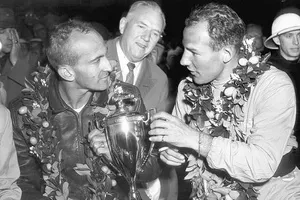
Bourdais, Moss headline second batch of Sebring's 75 all-time greatest drivers
IMSA
IMSA 30 d
Bourdais, Moss headline second batch of Sebring's 75 all-time greatest drivers
More from
Dale Coyne Racing

Dale Coyne Racing signs reigning Indy NXT champion Nikita Johnson for 2027 IndyCar season
IndyCar
IndyCar 2 d
Dale Coyne Racing signs reigning Indy NXT champion Nikita Johnson for 2027 IndyCar season
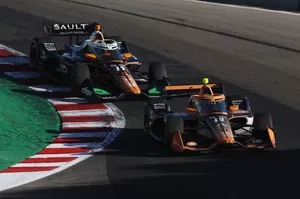
IndyCar 2026 season review: Dale Coyne Racing
IndyCar
IndyCar 3 d
IndyCar 2026 season review: Dale Coyne Racing
Herta endorses IndyCar’s international return with Barcelona while marveling at Palou’s dominance
IndyCar
IndyCar 17 d
Herta endorses IndyCar’s international return with Barcelona while marveling at Palou’s dominance
Latest news
IndyCar 2026 season review: ECR
IndyCar
Indy IndyCar 15 h
IndyCar 2026 season review: ECR
Toto Wolff reflects on Mercedes’ non-title years: ‘We weren’t complete losers’
Formula 1
F1 Formula 1
Sao Paulo GP
15 h
Toto Wolff reflects on Mercedes’ non-title years: ‘We weren’t complete losers’
Renger van der Zande moves to IMSA’s LMP2 class full-time with Tower Motorsports
IMSA
IMSA IMSA 16 h
Renger van der Zande moves to IMSA’s LMP2 class full-time with Tower Motorsports
Nick Sanchez will compete for 2027 NASCAR Truck title with McAnally-Hilgemann
NASCAR Truck
NSTR NASCAR Truck
Homestead
16 h
Nick Sanchez will compete for 2027 NASCAR Truck title with McAnally-Hilgemann
Feature
Discover prime content
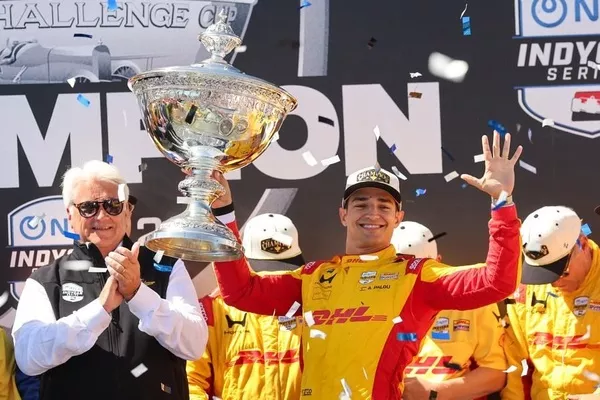
How Spanish engineering and Alex Palou brought IndyCar to Barcelona
Feature
IndyCar
Feature
IndyCar 14 d
By Joey Barnes
How Spanish engineering and Alex Palou brought IndyCar to Barcelona

Inside AJ Foyt Racing’s transition: Hauger’s arrival, Ferrucci’s future, and the Pierson waiting game
Feature
IndyCar
Feature
IndyCar 1 mo
By Joey Barnes
Inside AJ Foyt Racing’s transition: Hauger’s arrival, Ferrucci’s future, and the Pierson waiting game
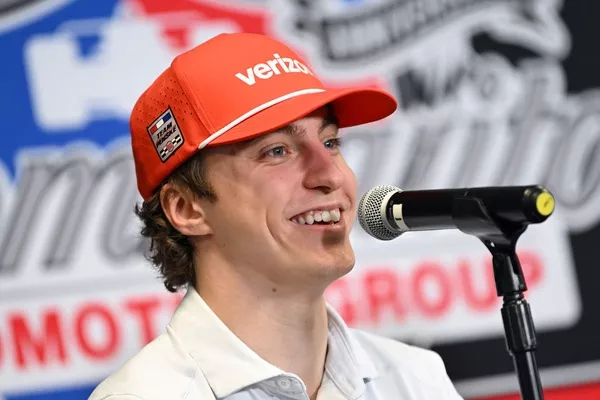
You Ask The Questions: David Malukas
IndyCar
By Joey Barnes
You Ask The Questions: David Malukas

Subscribe and access Motorsport.com with your ad-blocker.
From Formula 1 to MotoGP we report straight from the paddock because we love our sport, just like you. In order to keep delivering our expert journalism, our website uses advertising. Still, we want to give you the opportunity to enjoy an ad-free and tracker-free website and to continue using your adblocker.
You have 2 options:
- Become a subscriber.
- Disable your adblocker.
Subscribe now Already subscribed? Sign in here
Already disabled your adblocker?
Reload page
Manage Alerts
Subscribe