Commentary
Formula 1 Spanish GP
Why is it so difficult for F1 drivers to say they're sorry?
Max Verstappen stopping short of apologising to George Russell echoes Sebastian Vettel’s clash with Lewis Hamilton in Baku in 2017. Why is apologising so hard to do?

Ben Hunt
Edited: Jun 3, 2025, 9:24 AM
Copy link
Share on Viber
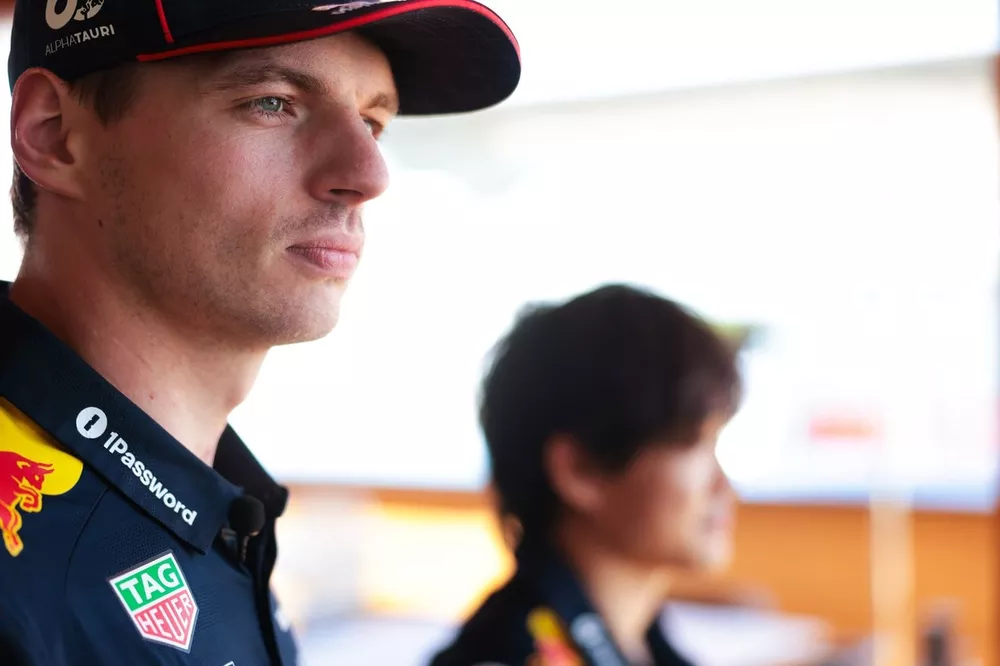
Max Verstappen, Red Bull Racing
Photo by: Red Bull Content Pool
It took a post from Red Bull boss Christian Horner on social media to clear it up, but finally we now know Max Verstappen has apologised for driving into George Russell during the Spanish GP.
The F1 world champion posted on Instagram, in which he delivered his verdict on the controversial end to the race in Barcelona which saw him receive a 10-second time penalty and three penalty points on his super licence, which leaves him perilously close to an automatic one-race ban.
Verstappen’s choice of words, however, were interesting. In the wake of those calling for him to be disqualified and the ever-increasing condemnation of his actions, he stopped short of apologising for his actions when he drove into Russell, instead leaving it open to interpretation.
For instance, saying “the move that was not right and shouldn’t have happened” could for some be intended as some sort of admission of guilt, which it may have been.
But that line was teed up with excuses about the “tyre choice and some moves after the safety car restart” that had “fuelled [his] frustration”.
Put together and the explanation could be read as a ‘sorry-not-sorry’, or perhaps a bungled attempt to stop the heat he's receiving for driving into a competitor. It lacked the clarity of an all-out apology, which could have drawn a line under the incident.
Horner’s post, however, was much clearer, in which he explained the team’s strategy mistake before adding that “Max apologised in the debrief for his incident with Russell”.
Horner’s text is clear - the Dutchman had said sorry - but if Verstappen had indeed apologised to the team, then why not come out and say it publicly?
There were similarities in his behaviour and that of Sebastian Vettel's when he rammed his Ferrari into Lewis Hamilton’s Mercedes in the 2017 Azerbaijan Grand Prix in a fit of frustration.
At the Austrian GP which followed, the German released a statement saying he had overreacted in the heat of the moment. He said: “It was the wrong move, the wrong decision. It was the wrong move to drive alongside him and hit his tyre…” again, stopping short of a full apology.
It took three attempts in the press conference for Vettel to accept some of the blame before he added: “I overreacted. The intention was not to hurt him [Hamilton], damage his car, it was at low speed but looking back it was the wrong thing to do, it was dangerous, plus it was unnecessary because it didn’t win me anything.”
In fact, Vettel would not fully apologise to Hamilton until five years later at his final F1 race at the 2022 Abu Dhabi GP. As they sat discussing their rivalry over the years, Vettel interjected and said: “I’m actually quite sorry, it’s your answer. I think Baku for me wasn’t a great moment, because what I did wasn’t right.”
So why is it so hard for some drivers to say sorry? It is not the case for all.
Hamilton apologised to Oscar Piastri at the 2023 Italian GP saying it was not intentional and that’s what ‘gentlemen do’.
Russell apologised to Valtteri Bottas after they collided at speed in Imola in 2021, saying he was not proving to be a good role model for youngsters. And recently, Alex Albon picked up the bill for Russell for his slow-driving tactics in the Monaco GP.
One explanation could be that Verstappen’s reluctance to apologise is part of his personality. Much has been made of his tough upbringing and it has clearly formed part of his racing mentality. His mental fortitude has been lauded in the past, perhaps as much as it has earned him criticism.
Another suggestion may be it being a deflective tactic, his words on social media indeed look to apportion blame in another direction.
Perhaps, like Vettel, it is that attitude that is required to win four F1 titles? By never admitting you were wrong — at least publicly — a driver can maintain the mentality of being in the right.
Another factor may be that by apologising, that could be picked up and interpreted as a weakness by his rivals — a stick to further beat him with. Whatever the reason for his failure to say sorry to Russell, ultimately the question is, does it really matter?
Other F1 non-apologists include the likes of Michael Schumacher and Ayrton Senna, who remain heroes to many. It may matter to commentators, the critics and society as a whole, but ultimately it does not matter to Verstappen — otherwise, he’d have said it.
We want your opinion!
What would you like to see on Motorsport.com?
Take our 5 minute survey.
- The Motorsport.com Team
Read and post comments
Read also :
Share Or Save This Story
Copy link
Share on Viber
Previous article Norbert Haug responds to Verstappen-Russell clash: "Couldn't believe someone would lash out like that"
Next article Helmut Marko didn’t understand Max Verstappen’s “thought process” during Spanish GP: “All hell broke loose”
Top Comments
There are no comments at the moment. Would you like to write one?
View More & Comment

More from
Ben Hunt
How Jonathan Wheatley wants Sauber to use F1 podium momentum in Audi transformation
Formula 1
Formula 1
British GP
Jul 13, 2025
How Jonathan Wheatley wants Sauber to use F1 podium momentum in Audi transformation

How Christian Horner’s Red Bull exit mirrored his F1 arrival and why he will be missed
Formula 1
Formula 1 Jul 10, 2025
How Christian Horner’s Red Bull exit mirrored his F1 arrival and why he will be missed
Keanu Reeves to star in new Cadillac F1 team documentary
Formula 1
Formula 1
Austrian GP
Jul 2, 2025
Keanu Reeves to star in new Cadillac F1 team documentary

More from
Lewis Hamilton
Lewis Hamilton: Ferrari’s top-speed deficit was “brutal” at F1 Las Vegas GP
Formula 1
Formula 1
Las Vegas GP
1 d
Lewis Hamilton: Ferrari’s top-speed deficit was “brutal” at F1 Las Vegas GP
Why Ferrari believes written rules won't help manage Charles Leclerc and Lewis Hamilton
Formula 1
Formula 1
Las Vegas GP
1 d
Why Ferrari believes written rules won't help manage Charles Leclerc and Lewis Hamilton

More from
Red Bull Racing
Isack Hadjar frustrated – What really happened on Red Bull's team radio in Las Vegas
Formula 1
Formula 1
Las Vegas GP
16 h
Isack Hadjar frustrated – What really happened on Red Bull's team radio in Las Vegas
Max Verstappen reveals he is considering 2027 Daytona 24 Hours entry
Formula 1
Formula 1
Las Vegas GP
1 d
Max Verstappen reveals he is considering 2027 Daytona 24 Hours entry
Latest news

Joe Gibbs Racing constructs timeline of Chris Gabehart's alleged theft
NASCAR Cup
NAS NASCAR Cup 3 h
Joe Gibbs Racing constructs timeline of Chris Gabehart's alleged theft
IndyCar adds Kansas Speedway to 2027 schedule in joint NASCAR weekend
IndyCar
Indy IndyCar 7 h
IndyCar adds Kansas Speedway to 2027 schedule in joint NASCAR weekend
Decision time looms for Colton Herta after 2027 Cadillac F1 snub
Formula 1
F1 Formula 1
Las Vegas GP
8 h
Decision time looms for Colton Herta after 2027 Cadillac F1 snub
Kalle Rovanpera: New 2027 WRC cars will see "everybody start from zero"
WRC
WRC WRC 9 h
Kalle Rovanpera: New 2027 WRC cars will see "everybody start from zero"
Feature
Discover prime content


Subscribe and access Motorsport.com with your ad-blocker.
From Formula 1 to MotoGP we report straight from the paddock because we love our sport, just like you. In order to keep delivering our expert journalism, our website uses advertising. Still, we want to give you the opportunity to enjoy an ad-free and tracker-free website and to continue using your adblocker.
You have 2 options:
- Become a subscriber.
- Disable your adblocker.
Subscribe now Already subscribed? Sign in here
Already disabled your adblocker?
Reload page
Manage Alerts
Subscribe