Feature
Formula 1 Barcelona-Catalunya GP
Opinion
What next for Honda now its engine is confirmed as F1's weakest?
The FIA’s Additional Development and Upgrade Opportunities framework offers scope for improvement – but Honda’s room for manoeuvre remains limited

Stuart Codling
Published: Jun 15, 2026, 7:00 AM
Copy link

Share on Viber
Perhaps the least surprising aspect of the FIA’s controversial Additional Development and Upgrade Opportunities (ADUO) verdict last week was the confirmation that Honda’s Formula 1 engine is lagging compared with rivals. This much has been obvious from the start of the season.
ADUO, the ranking no competitor in F1 wishes to top, is the epitome of unforeseen consequences. The FIA was prepared to include many more parameters within its performance-measurement rubric, but the teams and manufacturers argued in favour of keeping it simple and minimal – and now at least one of them has been hoist by their own petulance.
But while Red Bull has been vehemently arguing the toss, having been deemed top of the charts – CEO Oliver Mintzlaff met with FIA president Mohammed Ben Sulayem in Paris last week, so this has been escalated to executive level already – Honda is quietly knuckled down to the task of making the most of the opportunity it has been handed.
Read Also:
“Kind of similar,” was Honda chief engineer Shintaro Orihara’s response when asked if the FIA’s official rankings aligned with his company’s own expectations. “I think RBPT [Red Bull Powertrains] did a great job and I respect what they have done. The FIA, the number we received from FIA, is quite fair for us. I can’t disclose detail points beyond what the FIA disclosed. But we got some number.
“And then now, we focus to develop our engine performance over summer period. We are working on improved combustion performance and also to lose some friction to improve engine performance. So that will help us to boost our performance.”
One of the wrinkles of the ADUO system is that while the internal combustion engine is the basis of the performance measurement, the development opportunities unlocked extend beyond it. So it’s clear that in choosing to focus on combustion efficiency and frictional losses, Honda believes the biggest gains are to be found there rather than the electrical system – even though it’s understood the Honda PU also falls short in that department as well.
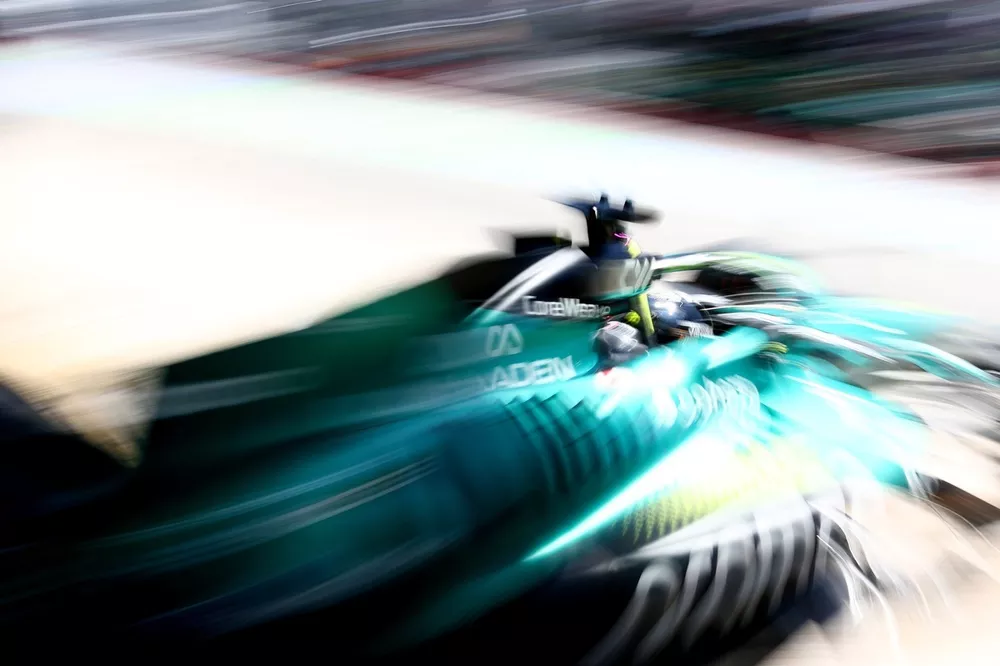
Honda has the biggest scope of improvement under ADUO, but can it utilise it to catch up with the competition?
Photo by: Alastair Staley / LAT Images via Getty Images
Manufacturers up to 2% off the benchmark engine (Red Bull’s in this case) are granted permission to develop one part of the power unit, which would otherwise be ‘frozen’ until 2028. Those beyond 2% are allowed two areas of development. The sliding scale also includes increased dyno time and permission to spend beyond the budget cap. The framework for the budget break goes up in brackets from 4% to 6%, then 6% to 8%, then 8% to 10%.
There are allowances for those more than 10% off the benchmark, with the facility for “extreme cases” to pull forward up to $8m from future budgetary periods. But the talk in the F1 paddock places Honda’s engine in the region of 6%-8% off the benchmark; it’s believed that Aston Martin’s chassis and gearbox are also contributing to the cars being well off the pace.
This was not the mood music coming out of the team at the beginning of the season, when managing technical partner Adrian Newey essentially threw Honda under the bus in an extraordinary press conference on the eve of the Australian Grand Prix. But in the intervening months it has become clear that many of the design choices – including some Newey himself insisted upon rather late in the day after joining the team last season – have contributed to the problem.
"We're waiting for the second half of the season, and hopefully when the new car arrives, we can improve a bit. Until the new car comes, we'll just try to make the weekends as enjoyable as possible,"
Fernando Alonso
The extreme packaging Newey wanted in order to package the rear end of the car more tightly for aerodynamic purposes dictated several compromises. One was the ‘double deck’ battery design, which proved vulnerable to vibrations through the chassis, another was the unusual location of the electrical motor – ahead of the engine rather than within the milieu around the gearbox.
Although the engine was initially blamed for the vibration problem, Honda insisted this wasn’t present on the dyno so an AMR26 chassis was shipped to its Sakura R&D facility for further experimentation. It’s understood that beyond a certain rev range the engine triggered a harmonic resonance through the chassis.
Hence Aston Martin has not brought any updates to the track since the beginning of the season, focusing its efforts on what will in essence be a B-spec version of the car, to be introduced this summer. Realising it needs to get its own house in order should at least enable the team to avoid a catastrophic breakdown of relations with its engine partner, such as was the case between McLaren and Honda in 2017. That scenario led to a parting of the ways and it was only when it adopted another engine that McLaren properly faced the shortcomings of its own part of the package.
As the team dug into the data, it turned out its woes weren't all down to Honda
Photo by: Alastair Staley / LAT Images via Getty Images
Since before the Canadian GP, both Aston Martin’s drivers have been unanimous in saying that the most important obstacle that needs to be addressed is driveability, given the tendency of the power unit and gearbox to lose synchronisation. That has led to “random” downshifts and a handbraking effect, which has destroyed their confidence in the car.
“We repeat the same thing every weekend,” said Fernando Alonso after qualifying in Barcelona. “It's exhausting. We're last, we know it, and we have no problem admitting it.
“We're waiting for the second half of the season, and hopefully when the new car arrives, we can improve a bit. Until the new car comes, we'll just try to make the weekends as enjoyable as possible, with the fewest problems possible, without damaging the car so we don't affect the cost cap or anything like that.
“It's all becoming very repetitive. In some corners it felt like pulling a handbrake, complete rear locking with both rear wheels fully locked. In other corners I had what felt like half-throttle while braking, and then you just go straight on. So every lap is a bit of a lottery at the moment. We have a very poor engine – the worst one. We have very poor energy deployment. We have gearbox problems and aerodynamic problems.
“We're working on all of it, and hopefully in the second half of the season we can give people something to cheer about.”
Elite sport is a question of taking control of the aspects you can control. Clearly, there are elements of compromise ‘baked in’ to the AMR26 design, such as the battery and electrical motor placement. The extent to which this is the cause of the shortfall in electrical deployment is difficult to say from the outside looking in. But, in any case, it cannot be changed quickly.
It makes sense, therefore, for Honda to target the relatively low-hanging fruit of combustion efficiency and frictional losses within the internal combustion engine. But it has to tread carefully – do too good a job before the next quarterly ADUO measurement and it could end up with fewer performance breaks and less money to spend next time around…
Aston Martin and Honda are focused on a B-spec car set to be delivered later this summer to make a big step forward
Photo by: Simon Galloway / LAT Images via Getty Images
We want to hear from you!
Let us know what you would like to see from us in the future.
Take our survey
- The Autosport.com Team
Read and post comments
Read also :

Author Stuart Codling
Stuart studied history at the University of Kent and had a brief career as a road tester on car/bike magazine Redline until he ended up in a ditch with a Ducati 748 on top of him. He joined the Autosport ecosystem as deputy editor of sister title Le Mans & Sportscar Racer in 1999. Most recently he was the editor of GP Racing magazine. He's also the author of 15 books on automobiles and motor racing, including the award-winning Art of The Formula 1 Race Cars. No Ducatis were harmed during its production.
Read more
Previous article What were the chances of Hamilton winning in Barcelona without the virtual safety car?
Next article Barcelona Grand Prix Driver Ratings 2026
Top Comments
There are no comments at the moment. Would you like to write one?
View More & Comment
More from Stuart Codling
Cadillac retaining Bottas for F1 2027 is the logical move
Formula 1
F1 Formula 1
Las Vegas GP
8 h
Cadillac retaining Bottas for F1 2027 is the logical move
The factors behind the abortive 2030 F1 rules announcement
Formula 1
F1 Formula 1
Las Vegas GP
14 h
The factors behind the abortive 2030 F1 rules announcement
What has Cadillac got to lose by picking Herta?
Formula 1
F1 Formula 1
Las Vegas GP
2 d
What has Cadillac got to lose by picking Herta?
What the Brazilian GP revealed about F1's ability to cope with rain
Formula 1
F1 Formula 1
Sao Paulo GP
7 d
What the Brazilian GP revealed about F1's ability to cope with rain
How Formula 1 proved the naysayers wrong – for once
Formula 1
F1 Formula 1
Sao Paulo GP
9 d
How Formula 1 proved the naysayers wrong – for once
How Norris prevailed in a swift errors tour of Interlagos
Formula 1
F1 Formula 1
Sao Paulo GP
10 d
How Norris prevailed in a swift errors tour of Interlagos
"He really wanted it" – understanding Russell's rage over aborted ‘pole' lap in Brazil
Formula 1
F1 Formula 1
Sao Paulo GP
10 d
"He really wanted it" – understanding Russell's rage over aborted ‘pole' lap in Brazil
LIVE: F1 Brazilian GP – Norris wins from Verstappen in the rain
Formula 1
F1 Formula 1
Sao Paulo GP
10 d
LIVE: F1 Brazilian GP – Norris wins from Verstappen in the rain
Latest news

Top five roles on Motorsport Jobs this week
General
MISC General 3 min
Top five roles on Motorsport Jobs this week
Alonso won't stay for V8 return: "F1 has lost 16 years of pure racing"
Formula 1
F1 Formula 1
Las Vegas GP
27 min
Alonso won't stay for V8 return: "F1 has lost 16 years of pure racing"
Cadillac retaining Bottas for F1 2027 is the logical move
Formula 1
F1 Formula 1
Las Vegas GP
8 h
Cadillac retaining Bottas for F1 2027 is the logical move
Cadillac completes F1 2027 driver pairing
Formula 1
F1 Formula 1
Las Vegas GP
8 h
Cadillac completes F1 2027 driver pairing
Subscribe and access Autosport.com with your ad-blocker.
From Formula 1 to MotoGP we report straight from the paddock because we love our sport, just like you. In order to keep delivering our expert journalism, our website uses advertising. Still, we want to give you the opportunity to enjoy an ad-free and tracker-free website and to continue using your adblocker.
You have 2 options:
- Become a subscriber.
- Disable your adblocker.
Subscribe now Already subscribed? Sign in here
Already disabled your adblocker?
Reload page
Manage Alerts
Subscribe