Special feature
Formula 1
What F1's 2020 wing designs tell us about each team - Part II
A new rules package introduced last year led to a diverse selection of front wing designs, with even the frontrunners choosing very different designs. Now, after a year of development, we look at what lessons have been taken on board.
Giorgio Piola Matt Somerfield
Published: May 7, 2020, 10:43 AM
Copy link
Share on Viber
Giorgio Piola's F1 technical analysis
Giorgio Piola is the preeminent Formula 1 technical journalist. View our full selection of Giorgio's technical illustrative content
Radical regulation tweaks usually leads to an element of divergence, as each of the teams go in their own direction. However, over time, we usually see convergence on the solution that's perceived to give the best overall performance.
Thanks to Giorgio Piola's illustrations, we're able to get some insight into how the teams have adapted not only their front wings but also their nose designs, recovering some of the downforce and reducing some of the drag penalty naturally created by the introduction of these new regulations.
Racing Point
Racing Point and the rebranded Alpha Tauri team will undoubtedly be looking to improve on their finishing position when the season finally gets underway, but let's take a look at what changes they've made to their front wing and nose solutions since the regulations were altered for 2019.
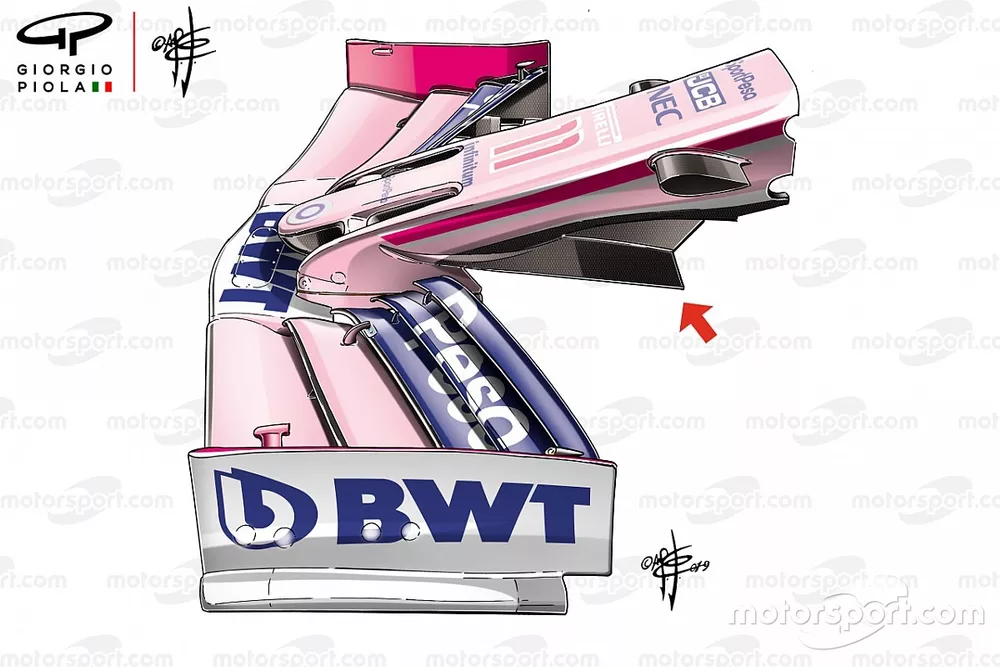
Racing Point RP19, front wing comparsion
Photo by: Giorgio Piola
Racing Point has generally been trying to follow the Red Bull aerodynamic route over the last few years but, with its 2020 challenger it took a U-turn and opted for a Mercedes replica instead.
During 2019 most of its front wing development lay in adjusting the footplate design, altering the length and shape at the rear of its surface on several occasions. Its intent was to alter the vortex shed from here, thus having an effect on the turbulence created by the wheel and tyre behind.
Racing Point RP19 front nose
Photo by: Giorgio Piola
Having tracked the ongoing trend for an under nose cape, Racing Point joined the fray at the Canadian GP but seemingly weren't wholly convinced by the solution in combination with its existing 'Cobra' nose inlets, a feature the team introduced back in 2015 and had improved upon since.
An entirely new solution appeared for the Belgian GP as it switched to a more simplistic thumb-style nose tip and a set of long slotted wing pillars.
Side by side
The 2020 nose and front wing assembly, like the rest of the car, is almost a carbon copy of Mercedes 2019 design, with a slender body, large cape, more bulbous nose tip and narrow wing pillars. There are some subtle changes between the two designs though, with the shape of the footplate and the vane atop it both distinguishing features that sets the Racing Point apart from the Mercedes.
AlphaTauri
The name above the door and the colour scheme might be different but it's business as usual for the sister Red Bull team for 2020.
Toro Rosso STR14 front wing
Photo by: Giorgio Piola
The Italian outfit, much like Ferrari and Alfa Romeo, decided upon the unloaded front wing design for 2019 but did so with a certain amount of panache considering its budget. The transition of the flaps to the point where it meets the endplate was more akin to the Ferrari design than the Alfa Romeo, for example.
You'll note that it bucked the nose cape trend too, choosing a simpler thumb tip extension design for the nose and a long set of wing pillars with holes that allow airflow/pressure to bleed from one side to the other.
AlphaTauri AT01 front wing nose
Photo by: Giorgio Piola
For 2020, the team made some small changes to its front wing design, as the designers paid attention to the inner flap tips and how the flow off of that region interacts with the Y250 vortex formed below. Married to this is a change to the length of the front wing pillars, which are now much shorter and feature just one slot in their surface.
We want your opinion!
What would you like to see on Motorsport.com?
Take our 5 minute survey.
- The Motorsport.com Team
Read and post comments
Read also :
Share Or Save This Story
Copy link
Share on Viber
Previous article New Asian team still targeting F1 2022 entry
Next article Formula 1 reveals massive drop in 2020 income
Top Comments
There are no comments at the moment. Would you like to write one?
View More & Comment
More from
Giorgio Piola
The fascinating story behind McLaren's most iconic F1 car
Formula 1
Formula 1 Apr 3, 2024
The fascinating story behind McLaren's most iconic F1 car
Emilia Romagna GP: F1 technical images from Imola's pitlane
Formula 1
Formula 1
Emilia Romagna GP
Apr 21, 2022
Emilia Romagna GP: F1 technical images from Imola's pitlane
The F1 downforce choices that proved key at the Saudi GP
Formula 1
Formula 1
Saudi Arabian GP
Mar 29, 2022
The F1 downforce choices that proved key at the Saudi GP
Latest news
Freddie Slater replaces Rafael Camara in F2 as Nikola Tsolov becomes title favourite
FIA F2
F2 FIA F2
Lusail
35 min
Freddie Slater replaces Rafael Camara in F2 as Nikola Tsolov becomes title favourite

Grasser and Bortolotti to McLaren? What McLaren's head of motorsport says
DTM
DTM DTM 1 h
Grasser and Bortolotti to McLaren? What McLaren's head of motorsport says

New Super Formula champion Kakunoshin Ohta’s goal: standing for Japan in IndyCar
Super Formula
SF Super Formula
Suzuka II
1 h
New Super Formula champion Kakunoshin Ohta’s goal: standing for Japan in IndyCar

Marc Marquez's engineer explains how he pushed MotoGP rivals to the limit until they made mistakes
MotoGP
MGP MotoGP
Portuguese GP
1 h
Marc Marquez's engineer explains how he pushed MotoGP rivals to the limit until they made mistakes
Feature
Discover prime content




Subscribe and access Motorsport.com with your ad-blocker.
From Formula 1 to MotoGP we report straight from the paddock because we love our sport, just like you. In order to keep delivering our expert journalism, our website uses advertising. Still, we want to give you the opportunity to enjoy an ad-free and tracker-free website and to continue using your adblocker.
You have 2 options:
- Become a subscriber.
- Disable your adblocker.
Subscribe now Already subscribed? Sign in here
Already disabled your adblocker?
Reload page
Manage Alerts
Subscribe