Analysis
Formula 1
Video analysis: How different will F1 cars be in 2017
Formula 1 is heading for one of the biggest overhaul of its rules next year, when new technical regulations deliver cars that are up to five seconds per lap quicker.
Giorgio Piola Matt Somerfield
Edited: Dec 9, 2016, 4:12 PM
Copy link
Share on Viber
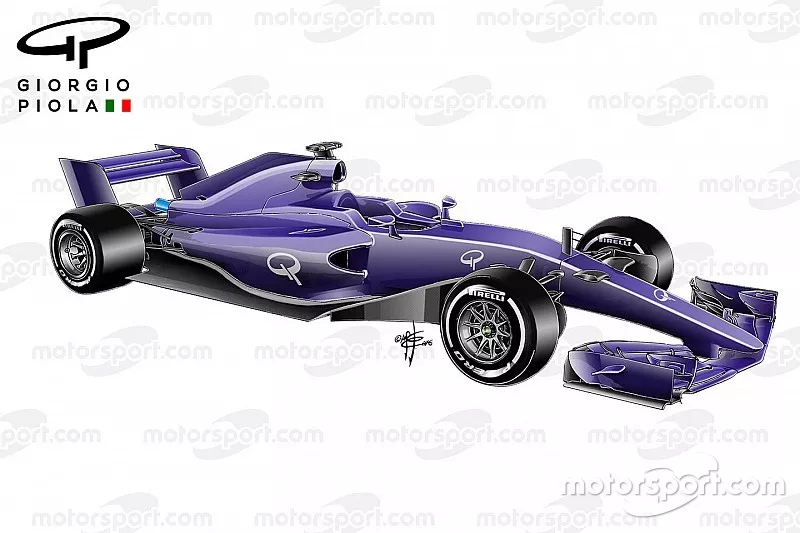
Giorgio Piola's F1 technical analysis
Giorgio Piola is the preeminent Formula 1 technical journalist. View our full selection of Giorgio's technical illustrative content
It is hoped that the changes will deliver a more exciting spectacle and make things especially challenging for drivers who will have to cope with more physical and mental demands.
But there have been concerns that all may not be positive: especially with some fearing that the increase in downforce could hurt overtaking opportunities.
So let's take a look at the way these changes will impact the look of the 2017 cars, firstly with a 3D rendering comparing a generic 2017 car with the Ferrari SF16-H.
It is clear to see that the changes are significant as an overall package, but it is when you look at parts in details some fascinating aspects of the new rules come to light.

2017 aero regulations, top view
Photo by: Giorgio Piola
The front wing is perhaps one of the most important aerodynamic elements on the car, as the air it receives is responsible for the performance of every other structure downstream of it.
As such, when a Technical Working Group was set up to form the 2009 regulations, they concluded that a 'neutral' central section of the mainplane could help to improve the lack of overtaking suffered by the sport in previous years.
It was hoped that requiring all teams to run a pre-defined mainplane shape would make the wing less sensitive as it ran behind another car, allowing a slipstream to occur.
The true impact of the 2009 regulations will never be known, as the double diffusers used in 2009/10, followed by exhaust blown diffusers in various forms in 2010-2013, changed the intention of what the technical working group first introduced.
For 2017, the 'neutral' section is retained, however, a triangular section forms the leading edge of the wing, which itself follows the same diagonal lines.
The tip of the neutral section will reside at 1200mm forward of the front wheel centreline, with the leading edge swept back to 1000mm at the wing's outermost edge. The intent of this is to extend the wing forward and make it less sensitive to the wake of the lead car.

2017 aero regulations, front view
Photo by: Giorgio Piola
The front wing increases in width from 1650mm to 1800mm, in line with the change in tyre size, which increases from 245mm to 305mm.
These changes to the dimensions and shape of the wing are going to have a marked effect on the design of the wings, with their sensitivity to wake being increased as the regulations mature, just as we have seen since 2009.
The increased width of the car, due to wider tyres, isn't only limited to the front wing, because the width of the floor and sidepods are also increased to match, up from 1400mm to 1600mm.
Like the front wing, the sidepods' and floor's leading edge will also be swept back, which will also limit the designer's scope for utilising lift negating appendages, such as the vertical vortex generators, leading edge slats etc. that we have been accustomed to seeing over the last few years.

2017 aero regulations, nose design
Photo by: Giorgio Piola
The size of the bargeboards have been dramatically increased to help the designers improve airflow around the front of the car and limit the effect the tyre's wake has on that region.
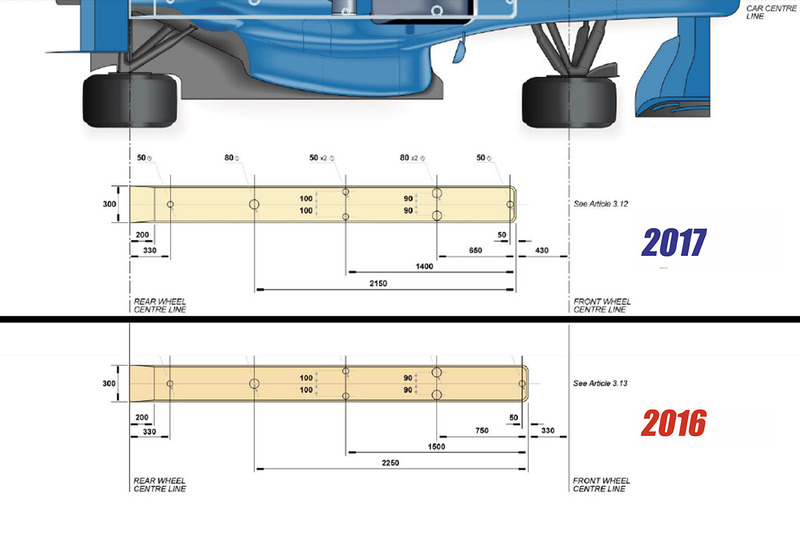
2017 aero regulations, plank design
Photo by: FIA
The plank has been reduced in length, by 100mm, to accommodate the changes made to the shape of the neutral section ahead of it and the swept profile of the floor behind.
The rear tyres width has been increased by 80mm to 405mm, which will clearly have an impact on the floor's design ahead of it. More freedom in the floors radii rules could lead to some interesting tyre squirt slot solutions as the designers find their feet with how the tyres deformation has an impact on the new diffuser dimensions.

2017 aero regulations, side view
Photo by: Giorgio Piola
The diffuser will have a much larger footprint going forward, with its throat inclining from 175mm ahead of the rear wheel centreline, rather than on it. The height at which it terminates is up 50mm from 125mm to 175mm, whilst the width is up to 1050mm from 1000mm.

2017 aero regulations, rear view
Photo by: Giorgio Piola
The rear wing design is also dramatically different with the rear wing endplates relaxed diagonally rearwards to move the point at which the diffuser's airflow structure interacts with the rear wing. The overall height is also reduced, down from 950mm to 800mm but made 200mm wider, up from 750mm to 950mm.
There is also scope for the endplates to be curved outwards from their floor mounting position, with the lower part of the endplate able to start 400mm from the car's centreline, whilst the upper element must be 475mm from it.
The impact of the changes
On the face of it, the 2017 regulations seem to be born out of a need to fix the aesthetic appearance of the cars, with a string of ill-conceived regulation changes in recent years responsible for some terrible looking cars.
That said, the intention was to reduce lap times by up to five seconds, something that should be easily accomplished in this framework, with lap and pole records likely to tumble at every GP.
Fears of cars not being able to follow one another should be heeded, however, because the way in which the front and rear wings have been designed should mitigate any increase in downforce, simply by changing the car's wake profile and the front wing's sensitivity.
One of the key problems the sport has had since 2014 is weight. The cars are carrying around 50kg's less fuel at the start of a race, yet they are still much heavier than their V8 counterparts. This is chiefly due to the weight and packaging of the extra power unit components.
This becomes more of a problem when you realise in dry weight, ie qualifying trim, they are currently 60kg heavier, which is set to rise a further 20kg in 2017 (722kg). This is due to the weight increase of the suspension and brake elements, accommodating the increase in size, weight and inertia of the wheels and tyres.
Wide scale weight reduction isn't really viable, but one way to alleviate the issue is to increase downforce and change the approach to cornering forces, which is what we are going to see in 2017.
These changes will have a significant effect on the driving style that needs to be employed, with a change of approach not only in the braking phase but also how the throttle is applied through the radius of the corner.
Brembo has indicated to use that it is expecting a 30 percent uplift in the energy needed to be dissipated (peak loading), owing to the deceleration of the additional weight. This, along with the additional cornering forces, should make the car much more challenging for the drivers.
We want your opinion!
What would you like to see on Motorsport.com?
Take our 5 minute survey.
- The Motorsport.com Team
Read and post comments
Read also :
Share Or Save This Story
Copy link
Share on Viber
Previous article Renault consider the Monaco GP its ‘home’ race
Next article Mercedes needs to 'hit back hard' in Monaco - Wolff
Top Comments
There are no comments at the moment. Would you like to write one?
View More & Comment
More from
Giorgio Piola
The fascinating story behind McLaren's most iconic F1 car
Formula 1
Formula 1 Apr 3, 2024
The fascinating story behind McLaren's most iconic F1 car
Emilia Romagna GP: F1 technical images from Imola's pitlane
Formula 1
Formula 1
Emilia Romagna GP
Apr 21, 2022
Emilia Romagna GP: F1 technical images from Imola's pitlane
The F1 downforce choices that proved key at the Saudi GP
Formula 1
Formula 1
Saudi Arabian GP
Mar 29, 2022
The F1 downforce choices that proved key at the Saudi GP
Latest news
Skoda considers WRC Rally1 update kit for 2027
WRC
WRC WRC 3 min
Skoda considers WRC Rally1 update kit for 2027
Zak Brown rules out McLaren engine programme for F1 2030
Formula 1
F1 Formula 1
Las Vegas GP
59 min
Zak Brown rules out McLaren engine programme for F1 2030

Lennix Busch tests kart for the first time, okay after "pretty big" crash
NASCAR Cup
NAS NASCAR Cup 1 h
Lennix Busch tests kart for the first time, okay after "pretty big" crash
Top 10 F1 cars of the 1990s
Formula 1
Top 10 F1 cars of the 1990s
Feature
Discover prime content

Top 10 F1 cars of the 1990s
Formula 1
By Kevin Turner
Top 10 F1 cars of the 1990s



Subscribe and access Motorsport.com with your ad-blocker.
From Formula 1 to MotoGP we report straight from the paddock because we love our sport, just like you. In order to keep delivering our expert journalism, our website uses advertising. Still, we want to give you the opportunity to enjoy an ad-free and tracker-free website and to continue using your adblocker.
You have 2 options:
- Become a subscriber.
- Disable your adblocker.
Subscribe now Already subscribed? Sign in here
Already disabled your adblocker?
Reload page
Manage Alerts
Subscribe