Formula 1
How brake designs could explain Red Bull/Ferrari F1 tyre differences
Ferrari started the current Formula 1 season as the car to beat, with Charles Leclerc winning two of the opening three grands prix of the campaign.
Matt Somerfield Franco Nugnes
Edited: Oct 25, 2022, 4:29 PM
Copy link
Share on Viber
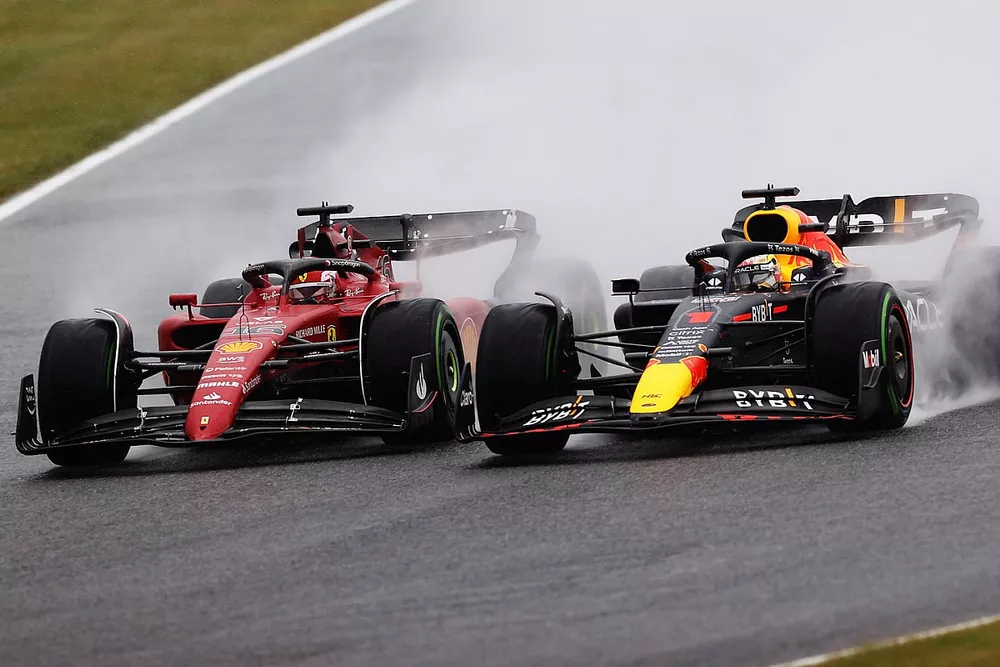
However, rival Red Bull quickly hit its stride and since the summer break has stepped even further clear, especially in race pace, as the RB18 appears to have a clear edge with its tyre management characteristics.
A lot of the focus for the swing in performance has inevitably focused around aero development, as it's an area where all teams make a lot of changes throughout the year.
However, there are other aspects of car design and setup that can play just as important a role in overall package performance, and this is why Ferrari's tyre headaches may not just be an aero thing.
It would appear that Ferrari's tyres have a higher propensity to overheat compared to those on the Red Bull. This is perfect for qualifying sessions as it helps switch tyres on, and has contributed to Leclerc and Carlos Sainz still being able to challenge for pole position up until now.
However, during the sustained heat cycle that the tyres undergo during the course of a race stint, Ferrari's temperatures can rise more quickly than its main rival, offsetting the strategic advantage it once yielded.
Knowing how different the tyres are performing on the Red Bull and Ferrari cars, it's interesting to note that the two teams fall on opposite sides of the fence when it comes to how they approach heat management for their brakes.
This is especially true when we consider the relationship this poses with the wheel rim and the tyre's bulk temperature.
This is an area where teams spent a considerable amount of their resources during the previous regulation set, but the introduction of the new rules for 2022 has largely led to that research and development being reset.
The arrival of the standard specification 18" wheel rim has resulted in numerous dimensional changes, with the discs at the front of the car now required to be between 325 and 330mm, rather than 278mm.
Furthermore, the drill holes that reach through the disc have to be a minimum of 3mm, altering not only the way the heat is transferred but also the behaviour of the airflow too.
Adding to this is a requirement to reject airflow passing through the brake assembly only through a rearward facing outlet, whereas teams had previously forced this out through the wheel face for an added aerodynamic effect.
Ferrari F1-75 front brakes
Photo by: Giorgio Piola
In response to these changes, we've seen Red Bull, McLaren, Alfa Romeo and Alfa Tauri adopt an internal brake disc fairing. Mercedes and Williams have applied a quasi-faired solution too.
Meanwhile, Ferrari, Alpine, Aston Martin and Haas are the four teams that have left the disc exposed within the now much larger brake drum, as its size has been increased to fit within the enlarged wheel well.
McLaren's first attempts at using the fairing solution did not come without its own dramas. Whilst the MCL36 seemed extremely competitive during the first pre-season test in Barcelona, when it arrived in Bahrain it quickly realised it had to make changes because of extreme overheating.
McLaren MCL36 front brakes
Photo by: Giorgio Piola
This resulted in the original carbon fibre concept being cast aside and a metal version put into service in the interim, whilst a thorough redesign could be completed.
The new version, which arrived at the Spanish Grand Prix (right), resulted in a much larger fairing and required the pipework feeding cool air to the caliper to be rerouted.
Whilst the other teams using this fairing solution didn't have the glaring issues that McLaren faced, they've also spent the entire season optimising their designs to improve performance.
Using Red Bull as the example, it's easy to see how smaller changes have resulted in a breakthrough in performance, as the exposed insulation wadding used in its original design (below, left) was removed when the team redesigned the shape of the fairing.
The fairing then received numerous iterational shape changes to help moderate the transfer of heat between the brakes, wheel rim and tyres (below, right, red arrow, for example)
Red Bull RB18 front brake assembly
Photo by: Uncredited
In its quest to help manage this temperature transfer, the team also applied a thermal coating to the fairing and the (see insets, below).
Given that Ferrari has already announced it won't be bringing any major new parts to the races in the closing stages of the season, we can't expect to see the F1-75 copy the approach of its rival.
However, that's not to say that the Scuderia hasn't been paying close attention to its rivals and might look to incorporate something similar next season.
Red Bull RB18 front brake comparison
Photo by: Giorgio Piola
Read Also:
- Red Bull's F1 cost cap overspend "constitutes cheating", Brown tells FIA
- Hamilton: Important I “gee everyone up” at Mercedes F1 for 2023 fightback
We want your opinion!
What would you like to see on Motorsport.com?
Take our 5 minute survey.
- The Motorsport.com Team
Read and post comments
Read also :
Share Or Save This Story
Copy link
Share on Viber
Previous article Former Champ Car drivers set for Mexican GP support race
Next article Sainz had to "completely change" F1 driving style to get on top of 2022 Ferrari
Top Comments
There are no comments at the moment. Would you like to write one?
View More & Comment

More from
Matt Somerfield

Gallery: How F1 tech evolved during the 2024 season
Formula 1
Formula 1 Dec 31, 2024
Gallery: How F1 tech evolved during the 2024 season
How McLaren’s rear wing push changed the game in F1
Formula 1
Formula 1 Dec 20, 2024
How McLaren’s rear wing push changed the game in F1
How 2026 F1 rules will help avoid identikit designs
Formula 1
Formula 1 Dec 16, 2024
How 2026 F1 rules will help avoid identikit designs
Latest news
Live: MotoGP Portuguese GP as it happens
MotoGP
MGP MotoGP
Portuguese GP
13 min
Live: MotoGP Portuguese GP as it happens
The one aspect of Max Verstappen "outsmarting" Mercedes that left Red Bull speechless
Formula 1
F1 Formula 1
Las Vegas GP
35 min
The one aspect of Max Verstappen "outsmarting" Mercedes that left Red Bull speechless
Lewis Hamilton: ‘Charles Leclerc’s frame of mind cost us a lot of points today’
Formula 1
F1 Formula 1
Las Vegas GP
1 h
Lewis Hamilton: ‘Charles Leclerc’s frame of mind cost us a lot of points today’
Feature
Discover prime content

Subscribe and access Motorsport.com with your ad-blocker.
From Formula 1 to MotoGP we report straight from the paddock because we love our sport, just like you. In order to keep delivering our expert journalism, our website uses advertising. Still, we want to give you the opportunity to enjoy an ad-free and tracker-free website and to continue using your adblocker.
You have 2 options:
- Become a subscriber.
- Disable your adblocker.
Subscribe now Already subscribed? Sign in here
Already disabled your adblocker?
Reload page
Manage Alerts
Subscribe