Analysis
Formula 1
The car changes that have helped McLaren shine in 2020
For a team that was facing huge financial pressures as the coronavirus pandemic hit, McLaren’s strong form this season has been one of the feel-good stories of the year.
Giorgio Piola Matt Somerfield
Edited: Sep 10, 2020, 1:49 PM
Copy link
Share on Viber
Giorgio Piola's F1 technical analysis
Giorgio Piola is the preeminent Formula 1 technical journalist. View our full selection of Giorgio's technical illustrative content
From the bitter reality of needing to make staff cuts, to questions over its actual future, McLaren has not let any of that distract it as it has emerged as one of the contenders for a top three spot in the constructors' championship.
Podium finishes for Lando Norris in Austria and Carlos Sainz in Italy were not just down to luck, as the MCL35 has been quick – and is now a regular in Q3 and the battle for points.
The MCL35 is a continuation of the ground work already laid down by the team in recent years, with a measured approach taken to developing the various concepts already on the car.
That work has delivered an all-round boost and a car that seems relatively easy to setup and get the best from at each and every track.
But that's not to say that the MCL35 isn't innovative either though, with particular attention paid by the team to the design of the chassis in order that it can exploit its aerodynamic potential.
McLaren MCL35 chassis front
Photo by: Giorgio Piola
For example, its keel-shaped chassis design underlines its commitment to pushing the limits of the regulations and construction techniques in order that it can drive more airflow to critical areas of the car.
The chassis design also takes advantage of a solution that the team introduced back at the Spanish GP in 2018 and has continually improved since.
The slimmer nose box and cape solution was first deployed by Mercedes in 2017, as a way of improving load on the front axle and creating flow structures at the front of the car that connected with the bargeboards behind.
Since then most of the field has converged on the solution in their own ways but McLaren has continued to iterate throughout as it honed in on a more consistent design.
Taking its time throughout 2019, the team has also developed its front suspension, using free practice sessions as a platform to understand and evolve the arrangement that's been used in 2020.
This not only included optimising the 'Pushrod-On-Upright' (POU) solution already being developed, but also a repositioning of the upper and lower wishbones to improve the aerodynamic stability of flow structures created by the front wing and used further downstream by the bargeboards and leading edge of the floor.
This required the team to use a similar upright extension to the ones that were first seen in 2017 on the Mercedes and Toro Rosso.
This was an iterative process, with several different versions tested before McLaren arrived at the solution seen on the car this season.
You'll also note how this has led to the team having to develop and optimise new brake ducts too, as every component needs to work in harmony to improve both the mechanical and aerodynamic output of the car.
McLaren MCL35 front wing detail
Photo by: Giorgio Piola
Switching tack and moving forward to the front wing, it's also important to note that McLaren has made changes to its front wing design to work in harmony with the ones already mentioned.
The alterations have coincided with the trend for Pirelli to increase the minimum tyre pressures this season when compared with last season.
These changes alter the flexibility of the tyre's sidewall under load and thus alter the shape and ferocity of the wake turbulence generated, affecting the rear of the car in a slightly different way than before.
Meanwhile, the changes made by McLaren largely centre around the way the wing works in the outer section, with the team combining what it learned in 2019 when the regulations changed, and some of their aerodynamic tricks and tools were lost.
As such, it has developed a solution that may deliver less peak performance but draws the airflow across and around the front tyre in a more consistent and predictable manner, improving performance downstream.
McLaren MCL35 new barge boards
Photo by: Giorgio Piola
To alter the performance of the central portion of the car and take advantage of the other changes made up and downstream of them, there has been a continuous development of the bargeboards and sidepod deflectors.
Like most of the field, McLaren has opted to use what's known as a boomerang winglet on top of the main vertical bargeboard that connects with the outer sidepod deflector panels.
The shape of the boomerang is usually dictated by the various elements that make up the bargeboard's footplate beneath. It features slots within its surface to mirror those below, in order to maintain legality.
To define the airflow's passage through this region the team added two L-shaped appendages in Austria (blue arrow), whilst tests were conducted in Belgium to include the venetian-blind like slats beneath the main sidepod deflectors (red arrow).
This is a design concept we've seen from several other teams on the grid already, with the proposed intent of these slats being that they create a string of vortices along the cars flank.
Only Sainz had this latest development at his disposal for the Italian GP though, with the production and availability of parts during 2020 stretching the teams to their absolute maximum.
McLaren MCL35 cooling, Hungarian GP
Photo by: Giorgio Piola
At the rear of the car, the team has displayed the usual decorum when it comes to having different wing options available for the various track configurations.
It has sometimes paired with a T-Wing, sometimes without, whilst a focus has also been placed on the size and shape of the rear cooling outlet.
The team knows only too well that performance, both from a power unit perspective and in terms of aerodynamics, can be won and/or lost here, and so it's critical to make the right choices during the course of a race weekend.
The slat (red arrow) was added for the Hungarian GP as a way of increasing the flow volume that's extracted from the outlet, without having to make entirely new bodywork. In fact it's a trick we've seen the team perform on previous occasions too.
Meanwhile, the team also trialled a new floor section in Austria (inset). It's a similar solution to what we've seen Ferrari use this season and featured a raised section ahead of the rear tyre that connects to the inboard vertical strake.
It hasn't appeared again since, but certainly suggests that the team are open to investigating different solutions in an effort to improve performance.
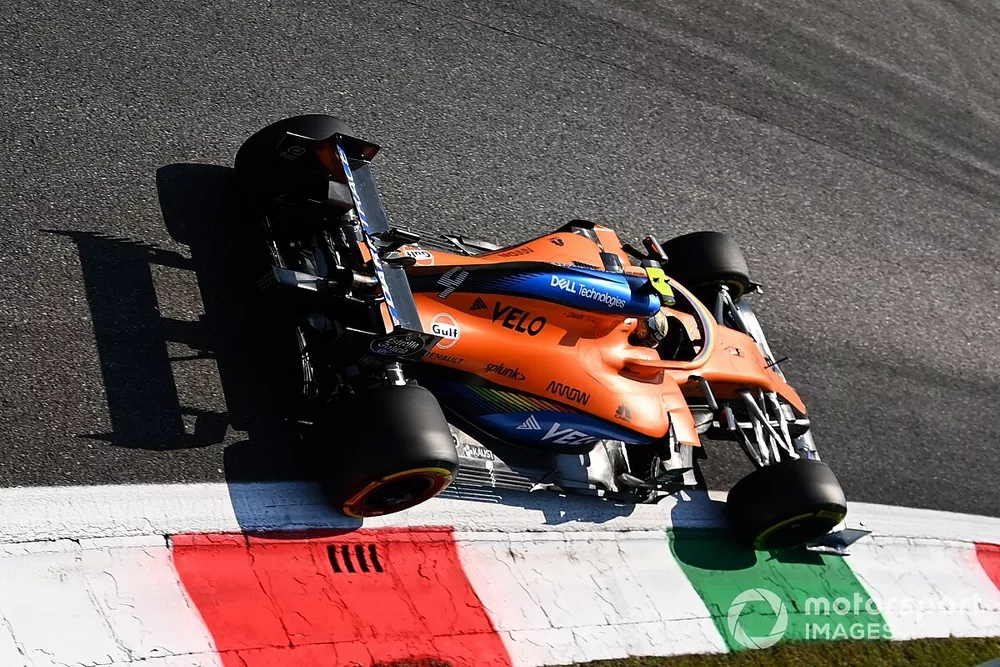
McLaren MCL35 rear
Photo by: Motorsport Images
The unique high speed characteristics of Monza forced all of the teams last weekend to focus their effort on drag reduction, with McLaren choosing its lowest downforce option yet, as seen here when compared with its choice in Belgium.
This allowed both drivers to reach speeds of around 350km/h, keeping them out of the reach of the Mercedes powered cars of Lance Stroll and Valtteri Bottas as they went on to take second and fourth place at the Italian GP respectively.
We want your opinion!
What would you like to see on Motorsport.com?
Take our 5 minute survey.
- The Motorsport.com Team
Read and post comments
Read also :
Share Or Save This Story
Copy link
Share on Viber
Previous article The 'blonde American' that could have saved Mercedes' race
Next article McLaren's infrastructure its biggest "deficit" - Seidl
Top Comments
There are no comments at the moment. Would you like to write one?
View More & Comment
More from
Giorgio Piola
The fascinating story behind McLaren's most iconic F1 car
Formula 1
Formula 1 Apr 3, 2024
The fascinating story behind McLaren's most iconic F1 car
Emilia Romagna GP: F1 technical images from Imola's pitlane
Formula 1
Formula 1
Emilia Romagna GP
Apr 21, 2022
Emilia Romagna GP: F1 technical images from Imola's pitlane
The F1 downforce choices that proved key at the Saudi GP
Formula 1
Formula 1
Saudi Arabian GP
Mar 29, 2022
The F1 downforce choices that proved key at the Saudi GP

More from
McLaren

"I actually liked it" – McLaren boss defends Piastri's four-letter outburst in Las Vegas GP
Formula 1
Formula 1
Las Vegas GP
13 h
"I actually liked it" – McLaren boss defends Piastri's four-letter outburst in Las Vegas GP
Oscar Piastri questions "strange" pace deficit to other Mercedes-powered cars in Las Vegas
Formula 1
Formula 1
Las Vegas GP
1 d
Oscar Piastri questions "strange" pace deficit to other Mercedes-powered cars in Las Vegas
Top 10 F1 cars of the 1980s
Formula 1
Top 10 F1 cars of the 1980s
Latest news
F1 set to reduce customer teams as key 2030 details emerge
Formula 1
F1 Formula 1
Las Vegas GP
10 h
F1 set to reduce customer teams as key 2030 details emerge
Haas keeps Rafael Camara in F1, ending his 2026 F2 title bid
Formula 1
F1 Formula 1
Las Vegas GP
12 h
Haas keeps Rafael Camara in F1, ending his 2026 F2 title bid

Laurin Heinrich "deeply disappointed but not surprised" by Raffaele Marciello after Macau clash
GT
GT GT 13 h
Laurin Heinrich "deeply disappointed but not surprised" by Raffaele Marciello after Macau clash
"I actually liked it" – McLaren boss defends Piastri's four-letter outburst in Las Vegas GP
Formula 1
F1 Formula 1
Las Vegas GP
13 h
"I actually liked it" – McLaren boss defends Piastri's four-letter outburst in Las Vegas GP
Feature
Discover prime content


Subscribe and access Motorsport.com with your ad-blocker.
From Formula 1 to MotoGP we report straight from the paddock because we love our sport, just like you. In order to keep delivering our expert journalism, our website uses advertising. Still, we want to give you the opportunity to enjoy an ad-free and tracker-free website and to continue using your adblocker.
You have 2 options:
- Become a subscriber.
- Disable your adblocker.
Subscribe now Already subscribed? Sign in here
Already disabled your adblocker?
Reload page
Manage Alerts
Subscribe