Analysis
Formula 1
Tech verdict: How Ferrari really turned the tables on rivals
Ferrari turned the tables on its Formula 1 rivals since the summer break, not only taking victories at low-downforce tracks where expectations were high, but also at races where they were expected to be on the backfoot. The result in Russia may not have swung in its direction, but the signs are there that it will be able to fight Mercedes more often at the remaining races this season.
Matthew Somerfield
Edited: Oct 2, 2019, 8:00 AM
Copy link
Share on Viber
Giorgio Piola's F1 technical analysis
Giorgio Piola is the preeminent Formula 1 technical journalist. View our full selection of Giorgio's technical illustrative content
The SF90, with the new higher downforce package, made a big leap forward and while the aerodynamic upgrade will clearly have resulted in some additional drag, it’s been able to exploit superior power unit performance to overcome this and retain a top speed advantage relative to Mercedes.
This came as a blow to the Silver Arrows, whose Spec-3 update has failed to live up to expectations and requires that it operates below its upper thresholds in order to maintain reliability. Ferrari, who already held the trump card in terms of outright power, added more performance with its new specification power unit in Italy and continued to exploit it in the subsequent rounds.
Read Also:
- F1 tech race: How Ferrari now follows Mercedes’ lead of 2017
- Singapore GP: Latest F1 tech updates, straight from pitlane
The impressive thing is that it’s been able to unlock performance across the board, giving the upper hand during the race and another marginal boost in performance for qualifying too. Charles Leclerc has reaped the reward of this qualifying boost, taking four pole positions in the last four races, indicating that there’s some margin to be gained from setup and driving style.
The most important factor, and perhaps one that’s being overlooked, is that the aerodynamic update implemented by Ferrari means the team is now able to trigger tyre performance in a way it couldn’t before. It appears that the Scuderia was unable to generate enough heat in the front tyres before, meaning it had to operate in a much narrower working window, reducing tyre performance and lifespan relative to their competitors.
It would also appear that Ferrari’s overall concept, taking into account the change in aerodynamic regulations for 2019, had not accounted for Pirelli’s thinner gauge rubber – the tyre supplier reducing the tyres tread by 0.4mm, as it did for several rounds in 2018. The updates introduced in Singapore sought to overturn its lower speed weaknesses, but even Ferrari didn’t think the car would respond as well as it actually has to them.
Here are the changes that boosted Ferrari’s form; click on the arrows to scroll through the images…
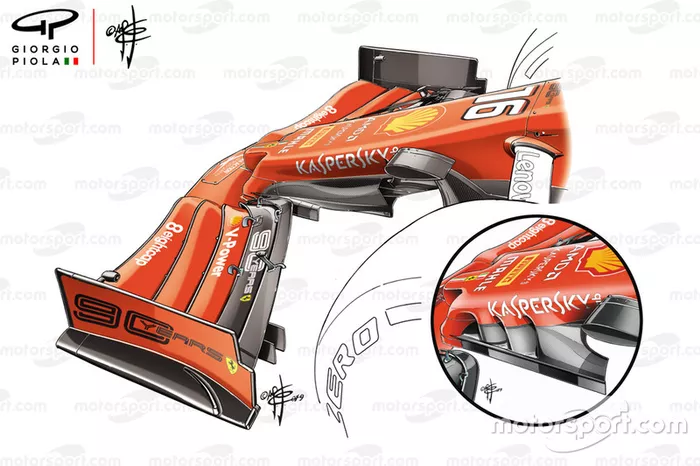
The update centres on a solution that we’ve seen proliferate the grid since Mercedes first utilised the concept at the start of 2017 – an under-nose cape. In Ferrari’s case it has added their cape to the previous nose structure, doing away with the elongated and slotted wing pillars (inset) in the process.
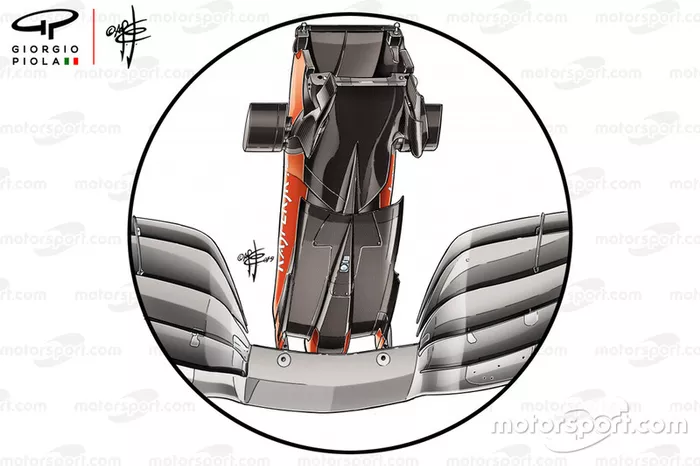
The sled-like structure not only influences the airflow’s path downstream, further amplifying key aerodynamic structures such as the bargeboards, but also repositions the car's aerodynamic centre of pressure (CoP), putting it a little more 'on the nose', which is likely aided by the dividing keel under the nose in yaw.

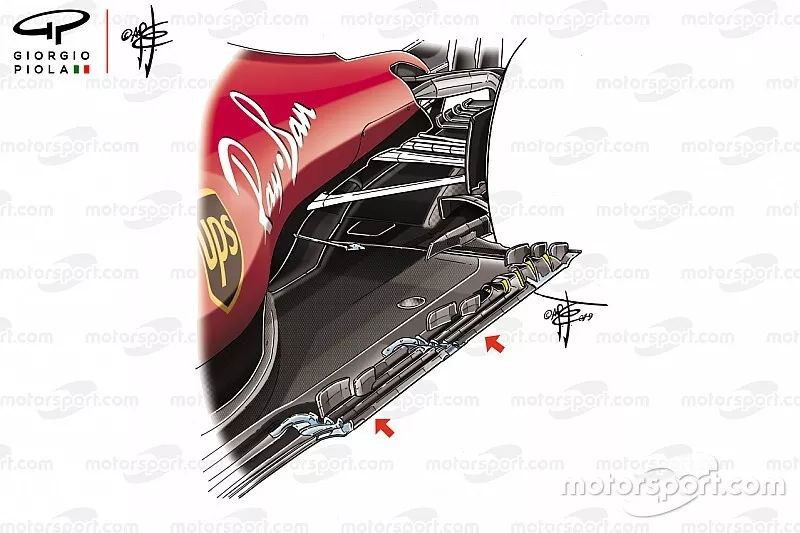
To take advantage of the newfound front-end performance, and to balance and improve flow stability around the rear end of the car, the team stiffened the slots on the edge of the floor, incorporating metal inserts in the areas that are prone to flex. Fluctuations in the slot gaps would have previously led to compromised performance, which in-turn would reduce the effectiveness of the tyre squirt slots ahead of the rear tyre (highlighted in yellow).
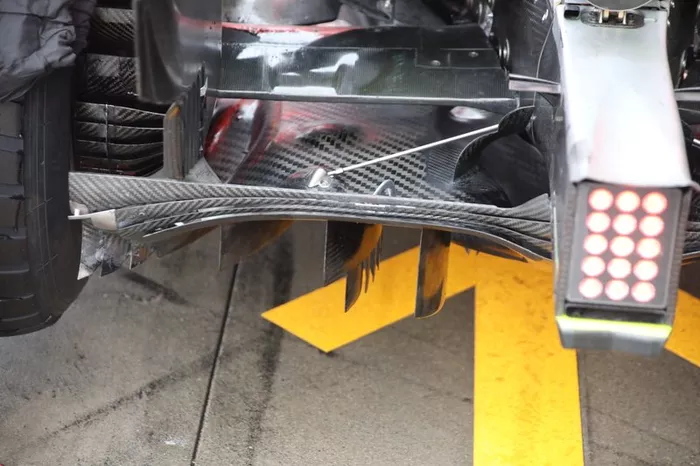
Ferrari also took this as an opportunity to revisit a diffuser development that was tested in France but didn’t deliver the performance uplift that was anticipated. The changes centre on the Gurney-style flaps that populate the periphery of the upper and outer sections of the diffuser.
4
Mercedes plays the longer game
While the resurgence of Ferrari over the last few races has added to the spectacle, and brings us hope of a better or closer end to the 2019 season, Mercedes is already eyeing gains it may be able to make for 2020.

The regulations will remain relatively stable for 2020, but we will see a change from Pirelli in how the tyres deliver their performance and teams will have to adjust accordingly. With this in mind, Mercedes, which has been at the forefront of hydraulic suspension elements since before the hybrid era, has begun testing a revised ‘heave’ element.
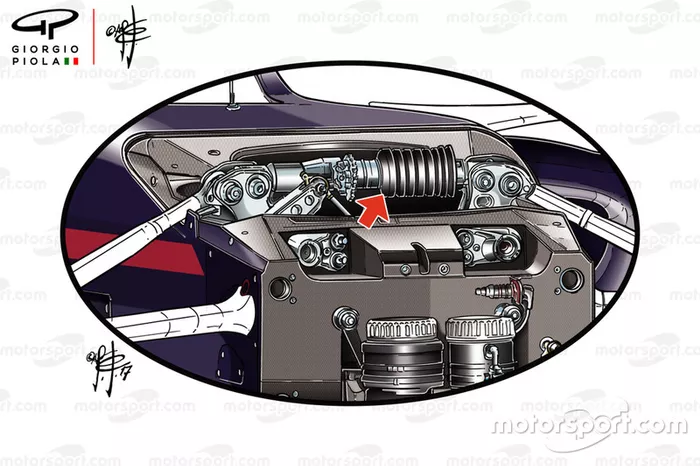
The solution Mercedes is testing has seen continuous use by other teams throughout the last few years, like Red Bull.
2
Red Bull slips off the pace
Although magnified by Ferrari’s sudden turn of speed, Red Bull has fallen back to third place in the pecking order – despite races at tracks where it was expected to excel and repeat its form before the summer break.
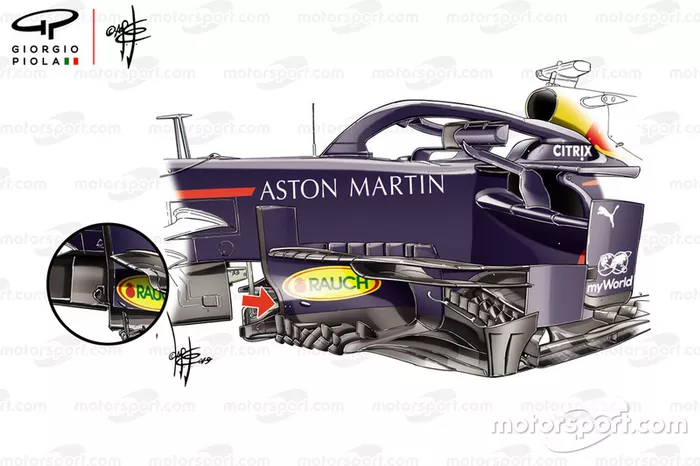
Red Bull has fallen a little behind its rivals partly due to the power unit penalties, and partly due to the rate of development being made around them. However, in Singapore the team applied an update of its own, reprofiling the leading edge of the bargeboards and exposing the splitter to more flow.
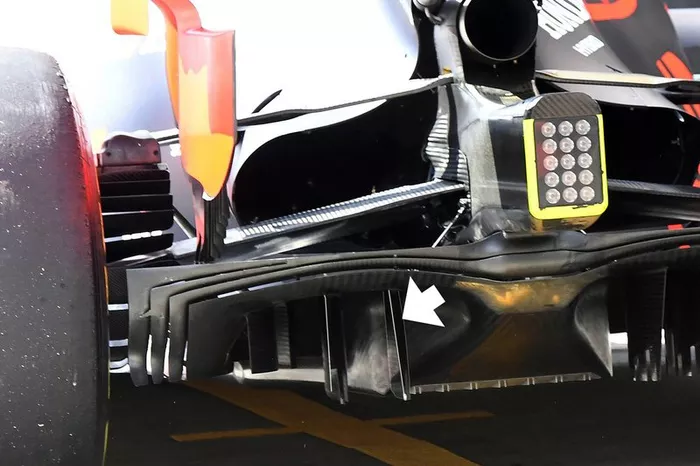
This was paired with a change at the rear of the car, as the team added two slots in the base of the two innermost strakes while making a novel change to innermost strake (white arrow) as it tilted it from the vertical.
2
We want your opinion!
What would you like to see on Motorsport.com?
Take our 5 minute survey.
- The Motorsport.com Team
Read and post comments
Read also :
Share Or Save This Story
Copy link
Share on Viber
Previous article Hulkenberg: Renault “deserved better” than “bitter” Sochi
Next article Wolff: Recent Ferrari engine gains "an outlier"
Top Comments
There are no comments at the moment. Would you like to write one?
View More & Comment
More from
Matthew Somerfield

Haas reveals its major F1 United States Grand Prix update
Formula 1
Formula 1
United States GP
Oct 20, 2023
Haas reveals its major F1 United States Grand Prix update
British GP: F1 technical images from the pitlane explained
Formula 1
Formula 1
British GP
Jul 9, 2023
British GP: F1 technical images from the pitlane explained
Australian GP: F1 technical images from the pitlane explained
Formula 1
Formula 1
Australian GP
Mar 30, 2023
Australian GP: F1 technical images from the pitlane explained
Latest news
2026 MotoGP Valencia Grand Prix – How to watch, session times & more
MotoGP
MGP MotoGP
Valencia GP
48 min
2026 MotoGP Valencia Grand Prix – How to watch, session times & more

Mercedes boss Toto Wolff reveals why rival F1 teams never try to hire him
Formula 1
F1 Formula 1
Las Vegas GP
6 h
Mercedes boss Toto Wolff reveals why rival F1 teams never try to hire him
Jack Miller to revive unraced Australian GP livery for MotoGP farewell
MotoGP
MGP MotoGP
Valencia GP
9 h
Jack Miller to revive unraced Australian GP livery for MotoGP farewell
Max Verstappen without Gianpiero Lambiase at Qatar GP as Tom Hart steps in
Formula 1
F1 Formula 1
Qatar GP
10 h
Max Verstappen without Gianpiero Lambiase at Qatar GP as Tom Hart steps in
Feature
Discover prime content


Top 10 F1 cars of the 1990s
Formula 1
By Kevin Turner
Top 10 F1 cars of the 1990s

Subscribe and access Motorsport.com with your ad-blocker.
From Formula 1 to MotoGP we report straight from the paddock because we love our sport, just like you. In order to keep delivering our expert journalism, our website uses advertising. Still, we want to give you the opportunity to enjoy an ad-free and tracker-free website and to continue using your adblocker.
You have 2 options:
- Become a subscriber.
- Disable your adblocker.
Subscribe now Already subscribed? Sign in here
Already disabled your adblocker?
Reload page
Manage Alerts
Subscribe