Analysis
Formula 1
Tech analysis: How Red Bull assimilated a Mercedes concept
Red Bull's 2016 challenger was the first in a number of years not to feature an 'S' duct, as the team sought to maximise room for suspension componentry rather than apportion space for aerodynamic pipework.
Matt Somerfield Giorgio Piola
Edited: Mar 30, 2017, 1:45 PM
Copy link
Share on Viber
Giorgio Piola's F1 technical analysis
Giorgio Piola is the preeminent Formula 1 technical journalist. View our full selection of Giorgio's technical illustrative content
For 2017, the designers have looked at how Mercedes and Toro Rosso achieved the packaging of their solutions last season and assimilated it into their own design.
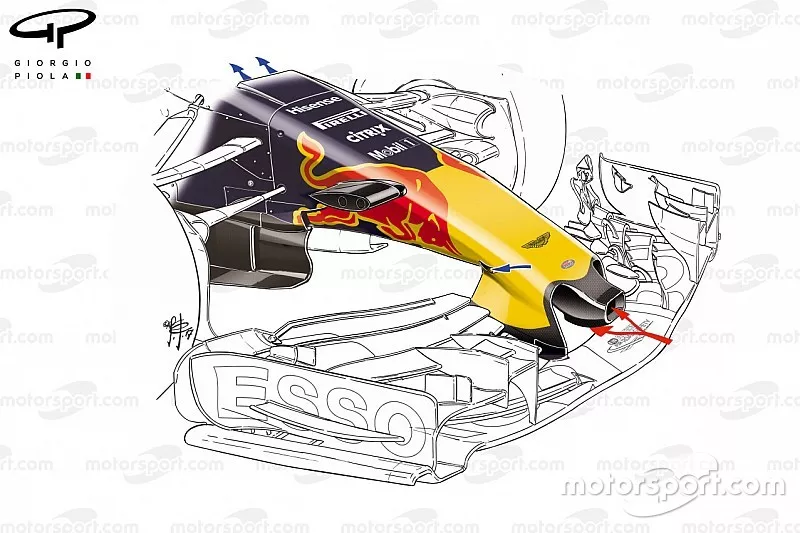
Of course we know most of the talk about its nose centered on the inlet in the nose tip in the early stages but as we've already talked about this, the main focus is the movement of air from a forward point on the nose and the channeling of it through the nose to the upper surface of the chassis.
As we can see (above) air is taken in around the nose pylons and is ejected out of the upper chassis panel (blue arrows).

Red Bull Racing RB13, inlets comparison
Photo by: Giorgio Piola
This is contrary to the previous solutions used by numerous teams, including Red Bull itself, who used to take air in 150mm ahead of the front wheel centreline (RB11 shown, right), using an S-shaped duct to channel the air ahead of the bulkhead, hence the name.
With the nose placed in position, the air is channeled through internal pipework to the vanity panel (RB13, left) which features three separate ducts in order to direct the airflow more efficiently.
Driver cooling remains the role of the small ducts at the base of the chassis, as has been the case throughout the RB10-13 lineage of cars.
Williams front wing

Williams F40, front wing detail
Photo by: Giorgio Piola
The change in regulations for 2017 will undoubtedly see more major changes as the designs mature. However, for the time being the teams have built on the philosophies they've already been using.
Williams' 2017 front wing is one such example, with the width increased to suit the new regulations, whilst changes have been made to the outer section of the wing to deal with the additional tyre width.
Two triangular canards have been added to the upper surface of the endplate (arrowed) whilst an enlarged canard sits behind the main cascade, in order that the airflow hits the front face of the tyre and moves around it more efficiently.
We want your opinion!
What would you like to see on Motorsport.com?
Take our 5 minute survey.
- The Motorsport.com Team
Read and post comments
Read also :
Share Or Save This Story
Copy link
Share on Viber
Previous article Haas "annoyed with missed opportunity" after Australia
Next article Liberty Media retains two Ecclestone era execs in pivotal F1 roles
Top Comments
There are no comments at the moment. Would you like to write one?
View More & Comment

More from
Matt Somerfield

Gallery: How F1 tech evolved during the 2024 season
Formula 1
Formula 1 Dec 31, 2024
Gallery: How F1 tech evolved during the 2024 season
How McLaren’s rear wing push changed the game in F1
Formula 1
Formula 1 Dec 20, 2024
How McLaren’s rear wing push changed the game in F1
How 2026 F1 rules will help avoid identikit designs
Formula 1
Formula 1 Dec 16, 2024
How 2026 F1 rules will help avoid identikit designs

More from
Red Bull Racing

Max Verstappen responds to George Russell after Vegas clash
Formula 1
Formula 1
Las Vegas GP
1 h
Max Verstappen responds to George Russell after Vegas clash
George Russell slams Max Verstappen after Las Vegas clash: ‘He walks around like he’s bigger and better than everyone’
Formula 1
Formula 1
Las Vegas GP
2 h
George Russell slams Max Verstappen after Las Vegas clash: ‘He walks around like he’s bigger and better than everyone’
Latest news
Lando Norris frustrated by McLaren's "shocking" top speed at Las Vegas GP qualifying
Formula 1
F1 Formula 1
Las Vegas GP
Lando Norris frustrated by McLaren's "shocking" top speed at Las Vegas GP qualifying
“We lost one second down the straight” – Charles Leclerc upset with Ferrari’s “crazy” Las Vegas deficiency
Formula 1
F1 Formula 1
Las Vegas GP
39 min
“We lost one second down the straight” – Charles Leclerc upset with Ferrari’s “crazy” Las Vegas deficiency
Super Formula Suzuka: Kakunoshin Ohta secures title in dramatic fashion as Ayumu Iwasa wins Race 1
Super Formula
SF Super Formula
Suzuka II
1 h
Super Formula Suzuka: Kakunoshin Ohta secures title in dramatic fashion as Ayumu Iwasa wins Race 1
Max Verstappen responds to George Russell after Vegas clash
Formula 1
F1 Formula 1
Las Vegas GP
1 h
Max Verstappen responds to George Russell after Vegas clash
Feature
Discover prime content

Top 10 F1 cars of the 1980s
Formula 1
By Kevin Turner
Top 10 F1 cars of the 1980s
Subscribe and access Motorsport.com with your ad-blocker.
From Formula 1 to MotoGP we report straight from the paddock because we love our sport, just like you. In order to keep delivering our expert journalism, our website uses advertising. Still, we want to give you the opportunity to enjoy an ad-free and tracker-free website and to continue using your adblocker.
You have 2 options:
- Become a subscriber.
- Disable your adblocker.
Subscribe now Already subscribed? Sign in here
Already disabled your adblocker?
Reload page
Manage Alerts
Subscribe