Analysis
Formula 1
Tech analysis: How F1 finds drag reduction through waved wings
Newcomers Haas used a spectacular-looking rear wing at the Italian Grand Prix, in order to deal with the demands of the Autodromo Nazionale Monza circuit. But it's not the first team to try this approach...
Giorgio Piola Matt Somerfield
Edited: Sep 11, 2016, 6:35 PM
Copy link
Share on Viber
Giorgio Piola's F1 technical analysis
Giorgio Piola is the preeminent Formula 1 technical journalist. View our full selection of Giorgio's technical illustrative content
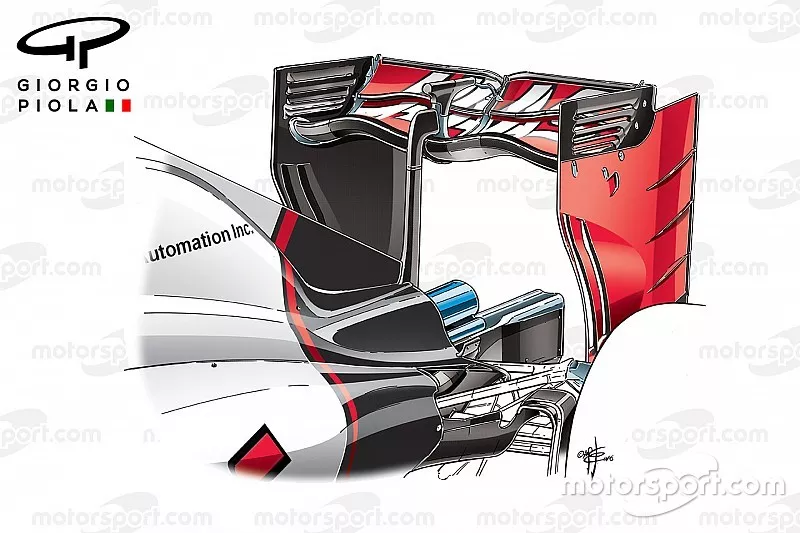
The wing features several geometric surface changes that fulfill both downforce and drag reduction roles. In a similar vein to Mercedes' ‘Spoon’ wing, it has a deeper-dished central section - but, rather than going out to a shorter chord as the flaps go out to the endplate, it sweeps back to a taller chord again.
Both designs are achieving similar goals but going about it in differing ways, with Haas retaining the usual endplate configuration to displace and lessen the tip vortex.

Renault R30 and R31 rear wings comparison
Photo by: Giorgio Piola
Perhaps the closest solution to the one run by Haas is Renault’s from 2010, when the R30 was also outfitted with a similar ‘double-wave’-style arrangement.
Renault may have run it for much longer into that season too, if it wasn't for the huge commitment put into the F-Duct system (lower-right, inset), which, it could be argued, was one of the best in the field by the end of the season.
With the F-Duct banned and DRS introduced for 2011, the team ran a similar wing on the R31 in free practice at Montreal (lower-left, inset) but didn’t get the desired result and chose to run the standard configuration instead.
This got us thinking - down the years we've seen numerous ‘Monza specials’ and, certainly in the past, teams have courted interesting solutions for circuits like Montreal and Spa, where drag reduction is paramount to overall laptime, but downforce cannot be fully conceded.
As such, we delved through the recent archive to show you the likes of Honda’s RA108 rear wing, which also featured the double-wave design, and created the following video.
We want your opinion!
What would you like to see on Motorsport.com?
Take our 5 minute survey.
- The Motorsport.com Team
Read and post comments
Read also :
Share Or Save This Story
Copy link
Share on Viber
Previous article Liberty should introduce “proper franchise system” in F1 – Force India
Next article F1 needs rules rethink for sake of fans, says Briatore
Top Comments
There are no comments at the moment. Would you like to write one?
View More & Comment
More from
Giorgio Piola
The fascinating story behind McLaren's most iconic F1 car
Formula 1
Formula 1 Apr 3, 2024
The fascinating story behind McLaren's most iconic F1 car

Emilia Romagna GP: F1 technical images from Imola's pitlane
Formula 1
Formula 1
Emilia Romagna GP
Apr 21, 2022
Emilia Romagna GP: F1 technical images from Imola's pitlane
The F1 downforce choices that proved key at the Saudi GP
Formula 1
Formula 1
Saudi Arabian GP
Mar 29, 2022
The F1 downforce choices that proved key at the Saudi GP
Latest news
Toyota, M-Sport weigh in on the WRC 2027 Rally1-vs-Rally2 debate
WRC
WRC WRC
Rally Saudi Arabia
56 min
Toyota, M-Sport weigh in on the WRC 2027 Rally1-vs-Rally2 debate

Fernando Alonso returns to Dakar: Why his first rally-raid experience was a shock to the system
Dakar
DAKR Dakar 2 h
Fernando Alonso returns to Dakar: Why his first rally-raid experience was a shock to the system
How the F1 2026 regulations neutered Oscar Piastri's "real strength"
Formula 1
F1 Formula 1
Las Vegas GP
2 h
How the F1 2026 regulations neutered Oscar Piastri's "real strength"

Feature
Discover prime content



Top 10 F1 cars of the 1980s
Formula 1
By Kevin Turner
Top 10 F1 cars of the 1980s
Subscribe and access Motorsport.com with your ad-blocker.
From Formula 1 to MotoGP we report straight from the paddock because we love our sport, just like you. In order to keep delivering our expert journalism, our website uses advertising. Still, we want to give you the opportunity to enjoy an ad-free and tracker-free website and to continue using your adblocker.
You have 2 options:
- Become a subscriber.
- Disable your adblocker.
Subscribe now Already subscribed? Sign in here
Already disabled your adblocker?
Reload page
Manage Alerts
Subscribe