Analysis
Formula 1 United States GP
Is ride height the hidden key to Red Bull and Max Verstappen's F1 resurgence?
What exactly is behind Red Bull’s “spectacular” progress? While many in the paddock point to ride height, team principal Laurent Mekies insists no single factor dominates

Ronald Vording
Published: Oct 21, 2025, 10:15 AM
Copy link
Share on Viber
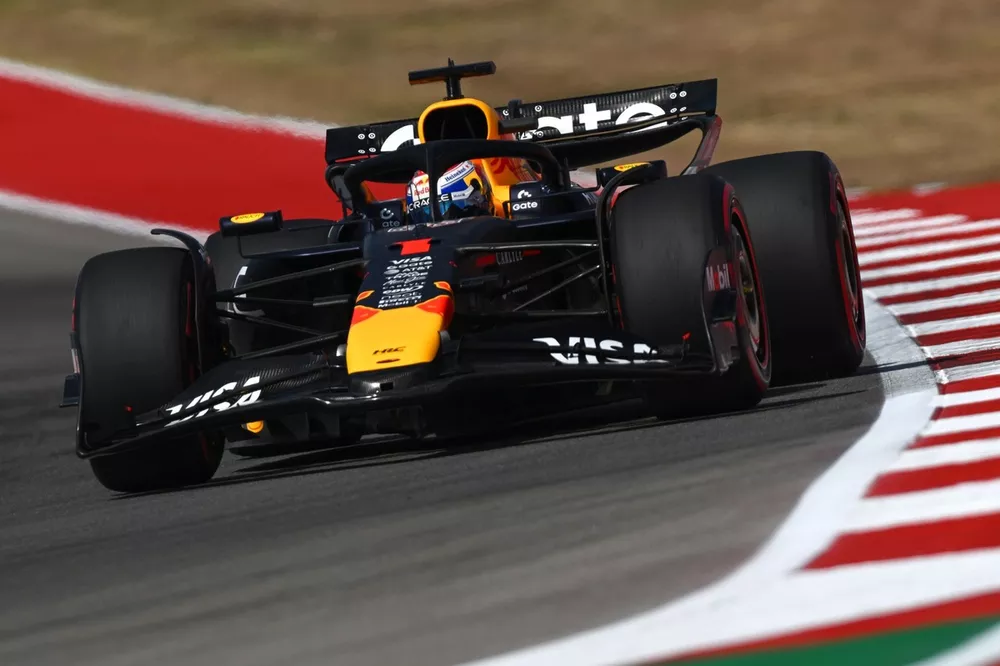
Red Bull Racing’s rise during the second half of the F1 season has been, to use Laurent Mekies’ own words from Singapore, “spectacular”. Since the summer break, Max Verstappen hasn’t finished lower than second. The pure pace wasn’t there in Zandvoort, but from then on, the form has been impressive: three wins (Monza, Baku, and Austin) and a sprint victory.
It confirms that Red Bull’s resurgence isn’t limited to one specific type of circuit. After triumphs on two low-downforce tracks, Singapore was expected to be a real test. Then came question marks over the medium-speed corners in Austin – yet Red Bull passed all those tests. Admittedly, the pure race pace in Texas wasn’t much better than McLaren’s – or Lando Norris’ – but the fact that Verstappen could at least operate at the same level already marks a huge contrast to earlier in the year.
The key question, of course, is what lies behind this turnaround. Verstappen admitted in Singapore that the new floor, introduced in Monza, has helped – but said it wasn’t the main factor.
“It’s more about a different philosophy,” he said. That new philosophy partly concerns how the team operates before and during a race weekend: listening more to the driver, relying less blindly on data. But that’s not the entire story. Mekies and senior advisor Helmut Marko have both added that it’s also about how Red Bull “runs the car”, and that particular element is interesting.
Stella would “bet his dollar” on ride height understanding
During the Austin weekend, McLaren team principal Andrea Stella shared his theory about Red Bull’s progress. Part of the explanation, naturally, is that Red Bull continued developing its 2025 car longer than McLaren, but according to Stella there's more.
“I think if they have improved their car, it is because they might have fixed some potential aerodynamic issues,” Stella said. “We know, like I said before, that there was a new floor in Monza and a new front wing in Singapore. And also, I think their drivers seem to be much more vocal about ride and about grounding. So it could be that they have simply understood that this generation of cars and their own car as well needs to be run challenging some aspects like ride heights. For me, if I needed to or if I had to speculate, this would be where I would put my $1.”
Charles Leclerc, Ferrari, Lando Norris, McLaren, Max Verstappen, Red Bull Racing
Photo by: Michael Potts / LAT Images via Getty Images
It’s well known that ground-effect cars must run as low as possible – and with particularly stiff suspension – to extract maximum performance. More than 60 percent of the total amount of downforce is generated underneath the car's floor. A lower ride height increases the suction effect of the ground effect and, together with the floor edges, helps to seal the airflow underneath the floor to maintain optimal pressure differences: lower pressure under the floor, higher pressure alongside it. These fundamentals have long been understood, but Stella’s impression is that, thanks to the Monza floor and a better grasp of how to use it, Red Bull can now run with lower ride heights than before – unlocking more potential from the RB21.
The ideal picture: unlocking rear downforce and front plank wear
This ties into an interesting talking point of last weekend – given the bumpy nature of the Circuit of the Americas: plank wear. Because ride height is so crucial, many teams try to run as low as possible, though there’s a limit. After any race, the FIA can check plank wear and the skid blocks (the titanium plates that create sparks). These checks are made using four measurement holes in prescribed locations on the plank, in line with article 3.5.9f of the technical regulations.
After a race, the plank must still measure at least 9mm thick at those points, meaning it may wear no more than 1mm during the race. That limit applies to the measurement holes, meaning other parts of the floor can theoretically wear more – as long as those zones pass inspection.
According to Sauber sporting director Inaki Rueda teams have made (varying) progress in lowering ride height without breaching those wear limits. Interestingly, different teams wear different parts of the plank more heavily – which is also seen in the FIA measurements. Most teams experience the greatest wear on the rear half of the plank, but McLaren has for some time already managed to wear the front of the plank more — which has several benefits.
“It is inherent in the car, but there are some mechanisms by which – with the stiffness of the suspension – you try to make it so that your weak point doesn't get as loaded as possible,” Rueda explained in Austin. That, he said, is crucial.
“Whichever team has managed to put it to the front, that means they are actually able to run the car lower than the rest of us. So, this is something quite clever. Whoever has managed to shift that wear to the front is probably able to run it lower than the rest of us, and thus get a competitive advantage.”
It’s directly linked to how the floor works and where it generates most of its downforce. “Exactly, because most of the downforce comes from where the driver is sitting towards the back. So that's where you really want the floor to be close to the ground. But if your main point of wear is back there, you need to raise the car at that point, and then you lose downforce at that point. And yes, a lot of design effort has been spent on trying to migrate that wear to the front, so that you can run it low. But it's not an easy task.”
Max Verstappen, Red Bull Racing
Photo by: Jim Watson / AFP via Getty Images
That challenge links to the suspension and kinematics. “It’s difficult to move the wear forward because of the fact that the actual downforce is generated in the rear. So, you need to find a way that you're still running all the downforce at the back, but that your main point of contact is at the front.”
That, in essence, is the puzzle every F1 team faces under the current regulations. McLaren was first to achieve that forward wear shift, but paddock suggestions indicate that Red Bull has at least made steps to lower the ride height in recent weeks as well – allowing it to extract more from the RB21.
Marko confirms ride height theory, Mekies more cautious
When Motorsport.com asked Helmut Marko about these ride height theories in the paddock – and whether the analysis is correct that Red Bull can now indeed run the car a bit lower than before – the Austrian smiled: “It's not a wrong one.”
It fits in with what Red Bull has been saying in recent weeks: improved understanding of how to operate the car and the introduction of the Monza floor have been key to the improved form. Asked whether such ride height progress would have been possible without that new Monza floor, Marko replied: “It wouldn't have been with such an effect.”
Team principal Laurent Mekies, however, prefers to remain cautious.
“I would certainly not be able to pinpoint one single element, such as one upgrade or one set of items,” he replied when asked by Motorsport.com. “I think it will be largely minimising the amazing analysis job that has been done to try to identify where the untapped areas of performance were, and the effort to put the car in these areas and to see if it was going to perform. It's not a combination of one factor, it's a combination of many, many factors.”
“We don't have a big incentive to explain to anyone what it is, but it's a combination of all that. And of course, every hundredth counts and the Monza floor has helped. Every single small detail that we've put on the car has helped, whether it is mechanically or aerodynamically. And this, together with that extensive exploration of where to run the car, has helped us on the performance.”
Read Also:
Formula 1Helmut Marko admits Red Bull “had already given up” before Laurent Mekies reset
Formula 1Max Verstappen: Anyone predicting my F1 2025 turnaround would've been an "idiot"
While Mekies is right that modern Formula 1 is too complex to reduce to a single cause, the floor and ride height that comes with it remain fundamental to a car’s performance. And on that front, Red Bull appears to have taken a significant step after the summer break, through both the Monza floor and a clearer understanding of how to use it without disturbing the overall car balance.
That progress has helped Red Bull find the RB21’s operating window more consistently than before, and unlock performance that according to Verstappen had been there for longer – at least to some extent. Whether that step forward has come in time for a fifth consecutive title remains to be seen – but it has unquestionably made Red Bull a major force again after some difficult months. In fact, over the past four race weekends, it’s done even more than that.
We want your opinion!
What would you like to see on Motorsport.com?
Take our 5 minute survey.
- The Motorsport.com Team
Read and post comments
Read also :
Share Or Save This Story
Copy link
Share on Viber
Previous article Jenson Button warns "confidence is with Lando Norris, negativity is more with Oscar Piastri"
Next article McLaren boss Zak Brown apologised to Nico Hulkenberg after F1 US GP clash
Top Comments
There are no comments at the moment. Would you like to write one?
View More & Comment

More from
Ronald Vording

Max Verstappen on Ferrari clashes: "I would never sign two number-one drivers"
Formula 1
Formula 1
Sao Paulo GP
2 d
Max Verstappen on Ferrari clashes: "I would never sign two number-one drivers"

What's behind Oscar Piastri's split with Mark Webber – and what it means for his F1 career
Formula 1
Formula 1
Sao Paulo GP
5 d
What's behind Oscar Piastri's split with Mark Webber – and what it means for his F1 career
More from
Helmut Marko

Helmut Marko lands new Austrian GP role after Red Bull retirement
Formula 1
Formula 1
Bahrain GP in Malaysia
7 mo
Helmut Marko lands new Austrian GP role after Red Bull retirement
Helmut Marko details what Red Bull has to do to keep Max Verstappen
Formula 1
Formula 1
Bahrain Pre-Season 1
9 mo
Helmut Marko details what Red Bull has to do to keep Max Verstappen

Helmut Marko reflects on Red Bull era with Max Verstappen: "No one could have imagined"
Formula 1
Formula 1
Haas launch
9 mo
Helmut Marko reflects on Red Bull era with Max Verstappen: "No one could have imagined"

More from
Red Bull Racing
“I was getting beat up” – How Daniel Ricciardo burned out on ‘humiliating’ F1 return
Formula 1
Formula 1 23 h
“I was getting beat up” – How Daniel Ricciardo burned out on ‘humiliating’ F1 return
Latest news
‘Lewis suspected a conspiracy’ – Nico Rosberg explains how Lewis Hamilton F1 rivalry went awry at Mercedes
Formula 1
F1 Formula 1 21 min
‘Lewis suspected a conspiracy’ – Nico Rosberg explains how Lewis Hamilton F1 rivalry went awry at Mercedes
BMW "proud of what we achieved" after securing runner-up in 2026 WEC
WEC
WEC WEC
Monza
1 h
BMW "proud of what we achieved" after securing runner-up in 2026 WEC
The numbers that reveal how sprint races have turned the MotoGP title fight upside down
MotoGP
MGP MotoGP
Qatar GP
3 h
The numbers that reveal how sprint races have turned the MotoGP title fight upside down
2027 Formula E drivers and teams: The line-up so far
Formula E
FE Formula E 5 h
2027 Formula E drivers and teams: The line-up so far
Feature
Discover prime content

Top 10 F1 cars of the 1970s
Formula 1
By Kevin Turner
Top 10 F1 cars of the 1970s
Subscribe and access Motorsport.com with your ad-blocker.
From Formula 1 to MotoGP we report straight from the paddock because we love our sport, just like you. In order to keep delivering our expert journalism, our website uses advertising. Still, we want to give you the opportunity to enjoy an ad-free and tracker-free website and to continue using your adblocker.
You have 2 options:
- Become a subscriber.
- Disable your adblocker.
Subscribe now Already subscribed? Sign in here
Already disabled your adblocker?
Reload page
Manage Alerts
Subscribe