Special feature
Formula 1
Retro F1 tech: The focus on safety
Motorsport.com looks back at how changes to the Formula 1 regulations affected the landscape of the sport in the past. Part 2: the 1990s and the early 2000s.

Matt Somerfield
Published: Feb 20, 2017, 3:31 PM
Copy link
Share on Viber
As the sport entered the noughties, the FIA and then-president Max Mosley looked to reign in the cost to compete in Formula 1, the first act being a single-engine specification, as 3-litre V10's became the order of the day.
Unable to effectively police the use of traction control, the FIA permitted its use again in 2001, banned the use of beryllium alloys, stipulated a maximum of three rear wing elements and increased the size of the safety cell and cockpit template.
Testing was also placed under the microscope with limitations imposed in 2003 that were designed to help the smaller teams, whilst the HANS device became a mandatory addition to the drivers' apparel.

Ferrari F2004 (655) 2004 side view
Photo by: Giorgio Piola
The next big chapter in Formula 1's technical framework came in 2004 when the FIA instructed teams that an engine must last an entire race weekend and, while further efforts were made to ban traction control, the teams were able to retain it due to the mooted increase in cost.

Regulation changes for 2004 - ngine cover and rear wing
Photo by: Giorgio Piola
Changes to the engine cover were also made, creating a minimum cross section in order that the cover not be made infinitely smaller.
The rear wing regulations were also refreshed, limiting the designers to just two upper elements, eliminating the forward elements that had become envogue, whilst changes to the endplate length were also invoked.
Often regarded as one of the key machines in the sports history, the F2004 allowed both Ferrari and Michael Schumacher to sweep the drivers' and constructors' titles for a fifth straight year.
In his recent book, Ross Brawn talks about his philosophy of creating a unified working structure at Maranello; the F2004 was the culmination of this effort with every aspect of the car designed to work harmoniously with the other.
The imperious V10 delivered unrivalled power and reliability at a point when the warring tyre manufacturers development had piqued, with Bridgestone throwing their weight behind the Scuderia.
Further restrictions continued to be placed on the teams in 2005, firstly in terms of aero, followed by a requirement that the engine would last two race weekends.
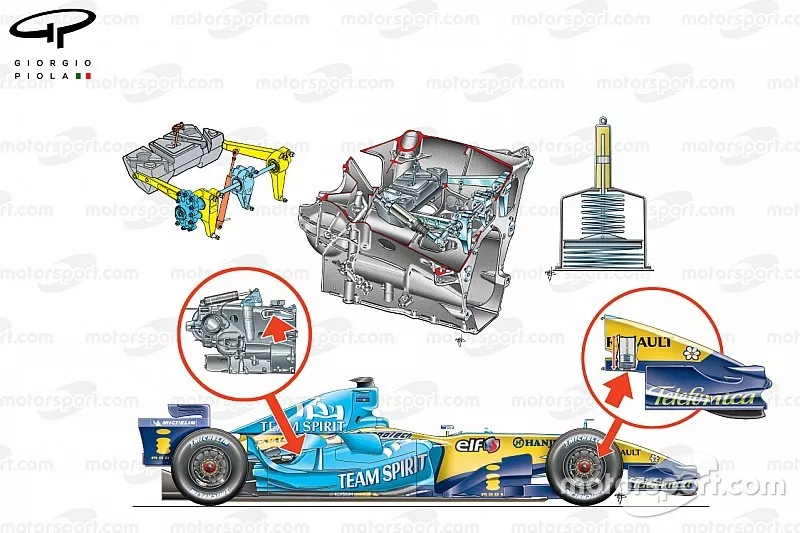
By far the most innovative element of this period was the use of mass damping, pioneered by Renault and subsequently adopted by others in the field

Renault R26 2006 exploded overview
Photo by: Giorgio Piola
Renault's earlier adaptation meant the pace of its development far outranked its adversaries and, after the French team's 2005 title, it was swiftly followed by a more advanced version.
It was a fairly simplistic idea, with a weight suspended firstly in the nose box and latterly at the rear of the car to be able to counter the forces acting on the chassis and to help stabilise both it and the tyre.
We want your opinion!
What would you like to see on Motorsport.com?
Take our 5 minute survey.
- The Motorsport.com Team
Read and post comments
Read also :
Share Or Save This Story
Copy link
Share on Viber
Previous article “The anniversary car for the new era” – Sauber reveals its 2017 F1 machine, the C36
Next article Christian Horner: Red Bull has “absolutely the most exciting driver pairing on the 2017 F1 grid”
Top Comments
There are no comments at the moment. Would you like to write one?
View More & Comment

More from
Matt Somerfield

Gallery: How F1 tech evolved during the 2024 season
Formula 1
Formula 1 Dec 31, 2024
Gallery: How F1 tech evolved during the 2024 season
How McLaren’s rear wing push changed the game in F1
Formula 1
Formula 1 Dec 20, 2024
How McLaren’s rear wing push changed the game in F1
How 2026 F1 rules will help avoid identikit designs
Formula 1
Formula 1 Dec 16, 2024
How 2026 F1 rules will help avoid identikit designs
Latest news
‘Aprilia lost the championship because it was up against Marc Marquez,’ says Alex
MotoGP
MGP MotoGP
Portuguese GP
12 min
‘Aprilia lost the championship because it was up against Marc Marquez,’ says Alex
Marc Marquez fails to deny MotoGP retirement rumours
MotoGP
MGP MotoGP
Portuguese GP
49 min
Marc Marquez fails to deny MotoGP retirement rumours
IndyCar 2026 season review: Andretti Global
IndyCar
Indy IndyCar 55 min
IndyCar 2026 season review: Andretti Global
Wright Motorsports adds second Porsche for 2027 Michelin Endurance Cup
IMSA
IMSA IMSA 1 h
Wright Motorsports adds second Porsche for 2027 Michelin Endurance Cup
Feature
Discover prime content
Top 10 F1 cars of the 1980s
Formula 1
By Kevin Turner
Top 10 F1 cars of the 1980s


Subscribe and access Motorsport.com with your ad-blocker.
From Formula 1 to MotoGP we report straight from the paddock because we love our sport, just like you. In order to keep delivering our expert journalism, our website uses advertising. Still, we want to give you the opportunity to enjoy an ad-free and tracker-free website and to continue using your adblocker.
You have 2 options:
- Become a subscriber.
- Disable your adblocker.
Subscribe now Already subscribed? Sign in here
Already disabled your adblocker?
Reload page
Manage Alerts
Subscribe