


Red Bull’s "big advantage" with 2026 F1 rules
Engine project is said to be behind the competition but team believes Max Verstappen will be its killer advantage

Max Verstappen, Red Bull Racing
Photo by: Rudy Carezzevoli / Getty Images
For the past few months a phoney war has been brewing in the Formula 1 paddock, as gossip has circulated about the state of preparations for the all-new regulations coming next season.
Specifically, well-connected sources have repeatedly claimed that Red Bull’s new in-house engine project is some way short of where it needs to be, while Mercedes is said to be in the best shape.
Although this may or may not be true, ahead of when the hybrid powertrains were introduced in 2014, mutterings to the effect that Mercedes had found a solution to the ERS-H issues which bedevilled all the other engine manufacturers turned out to be bang on the money.
While the ERS-H has been dropped from the new regulations for precisely this reason, the requirement for the electrical system to provide 50% of the power has brought challenges of its own in terms of managing the available power throughout the lap.
Five years ago Red Bull went on a recruitment spree to build its own in-house powertrain division, as Honda indicated it would withdraw from F1. Despite input from Ford, and the headhunting of senior figures from Mercedes in particular – including technical director Ben Hodgkinson – it was exceedingly ambitious to expect to be able to build a competitive powertrain immediately from a standing start.
But Red Bull’s motorsport advisor Helmut Marko, while treading around the subject of where the new powertrain might stack up relative to its competitors, was emphatic that Max Verstappen’s skillset would provide a decisive boost.
"Internally we are happy," he said, "but like the others we don't know the numbers from our competitors. But it's not only the combustion engine, it's fuel, it's battery... and the car. And it's also what I think is a big advantage for us.
"The driver has to be smart and clever how to use the power from the battery. And there is one driver who can drive fast and think. So that should be an advantage."

Max Verstappen, Red Bull Racing
Photo by: Frederic J. Brown / AFP Via Getty Images
Though he did not mention Verstappen by name, it was clear he was referring to the four-time world champion – for he, along with all the genuinely great drivers, requires so little thought to drive quickly that he retains a significant quantity of mental bandwidth to apply to racecraft.
The 2026 cars will place very different and complex demands on the drivers, hence the amount of negativity generated by their first evaluations in the simulator. On top of active aerodynamics, there will be an ‘override mode’ which deploys an extra burst of energy for a limited time, essentially replicating the effect of DRS.
But there are likely to be tremendous subtleties in terms of setting the cars up in the first place - as well as operating them on track. What the new regulations have done is couple energy management to aerodynamics: there will be hard choices to make regarding downforce levels and, once out on track, where to harvest energy and where to deploy it.
"Immense and plenty," was Red Bull chief engineer Paul Monaghan’s response, when asked how complex the 2026 project had been and how much work remained in the two months before the cars hit the track.
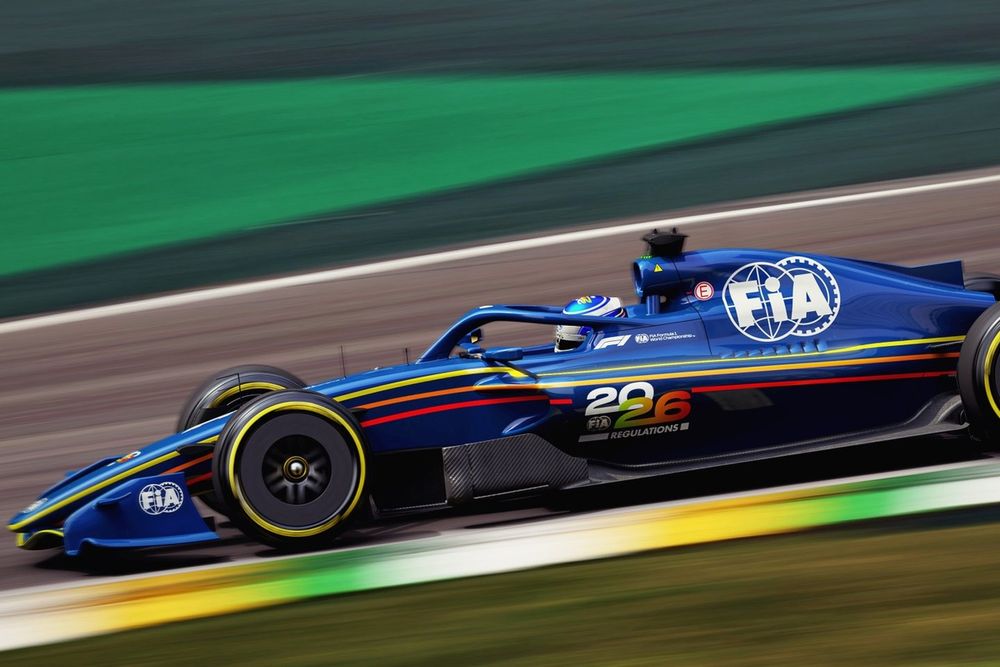
F1 concept
Photo by: FIA
"Two very simple words to sum it up. Some things are already set in stone. The engines are in manufacture. We've got large chunks of the car in manufacture. Getting a car to reliably do laps in a simulation world is proving quite difficult, but somehow we'll be ready for Barcelona [the first test, behind closed doors on 26-30 January], won't we? As will everybody else.
"How ready we will see – and then really it's quite a mountain to climb, 2026, but it's there for all of us to climb, isn't it?
"If we're at the summit first or if we're at the summit and others are already there, that's part of the sport. It's not a determined outcome. It's an unknown outcome and we I think can be competitive next year.
"I think we'll have a good car, a good engine. We've got awesome drivers so let's see how we get on."

Share Or Save This Story


'Senior moment' or breakdown of trust? The implications of Hamilton's Singapore GP meltdown

F1 Singapore GP live commentary and updates: Max Verstappen cruises to victory

Pierre Gasly questions FIA stewards' decision not to penalise Lando Norris after Singapore crash


Why Charles Leclerc failed to outbrake Max Verstappen in Turn 1 at Singapore GP

George Russell calls Red Bull "the team to beat" in F1, but Kimi Antonelli adds a key caveat

How the Bahrain GP in Malaysia exposed Red Bull’s hidden resurgence


Who slept worst last night: Nikola Tsolov

Who slept best last night: Max Verstappen

The hidden F1 performance differentiator nobody is talking about in 2026

How last-lap heartbreak turned the Bathurst 1000 on its head

Andrea Stella praises Lando Norris for reaction to Singapore GP sprint clash

Taylor Barnard secures Formula E future by joining Fortescue Zero
Why Charles Leclerc failed to outbrake Max Verstappen in Turn 1 at Singapore GP

'Senior moment' or breakdown of trust? The implications of Hamilton's Singapore GP meltdown

What we learned from the 2026 F1 Singapore GP sprint and qualifying

How Honda plans a return to being an F1 powerhouse

Why Red Bull's 'crazy' power unit success matters so much for F1
Subscribe and access Motorsport.com with your ad-blocker.
From Formula 1 to MotoGP we report straight from the paddock because we love our sport, just like you. In order to keep delivering our expert journalism, our website uses advertising. Still, we want to give you the opportunity to enjoy an ad-free and tracker-free website and to continue using your adblocker.


Top Comments