Formula 1 Hungarian GP
Why anti-lift rear suspension doesn’t always unlock instant F1 performance
Anti-lift rear suspension has become a trend in 2025, but here’s why implementing the novel idea doesn’t always make for a faster Formula 1 racer

Jake Boxall-Legge
Edited: Aug 8, 2025, 3:27 PM
Copy link
Share on Viber
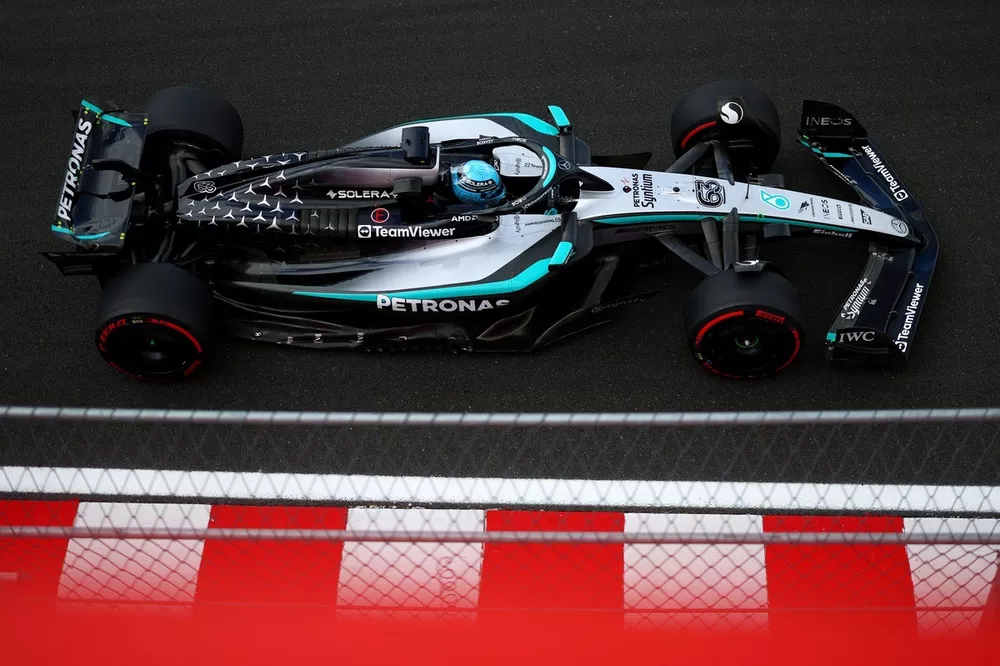
George Russell, Mercedes
Photo by: Zak Mauger / LAT Images via Getty Images
Mercedes eventually chose to end its on-off relationship with its rear suspension package, first pressed into action on its Formula 1 car at Imola, at the Hungarian Grand Prix. While not outwardly blamed for the team's general downturn in form, the revised suspension was seen as an obtrusive element in developing and understanding its W16 further.
What's known is that the package was aimed at reducing the rear axle lift under load. The theory in doing so is that the downward force on the rear tyres remains much steadier, and keeps the underbody at a static level to generate a consistent level of downforce.
The package was rolled out at Imola, then removed from the car at Barcelona and Monaco, and reintroduced at Montreal. At the Canadian circuit, Mercedes took its first (and so far, only) win of the season thanks to George Russell's starring turn in the Quebecois city.
Mercedes' trackside engineering director Andrew Shovlin contends that the Montreal conditions masked some of the stability issues that became apparent in recent races. This, arguably, prolonged the decision to abandon it for good, until the team had decided to take it off the car at the Hungaroring.
Other teams – Ferrari and McLaren among them – have opted for a suspension package with clear anti-lift properties. Shovlin explained in Hungary that even designing a rear suspension package in conjunction with a new gearbox (which contains the hard points for suspension mountings) is inherently driven by compromise – and this compromise is amplified by developing a new package for an existing gearbox design.
"The reality is even if you're designing a suspension and gearbox with a completely blank sheet of paper, it is an enormous compromise between where the aerodynamicists want to put all the legs, the various compliances, the kinematic characteristics, where the roll centres are... and it is impossible to actually set everything exactly where you want it to be," Shovlin explained.
Andrew Shovlin, Mercedes
Photo by: Sam Bloxham / LAT Images via Getty Images
"So the whole thing is a compromise, and that compromise is more extreme when you're doing it to an existing gearbox and an existing suspension – and the cost cap means that you can't just rip it all up and start again.
"The compromises that we might have faced could have been very different to those that Ferrari or McLaren had, so it's definitely getting into the subtle detail. McLaren have clearly made a great success of it, but it's not difficult to see how certain aspects can catch you out."
In F1's previous era, in which the floors were largely flat aside from the diffuser at the tail end, suspension layouts were largely set in stone; teams generally operated with a push-rod front suspension and pull-rod rear layout.
The suspension packages themselves could be tweaked, with some later designs offering some degree of flexibility at higher steering angles to keep the car's front end low for immediate downforce retention, but this was perhaps a small twist on an otherwise conventional solution.
However, the ground-effect floors are sensitive and require consistent ride heights to work across a range of cornering conditions. Although 1981's Lotus 88 is (by modern standards) a primitive example of this, the demands of maintaining the Venturi tunnels at a stable level were known even back then. In this case, the 'twin-chassis' 88 had a softly sprung inner chassis, and the outer chassis containing the tunnels was stiffly sprung to ensure the ground-effect floor maintained a consistent height.
Elio de Angelis, Lotus 88-Ford Cosworth
Photo by: Sutton Images
The contemporary anti-lift rear suspension route works to a not-dissimilar theory of keeping the floor at a static ride height. Developing the aerodynamic interface of the floor only produces marginal gains at this point, and thus teams have been keen to venture deeply into the kinematics involved to ensure the floors operate at their peak for longer.
Shovlin explained that external factors have also influenced the decisions to venture more into suspension development, particularly as teams have been keen to soak up their wind tunnel allowances with the incoming 2026 cars.
"I think it's the extent of how far you push it, not so much that lots of teams may well have had a percentage of anti-lift in the car, but what you could see that McLaren were doing was pushing that extremely hard.
"The fact is that as the aerodynamic gains from the regulations are starting to dwindle. You're finding smaller and smaller performance steps.
"The other fact is teams have to shift their wind tunnels on to next year's regulations. I think that naturally means that you start looking in other areas that you may not have explored as fully before.
"What you can find from the vehicle dynamics side is it's logical that towards the end of a set of regulations you start looking in areas that you might not have because the normal bread and butter of aero development starts to dry up."
Additional reporting by Ronald Vording
We want your opinion!
What would you like to see on Motorsport.com?
Take our 5 minute survey.
- The Motorsport.com Team
Read and post comments
Read also :
Share Or Save This Story
Copy link
Share on Viber
Previous article Chris Harris: Most people in the UK have got Max Verstappen wrong
Next article Liberty Media reports F1 revenue surge after success of Brad Pitt movie
Top Comments
There are no comments at the moment. Would you like to write one?
View More & Comment

More from
Jake Boxall-Legge
Haas sticks with Rafael Camara for Las Vegas, Ryo Hirakawa in for FP1
Formula 1
Formula 1
Las Vegas GP
1 d
Haas sticks with Rafael Camara for Las Vegas, Ryo Hirakawa in for FP1
Latest news

“He’s beaten Alpine on his own” - Racing Bulls on why it kept Liam Lawson
Formula 1
F1 Formula 1
Las Vegas GP
4 h
“He’s beaten Alpine on his own” - Racing Bulls on why it kept Liam Lawson

CrowdStrike Racing by APR keeps title-winning IMSA LMP2 roster intact for 2027
IMSA
IMSA IMSA 4 h
CrowdStrike Racing by APR keeps title-winning IMSA LMP2 roster intact for 2027
IndyCar 2026 season review: Team Penske
IndyCar
Indy IndyCar 5 h
IndyCar 2026 season review: Team Penske
Feature
Discover prime content


Subscribe and access Motorsport.com with your ad-blocker.
From Formula 1 to MotoGP we report straight from the paddock because we love our sport, just like you. In order to keep delivering our expert journalism, our website uses advertising. Still, we want to give you the opportunity to enjoy an ad-free and tracker-free website and to continue using your adblocker.
You have 2 options:
- Become a subscriber.
- Disable your adblocker.
Subscribe now Already subscribed? Sign in here
Already disabled your adblocker?
Reload page
Manage Alerts
Subscribe