Special feature
Formula 1
Giorgio Piola’s key cars of Niki Lauda’s awesome F1 career
Legendary technical illustrator Giorgio Piola drew all of the key cars of three-time Formula 1 World Champion Niki Lauda, who has passed away aged 70. Here are his best illustrations of some fantastic machinery, as driven by the legend himself.
Giorgio Piola Jake Boxall-Legge
Edited: Aug 20, 2019, 1:24 PM
Copy link
Share on Viber
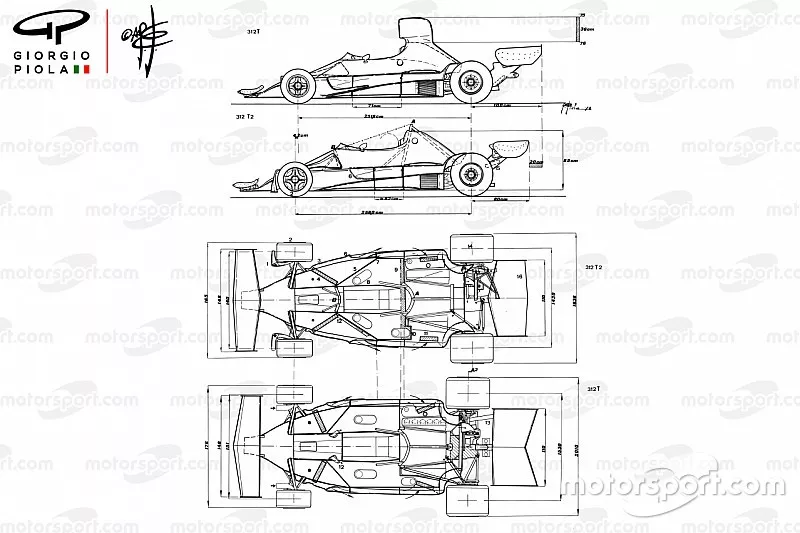
Giorgio Piola's F1 technical analysis
Giorgio Piola is the preeminent Formula 1 technical journalist. View our full selection of Giorgio's technical illustrative content
March 721
March 721 1972 detailed overview
Photo by: Giorgio Piola
A development of the first car Niki Lauda drove in Formula 1, the March 721 retained the lozenge-shaped front end and the madcap "tea-tray" wing, but didn't live up to the success of the preceding 711 chassis.
After two races, the 'X' specification of car was rolled out with a transverse gearbox, but the package proved unsuccessful - instead, the 721G was ushered out of the factory after round five.
Lauda scored no points for March, instead defecting to BRM at the end of 1972.
BRM P160C
BRM P160 1971 detailed overview
Photo by: Giorgio Piola
A third-year development of the P160, the BRM chassis was somewhat long in the tooth by the time Lauda joined - partnering Clay Regazzoni at the team.
Powered by BRM's in-house V12 engine, the car proved to be unreliable - Lauda only completed five of the fifteen races in 1973, scoring just two points during the Belgian Grand Prix at Zolder.
Regardless, Lauda proved himself as a driver to watch and, when Regazzoni returned to Ferrari for 1974, gave the Austrian such a glowing review that he was signed as well.
Ferrari 312B3
Ferrari 312B3 1974 detailed overview
Photo by: Giorgio Piola
The car that brought Lauda his first victory, the 312B3 was an evolution of the already-successful 312B family of Ferrari F1 cars. The chassis design was more contemporary than its forebears, falling in line more with the Lotus 72 and McLaren M23 of the time.
After celebrated designer Mauro Forghieri was moved upstairs by parent company FIAT, Ferrari hit a lean patch until reinstalling Forghieri as technical director - and he immediately set about shortening the car's wheelbase to produce a more nimble car.
The radiators were also moved to the side, assisting the weight distribution, while Ferrari's flat-12 engine kept the weight distribution low.
Lauda took his first win in the 1974 Spanish Grand Prix, then took his second four races later to finish fourth overall in the standings.
Ferrari 312T
Ferrari 312T 1976 detailed rear view
Photo by: Giorgio Piola
After being outscored by Regazzoni in 1974, Lauda suffered no such repeat when the 312T was pressed into service.
With its roots in the 312B3, the gearbox became transverse - hence the 'T' in the chassis designation - while the suspension and the chassis were reworked to improve the handling characteristics, an area in which the B3 was problematic.
The 312T began modestly, but as 1975 progressed Lauda began to march towards the title - winning five races en route.
1976 began with far more promise, and the 312T2 was introduced after the high, slender airboxes were banned from F1. Lauda looked irrepressible, until his accident at the Nurburgring took the rails off his year. After his miraculous recovery, Lauda couldn't beat Hunt to the '76 title - but won out in '77, again with the 312T2.
Brabham BT46
Brabham BT46 1978 overview
Photo by: Giorgio Piola
After Lauda moved to Brabham, he was initially paired up with the BT45C for two races - scoring podiums in both - until the BT46 became available.
Initially unreliable, Lauda managed just one finish - a second place at Monaco - in the first five races with the car. The famous 'fan car', the BT46B, joined the fray at Anderstorp, and Lauda won by over 34 seconds thanks to the obscene levels of the downforce the car could produce - before it was removed from competition
Lauda won again in Italy, but retirements were all too common - the Alfa Romeo V12 becoming a particular source of consternation - stifling any championship challenge.
The following BT48 was even more unreliable, and Lauda called it quits with two races remaining on the season's calendar.
McLaren MP4/2
McLaren MP4-2 1984 exploded-detail overview
Photo by: Giorgio Piola
After Lauda was tempted back into the F1 fold in 1982 by Ron Dennis, McLaren had undergone a colossal change of fortunes. John Barnard's carbon fibre MP4 chassis changed the game, and Lauda returned to winning ways after just three races.
However, the Cosworth DFV was starting to show its age as the turbo era had begun, prompting McLaren to get Porsche to build a bespoke turbo engine - financed by TAG - for 1984.
Using 1983 as a transition season, '84 was Lauda's final title. Beating Alain Prost by half a point, the McLaren MP4/2 was the class of the field - using sidepods that swooped around the rear tyres, the car was able to generate plenty of rear end grip thanks to the improved suction at the rear.
The TAG engine was one of the most reliable on the grid too, creating a perfect combination with McLaren's engineering prowess.
In the MP4/2B, rolled out for 1985, Prost beat Lauda by a healthy margin, winning the title and outscoring him 73 points to 14. Sensibly, Lauda called it a day at the end of the year - putting an end to an illustrious F1 career.
We want your opinion!
What would you like to see on Motorsport.com?
Take our 5 minute survey.
- The Motorsport.com Team
Read and post comments
Read also :
Share Or Save This Story
Copy link
Share on Viber
Previous article McLaren: 2019 car responding in a way 2018 one didn't
Next article Rio reveals definitive layout for F1 circuit
Top Comments
There are no comments at the moment. Would you like to write one?
View More & Comment
More from
Giorgio Piola
The fascinating story behind McLaren's most iconic F1 car
Formula 1
Formula 1 Apr 3, 2024
The fascinating story behind McLaren's most iconic F1 car
Emilia Romagna GP: F1 technical images from Imola's pitlane
Formula 1
Formula 1
Emilia Romagna GP
Apr 21, 2022
Emilia Romagna GP: F1 technical images from Imola's pitlane
The F1 downforce choices that proved key at the Saudi GP
Formula 1
Formula 1
Saudi Arabian GP
Mar 29, 2022
The F1 downforce choices that proved key at the Saudi GP
Latest news
Joe Gibbs Racing plans to push back on Denny Hamlin retirement timeline
NASCAR Cup
NAS NASCAR Cup 5 h
Joe Gibbs Racing plans to push back on Denny Hamlin retirement timeline
Retaining Liam Lawson isn't enough – Red Bull must stop treating him like a failure
Formula 1
F1 Formula 1 10 h
Retaining Liam Lawson isn't enough – Red Bull must stop treating him like a failure
Yamaha may not be competitive immediately in MotoGP's 850cc era, says Pramac
MotoGP
MGP MotoGP
Qatar GP
14 h
Yamaha may not be competitive immediately in MotoGP's 850cc era, says Pramac
Feature
Discover prime content

Subscribe and access Motorsport.com with your ad-blocker.
From Formula 1 to MotoGP we report straight from the paddock because we love our sport, just like you. In order to keep delivering our expert journalism, our website uses advertising. Still, we want to give you the opportunity to enjoy an ad-free and tracker-free website and to continue using your adblocker.
You have 2 options:
- Become a subscriber.
- Disable your adblocker.
Subscribe now Already subscribed? Sign in here
Already disabled your adblocker?
Reload page
Manage Alerts
Subscribe