Formula 1 Miami GP
Miami GP circuit: why F1 drivers still dislike it, and how it could be improved
The Miami International Autodrome’s fast, flowing opening sector gets generally favourable reviews but there’s work to be done elsewhere

Stuart Codling
Published: Apr 30, 2025, 8:33 AM
Copy link
Share on Viber
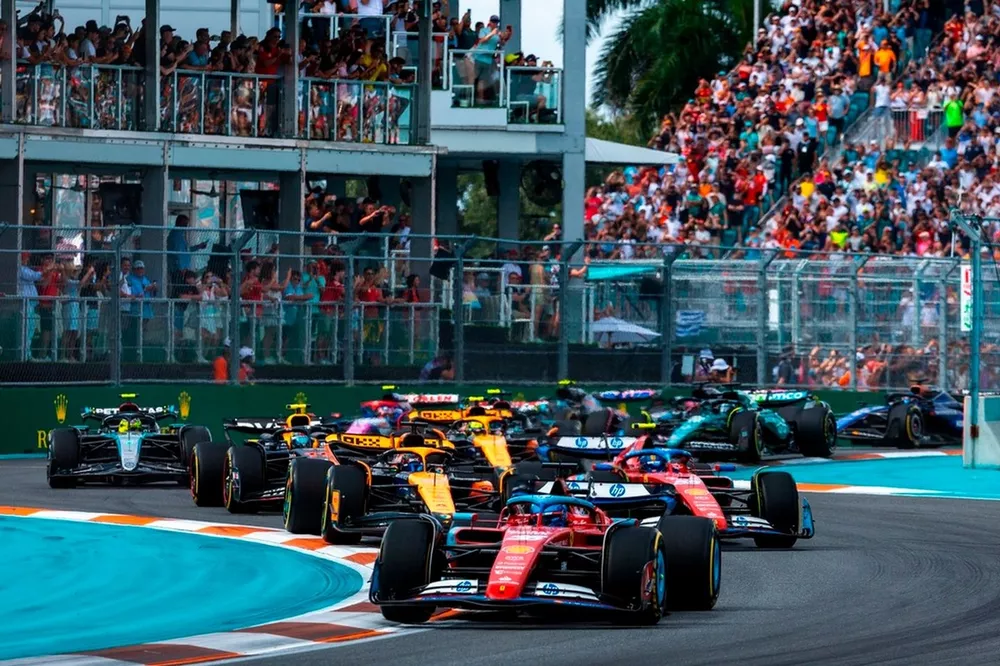
Race action
Photo by: Rolex / James Moy
“It’s probably at the bottom of my list of preferred circuits,” said Lewis Hamilton, the dismissive tone and matching facial expression indicating that no elucidation would be forthcoming.
Pity the poor scribbler who had clearly accepted a commission from some outlet or other to write a story talking up the Miami race, spending the most recent grand prix weekends doggedly working the rounds of press conferences for positive quotes. Some drivers saw the motive behind the otherwise incongruous line of questioning and generously did their best to facilitate; the majority were lukewarm at best.
Lewis was stone cold.
“As an event?” our colleague pressed, wearily.
“Same.”
Lewis Hamilton, Ferrari
Photo by: Sam Bagnall / Motorsport Images
Since the Miami Grand Prix joined the Formula 1 calendar in 2022 in the first blaze of post-Drive to Survive American audience growth, the temporary track around the Hard Rock Stadium has elicited mixed feelings at best.
From day one of the inaugural edition, F1’s drivers complained about the layout and surface (which had to be patched up during the opening weekend). The organisers have had to mitigate both this and the logistical difficulties of assembling the circuit without causing traffic issues which could sour relations with local businesses and residents.
There were also reported issues surrounding VIP catering – over which anybody not blessed with such a pass need not have fretted unduly for the poor celebs and hangers-on going hungry and athirst. Tuning up both this and the track surface was a major focus before the race’s second outing.
The new surface has quietened many complaints about racing practicalities but some elements of the layout remain problematic for drivers, particularly the section between Turns 13 and 16 – including the chicane which Max Verstappen famously said would be better taken “in a go-kart”.
To some extent this is unavoidable though, since the amount of real estate is finite and the circuit has to manoeuvre around a stadium as well as the elevated highway ramps which dictate that slow-speed section and chicane. The critical focus here detracts from those areas of the track which are regarded as successful, particularly the first sector which loops around the stadium and ends with the multi-apex Turns 6-7-8.
“Pretty mega” is how Esteban Ocon described Miami’s first sector, and he previously counted himself among the circuit’s critics after his shunt at Turn 13 during practice for the inaugural event.
Esteban Ocon, Alpine A522, crashes out
Photo by: Mark Sutton / Motorsport Images
“You can really push the edge in terms of lines and kerb usage,” said Ocon’s former team-mate Pierre Gasly of the opening sector and its positives.
The track designers evaluated 30 different permutations before alighting on this one and it’s easy to see why that first sector is so effective. Unfortunately its layout then dictates the route back towards the start.
“I think the part of the track from Turn 12 to 15 is probably not really made for these Formula 1 cars,” said Fernando Alonso, “but it’s the same for everybody.
“You just try to survive that sector but it’s not really a sector where you can push or find a tenth of a second or something like that, you just go in the middle of the track and it’s not super interesting.”
The challenge in using this area of the campus is the entrance and exit ramps and flyover sections of the Florida Turnpike and NW 203rd Street. Safety regulations dictate caps on speed and clearance around all that concrete, hence the fiddly chicane – to which the circuit designers added a crest as a ‘mistake generator’.
While drivers are always liable to complain about such elements, they do have their benefits in terms of potentially spicing up the racing. In that context the present layout in that area arguably represents the most effective use of the space.
So if Miami is to remain “an awkward track with awkward corners” as Alex Albon describes it, is there another way to resolve some of the drivers’ complaints? Potentially yes.
Alex Albon, Williams FW46
Photo by: Sam Bloxham / Motorsport Images
Over the first three editions, criticism of the track surface has proceeded hand in hand with complaints about tyre behaviour in Miami’s burgeoning spring heat. Last year Pirelli’s soft-compound rubber – the C4 compound – proved so sensitive to overheating that Lando Norris, Hamilton and George Russell swapped to mediums in Q3.
But the medium and hard compounds, as well as being less temperature-sensitive, were less prone to degradation and graining, making a one-stop race the optimal strategy. This naturally has the effect of making races more likely to be processional, as demonstrated in the early rounds this year – which is why the Miami compounds will actually be a step softer, with C4 becoming the medium choice.
Pirelli changed the C4 this year to make it less prone to degradation, so the outcome remains uncertain.
One way the organisers could get over the temperature issue would be to hold the race at night – and Miami Grand Prix president Tyler Epp is on record as saying this is a possibility he is evaluating. Moving the race’s calendar slot to a cooler time of year would be difficult, owing to the Miami Open tennis tournament and the requirements of the football season.
But hosting the race at night, or at least in the evening, could play to the event’s ambitions to be F1’s party capital – although the impact on neighbours would have to be considered and mitigated.
In terms of its effect on the on-track action, a time change could be transformational. As Ocon pointed out, lower temperatures would put the tyres under less duress and change the approach to the entire course.
“With 20 degrees less it would be super nice and flowing,” he concluded.
Read Also:
We want your opinion!
What would you like to see on Motorsport.com?
Take our 5 minute survey.
- The Motorsport.com Team
Read and post comments
Read also :
Share Or Save This Story
Copy link
Share on Viber
Previous article Ferrari brings back all-white race suit as Puma create new F1 fashion
Next article How Roland Ratzenberger beat the odds to realize his cruelly short-lived F1 dream
Top Comments
There are no comments at the moment. Would you like to write one?
View More & Comment

More from
Stuart Codling
Hankook tipped to enter race for F1 tyre supply contract
Formula 1
Formula 1
Qatar GP
6 h
Hankook tipped to enter race for F1 tyre supply contract
Lando Norris: Mercedes “at a different level” in Qatar
Formula 1
Formula 1
Qatar GP
18 h
Lando Norris: Mercedes “at a different level” in Qatar
Latest news
Marc Marquez's Ducati catches fire in aborted Valencia GP sprint start
MotoGP
MGP MotoGP
Valencia GP
13 min
Marc Marquez's Ducati catches fire in aborted Valencia GP sprint start
LIVE: F1 Qatar GP updates - Quiet start to FP3 with qualifying focus to come
Formula 1
F1 Formula 1
Qatar GP
44 min
LIVE: F1 Qatar GP updates - Quiet start to FP3 with qualifying focus to come
Marc Marquez unsure what he will do after MotoGP retirement
MotoGP
MGP MotoGP
Valencia GP
2 h
Marc Marquez unsure what he will do after MotoGP retirement
FIA explores DRS return alongside push-to-pass system for F1’s V8 engines
Formula 1
F1 Formula 1
Qatar GP
2 h
FIA explores DRS return alongside push-to-pass system for F1’s V8 engines
Feature
Discover prime content

Top 10 F1 cars of the 1990s
Formula 1
By Kevin Turner
Top 10 F1 cars of the 1990s
Subscribe and access Motorsport.com with your ad-blocker.
From Formula 1 to MotoGP we report straight from the paddock because we love our sport, just like you. In order to keep delivering our expert journalism, our website uses advertising. Still, we want to give you the opportunity to enjoy an ad-free and tracker-free website and to continue using your adblocker.
You have 2 options:
- Become a subscriber.
- Disable your adblocker.
Subscribe now Already subscribed? Sign in here
Already disabled your adblocker?
Reload page
Manage Alerts
Subscribe