Formula 1 Hungarian GP
McLaren brake drum hole prompts F1 tech intrigue
A small hole in the rear brake drum of McLaren’s MCL38 has become a talking point ahead of F1’s Hungarian GP

Jonathan Noble
Edited: Jul 18, 2024, 7:31 PM
Copy link
Share on Viber
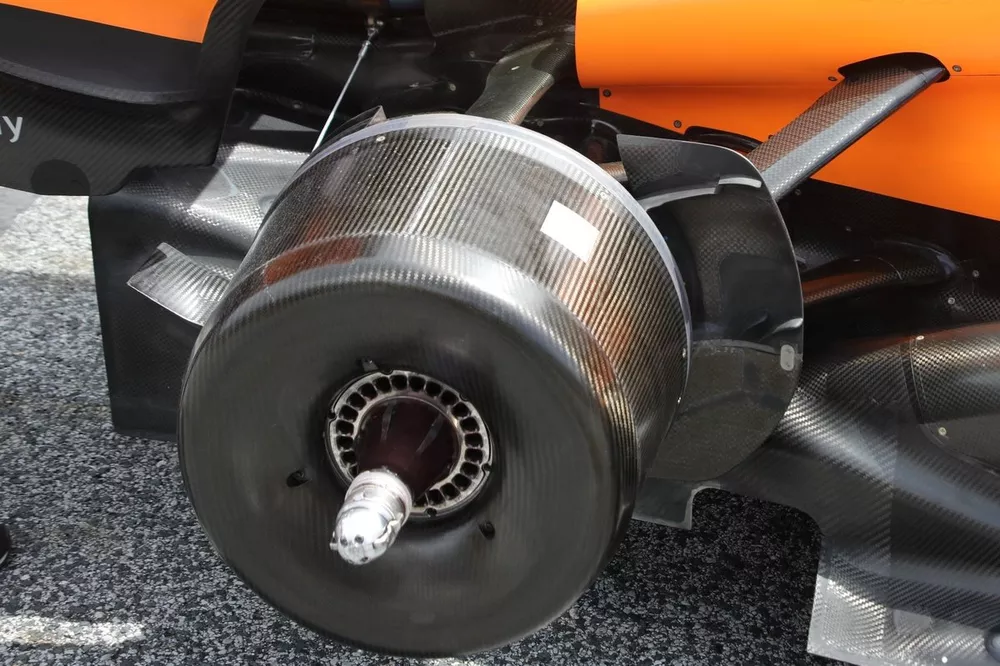
McLaren MCL38 drum detail
Photo by: Franco Nugnes
McLaren has found itself at the centre of technical intrigue ahead of Formula 1's Hungarian Grand Prix over a trick some think could have helped improve its tyre temperature management.
As first revealed by German publication Auto Motor Und Sport, the design of McLaren's brake drums recently grabbed the attention of main rival Red Bull, which is understood to have lodged some questions with the FIA about what its competitor was up to.
The issue at stake is a small hole that has been spotted on the rear brake drums of the MCL38.
The theory of its competitor is that the hole potentially allows McLaren to boost airflow between the brake drum and the wheel – which can provide advantages in both qualifying and the race in ensuring temperatures do not get too extreme.
F1 teams have long battled to find ways to ensure that the heat generated by the brakes inside the drum is controlled, and does not contribute to the tyres overheating and falling outside their operating windows.
Teams make use of double baskets to try to isolate the tyres from the heat source of the brakes.
A first carbon cover goes around the brake calliper and disc, which has specific ducts that extract the hot air towards an outlet that exits behind the brake ducts.
Watch: View from the Paddock - F1 News - Hungarian Grand Prix Thursday
The second basket acts as a buffer, with a cavity created between the wheel and the first drum where fresh air can be channelled to help cool things down.
A hole in this outer channel would allow this flow of fresh air to blow out towards the wheel rim - aiding cooling.
The main issue, however, is that such holes are not strictly allowed in the regulations because there is a demand that the drum has a 'continuous' surface.
Article 3.13.2 of F1's Technical Regulations states: "For each drum, a circumferential, continuous (around an arc of 360°), and uniform aerodynamic seal must be fitted in the outboard of the two annotated volumes, in order to prevent any significant aerodynamic or heat transfer flow between the drum and the axle."
But the presence of the hole is not necessarily against the rules, because it has been suggested it is utilised as a way to allow McLaren access to sensors that are used to monitor drum and wheel temperatures in practice.
F1's regulations allow teams to add extra devices in practice that fall outside the specifics of the rules – such as aerodynamic rakes – but cars have to fully fall in line with the regulations once parc ferme comes into force for qualifying.
In theory, the hole is therefore allowed in practice but would need to be covered from qualifying onwards.
It is understood that Red Bull spotted that the McLaren hole had been uncovered in previous races so sought some clarification from the FIA about the situation.
Sources have explained that the FIA looked into the matter and, while not unduly concerned about something it felt was very minor, did quietly remind McLaren that the hole would need to be covered under parc ferme conditions to ensure the car was in full compliance of the regulations.
As our exclusive photographs show, this change was spotted over the Austrian GP weekend when the McLaren ran in different configurations in the sprint and main race.
In Saturday's sprint, the McLaren holes were uncovered, while for the main grand prix a small section of tape was used to cover them up.

This change was allowed over the Red Bull Ring weekend because parc ferme reopens after the sprint race, and teams can make any changes necessary before qualifying in the afternoon.

The minor modification made with the tape appeared to have no impact on McLaren's pace in Austria, however, with Lando Norris ultimately challenging Max Verstappen for victory in the Red Bull Ring race prior to their late-race collision.
The potential impact at the British Grand Prix was also unclear because the changeable weather conditions that dominated the weekend meant tyre overheating was not such a headache.
But with the brake drum issue having now moved into the public spotlight, there will undoubtedly be a lot more attention on how McLaren's long run pace is at the Hungaroring this weekend – with the hot temperatures and nature of the circuit putting a high premium on teams looking after their tyres.
Read Also:
Formula 1Magnussen to depart Haas after 2024 F1 season, Ocon closes on 2025 deal
Formula 1Why trading Haas for Audi "wasn't a no-brainer" for Hulkenberg
We want your opinion!
What would you like to see on Motorsport.com?
Take our 5 minute survey.
- The Motorsport.com Team
Read and post comments
Read also :
Share Or Save This Story
Copy link
Share on Viber
Previous article Why trading Haas for Audi "wasn't a no-brainer" for Hulkenberg
Next article Tsunoda: It would be "weird" for Red Bull to pick Lawson ahead of me
Top Comments
There are no comments at the moment. Would you like to write one?
View More & Comment

More from
Jonathan Noble

Brundle awarded OBE in King’s New Year’s honours
Formula 1
Formula 1 Dec 31, 2024
Brundle awarded OBE in King’s New Year’s honours
The new rules dilemma that will define the 2025 F1 season
Formula 1
Formula 1 Dec 31, 2024
The new rules dilemma that will define the 2025 F1 season
Verstappen issues Red Bull title warning in push for RB21 progress
Formula 1
Formula 1
Australian GP
Dec 28, 2024
Verstappen issues Red Bull title warning in push for RB21 progress

More from
McLaren
Lando Norris: Mercedes “at a different level” in Qatar
Formula 1
Formula 1
Qatar GP
16 h
Lando Norris: Mercedes “at a different level” in Qatar
Five things to look out for at F1’s Qatar GP
Formula 1
Formula 1
Qatar GP
2 d
Five things to look out for at F1’s Qatar GP
Top 10 F1 cars of the 1980s
Formula 1
Top 10 F1 cars of the 1980s
Latest news
FIA explores DRS return alongside push-to-pass system for F1’s V8 engines
Formula 1
F1 Formula 1
Qatar GP
29 min
FIA explores DRS return alongside push-to-pass system for F1’s V8 engines
George Russell softens stance on Max Verstappen’s infamous 2024 “in the wall” threat
Formula 1
F1 Formula 1
Qatar GP
39 min
George Russell softens stance on Max Verstappen’s infamous 2024 “in the wall” threat

Supercars Adelaide: Title fight goes down to Sunday after Broc Feeney win in Race 2
Supercars
SUPC Supercars
Adelaide 500
41 min
Supercars Adelaide: Title fight goes down to Sunday after Broc Feeney win in Race 2
MotoGP Valencia GP: Marco Bezzecchi scorches to pole position, Marc Marquez second
MotoGP
MGP MotoGP
Valencia GP
1 h
MotoGP Valencia GP: Marco Bezzecchi scorches to pole position, Marc Marquez second
Feature
Discover prime content



Top 10 F1 cars of the 1990s
Formula 1
By Kevin Turner
Top 10 F1 cars of the 1990s
Subscribe and access Motorsport.com with your ad-blocker.
From Formula 1 to MotoGP we report straight from the paddock because we love our sport, just like you. In order to keep delivering our expert journalism, our website uses advertising. Still, we want to give you the opportunity to enjoy an ad-free and tracker-free website and to continue using your adblocker.
You have 2 options:
- Become a subscriber.
- Disable your adblocker.
Subscribe now Already subscribed? Sign in here
Already disabled your adblocker?
Reload page
Manage Alerts
Subscribe