Formula 1
Insight: Ferrari's late start on 2016 Formula 1 car - what does it actually mean?
Ferrari has revealed that it started work on its 2016 Formula 1 car later than it planned to continue working on the SF15-T that won three races la...
Edited: Jan 7, 2016, 11:28 PM
Copy link
Share on Viber

Motorsport Blog
Motorsport Blog
Ferrari has revealed that it started work on its 2016 Formula 1 car later than it planned to continue working on the SF15-T that won three races last year. But what consequences will this have on their title challenge?
The Italian company’s chairman, Sergio Marchionne, explained that while the team had started work its 2016 chassis late, he was confident the squad would not be hindered by the delayed start.

He said: "Maurizio [Arrivabene] will tell you we delayed some things to allow for the 2015 car to be finished.
"Hopefully he will not bitch about this. We pushed the start of some of the work on the 2016 cars on the chassis, delayed it a bit.
"But we have had adequate time and adequate financial resources to do the right thing given the rules.”
A late start on the new car is not the news Ferrari fans will have been hoping for as the team hopes to challenge Mercedes for F1 supremacy next season, so we asked JAonF1 technical advisor, Dominic Harlow, how the late start might affect the Scuderia.

The consequences
The normal time for an F1 team to finish developing its current car and start switching resources to the next one is at the August summer shutdown. The final major upgrades of the year will then arrive at the Singapore Grand Prix and unless a team is involved in the title fight, or developing a race winner as Ferrari was last year, the focus will be directed towards the new car for the rest of the year.
“The knock-on effects [of starting late] would simply be what state of development the car is then in at the first and second test and at the first race, because obviously you want the first race to be the culmination of the aerodynamic development so everything has to be ready for the car then, ideally,” says Harlow.
“Things that can sometimes happen with a late start is that you then end up with a slightly less evolved car at the first race and then a more developed car when you get back to Europe after the flyaways, with a potentially bigger update package for Barcelona.”

Recovering lost time
Marchionne is confident that Ferrari has “adequate time and adequate financial resources” to overcome the late start, but as time for aerodynamic progress is heavily regulated these days, through windtunnel restrictions and limited testing, it is not easy for teams to claw back development time.
“It is difficult because you are limited with the amount of aerodynamic development you can do,” says Harlow. “It’s not that you can oversaturate the aero development in the hope of getting a little bit more through in a shorter space of time to catch up.”
But Ferrari could make up for its late start by cleverly using the bigger gaps in the 2016 F1 calendar. There is a two-week gap between the Australian and Bahrain races, a trend that continues until the Canadian and Azerbaijan races in June, which are the first back-to-back races of the year.

“You can’t immediately compensate [a late start], and it’s then probably more about the planning and the timing of things,” says Harlow. ‘You’d see if there is any scope to reduce lead times for those early races or if there is anything in the calendar that you can exploit.
“For example, there’s a two week gap between the first two races this time, plus perhaps Bahrain puts a slightly bigger demand on cooling and brake cooling than Australia so you would work all of those things to your advantage.”
The early races are typically more about reliability than out race pace, which is another boost for any team that is behind schedule.

2016: evolution, not revolution
Unlike last year, when there were a number of aerodynamic changes to the F1 regulations after the 2014 season, the rules remain stable going into 2016. This is good news for Ferrari as any work the team did towards the end of 2015 on its old car will still be relevant next year.
“There is no difference between a 2015 car and a 2016 car, aerodynamically,” says Harlow. “Obviously every year it is slightly different but a lot of what you could learn or, arguably, more of what you could learn on a 2015 car still applies to 2016.
“What’s late and what’s early? Yes, it would be a different date to hit the optimum compared to last year than say from 2014 to 2015 when you had a crude 2014 car and a much bigger evolution for your 2015 car.”

Although Marchionne’s comments may have set pulses racing amongst the Tifosi, it’s still too early for Ferrari to be at panic stations. After all, Brawn and Red Bull missed tests in 2009 and 2010 and both teams took double title glory by the end of those seasons.
*The new Haas F1 team, which has collaborated closely with Ferrari on its 2016 car has indicated that it will not be subject to any delays.
What did you make of Marchionne’s remarks? Does Ferrari need to panic or will the still become challengers to Mercedes? Leave your thoughts in the comment section below.
We want your opinion!
What would you like to see on Motorsport.com?
Take our 5 minute survey.
- The Motorsport.com Team
Read and post comments
Read also :
Share Or Save This Story
Copy link
Share on Viber
Previous article A charming man: Tyler Alexander’s reflections on McLaren
Next article Newey: F1 risks Mercedes/Ferrari lockdown
Top Comments
There are no comments at the moment. Would you like to write one?
View More & Comment
More from
Ferrari
Lewis Hamilton on latest Charles Leclerc flashpoint: "We're free to race"
Formula 1
Formula 1
Qatar GP
23 h
Lewis Hamilton on latest Charles Leclerc flashpoint: "We're free to race"
Charles Leclerc urges "solution" after several clashes with Lewis Hamilton
Formula 1
Formula 1
Qatar GP
1 d
Charles Leclerc urges "solution" after several clashes with Lewis Hamilton
Top 10 F1 cars of the 1980s
Formula 1
Top 10 F1 cars of the 1980s
Latest news
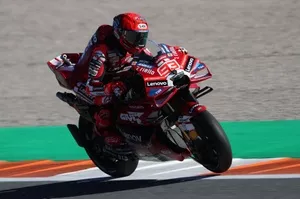
MotoGP Valencia GP: Marc Marquez ends first day of final MotoGP weekend in style
MotoGP
MGP MotoGP
Valencia GP
57 min
MotoGP Valencia GP: Marc Marquez ends first day of final MotoGP weekend in style
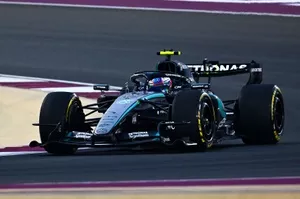
F1 Qatar GP: Kimi Antonelli leads Mercedes 1-2 in tricky FP1
Formula 1
F1 Formula 1
Qatar GP
1 h
F1 Qatar GP: Kimi Antonelli leads Mercedes 1-2 in tricky FP1

Grasser FIA appeal confirmed as GT3 future comes into focus
DTM
DTM DTM
Oschersleben
2 h
Grasser FIA appeal confirmed as GT3 future comes into focus
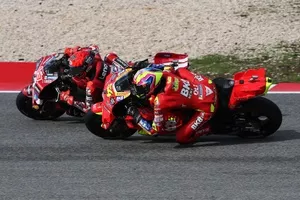
Who will replace Marc Marquez at Ducati?
MotoGP
MGP MotoGP
Valencia GP
2 h
Who will replace Marc Marquez at Ducati?
Feature
Discover prime content


Top 10 F1 cars of the 1990s
Formula 1
By Kevin Turner
Top 10 F1 cars of the 1990s

Subscribe and access Motorsport.com with your ad-blocker.
From Formula 1 to MotoGP we report straight from the paddock because we love our sport, just like you. In order to keep delivering our expert journalism, our website uses advertising. Still, we want to give you the opportunity to enjoy an ad-free and tracker-free website and to continue using your adblocker.
You have 2 options:
- Become a subscriber.
- Disable your adblocker.
Subscribe now Already subscribed? Sign in here
Already disabled your adblocker?
Reload page
Manage Alerts
Subscribe