Formula 1
In depth Analysis: What we learned from the first F1 test in Jerez
The first test of the new F1 season has thrown up many exciting questions about all the teams which were running.
Edited: Feb 6, 2015, 11:46 PM
Copy link
Share on Viber

Motorsport Blog
Motorsport Blog
The first test of the new F1 season has thrown up many exciting questions about all the teams which were running. Here we will focus on three specific questions: is the Ferrari as quick as it seems? The Mercedes is reliable already, but is it still well ahead of the field? What about Sauber? They were the second fastest car on several days, is that real performance?
With the help of JA on F1 technical adviser Dominic Harlow, formerly chief operations engineer at Force India and Williams, we can look at a comparison chart from the fourth and final day's running, drawing some conclusions about relative performance.
In the chart, Raikkonen's Ferrari is the Red line; Ericsson's Sauber the Blue line; and Hamilton's Mercedes the Black line. Click on the graph to enlarge it for more detail. Lap times are down the Vertical Axis; The groupings of times towards the top of the graph are the faster times. Time of Day is across the Horizontal axis.
A lot of what you see on the lap time sheets in testing with these hybrid turbo cars is affected by whether the car uses full ERS discharge for example, or what fuel level is being run, with a heaver car being slower and of course the tyre compounds.

Mercedes - Hamilton
He was faster than Raikkonen on similar wet track conditions in the morning (10:15 to 10:30)
Hamilton changes to dry tyres and continues the run, he completes 37 Laps in total without refuelling. That’s around 54Kg of fuel so likely that the base fuel load is 60Kg or more, quite high, in other words.
It looks from the consistency of the dry times and the length of the runs (several at 15 timed laps) that Mercedes don’t change fuel level all day, only tyre compound in the afternoon.

Mercedes were clearly concentrating on reliability at this test; after all reliability was the only thing, aside from the collision at Spa, that stopped them winning all the races last year.
For optimum testing it is obviously best to keep the fuel level constant between outings, to be able to draw conclusions on set up changes etc
Mercedes top speed is a bit lower than some rivals, particularly Williams, but also Lotus. The Mercedes engined cars still look generally the strongest in a straight line however.
Hamilton’s laptimes are continuously at a similar level. Unlike Raikkonen and Ericsson he doesn’t do any slow ‘charge management’ laps for the ERS. (These are laps where the focus is on recharging the ERS, for maximum performance the next lap.) So hamilton is in race mode, rather than qualifying mode here, not pushing for performance lap times at all.

Ferrari – Raikkonen
Raikkonen starts with a couple of longer runs through wet to dry track conditions to check crossover and subsequent dry tyre performance.
It appears from the graph that Raikkonen’s laptimes become quite a lot quicker after 13-30, suggesting a reduced fuel level. He is also using the Soft tyre which is 2s faster than the hard so we can’t be sure.
During Raikkonen’s performance runs in the afternoon he is always putting in ‘charge management’ laps suggesting he is using the full 4Mj/Lap ERS-K deployment but can’t supply this continuously in Jerez. In other words, this is clearly a Qualifying mode rather than a Race one.
Although the Ferrari seems improved and the drivers report a better handling car, with superior Energy Recovery System, it looks like they were using either lower fuel levels or enhanced engine modes compared to Mercedes who were in ‘Race trim’.
The Mercedes is still likely to be quicker but the gap could be smaller than in 2014. We will learn more in the Barcelona tests.

Sauber – Ericsson
Ericsson’s pace is typically slower than Hamilton or Raikkonen until around 16-00, when he starts a series of runs commencing with a quick lap and seemingly running down from a high fuel level.
On his final run he runs a slow lap, followed by his best time and then backs off again suggesting some ‘charge management’ therefore a high level of ERS-K deployment.
The run continues until almost the end of the day when there is a short Red-Flag. He then returns to the track and immediately runs out of fuel.This is called a run out.
Given that Sauber could not have planned the Red Flag and said that they carried out a run-out test it would appear that the fuel load in the car on ERI’s fastest lap is unlikely to have been more than around 25Kg (an advantage of at least 1.1s over HAM).
As a general note, people have been saying that the cars are faster than last year, which is not surprising as they have had a year of development. What is interesting is that, compared to 2013, the laptimes were still quite a lot slower, 1m 18s was the quickest lap then, as opposed to 1m 20 this year, so perhaps this is another indication we haven’t seen everything from the cars and that the aero is still perhaps a bit behind 2013 levels. They are also 11kg heavier this year than last, which is over 3/10ths of a second per lap of disadvantage.

Williams looked a little bit off despite high top speeds again. Maybe theirs is not the perfect car for Jerez. They should be more in evidence at Barcelona.
McLaren had teething problems with the new Honda and we will look at Red Bull in a separate piece.
Jerez F1 Test – Fastest times of the week
1. Ferrari – Raikkonen – 1m20.841s
2. Sauber – Nasr – 1m21.545
3. Mercedes – Rosberg 1m21.962
4. Williams – Massa – 1m 22.276
5. Toro Rosso – Verstappen – 1m22.553
6. Lotus – Maldonado – 1m22.713
7. Red Bull – Ricciardo – 1m32.338
8. McLaren – Button – 1m 27.660s
We want your opinion!
What would you like to see on Motorsport.com?
Take our 5 minute survey.
- The Motorsport.com Team
Read and post comments
Read also :
Share Or Save This Story
Copy link
Share on Viber
Previous article End of the Road in Sight for Caterham as Assets Go Up For Sale
Next article Renault Sport F1 Jerez test review
Top Comments
There are no comments at the moment. Would you like to write one?
View More & Comment
Latest news
Toyota, M-Sport weigh in on the WRC 2027 Rally1-vs-Rally2 debate
WRC
WRC WRC
Rally Saudi Arabia
42 min
Toyota, M-Sport weigh in on the WRC 2027 Rally1-vs-Rally2 debate
Fernando Alonso returns to Dakar: Why his first rally-raid experience was a shock to the system
Dakar
DAKR Dakar 1 h
Fernando Alonso returns to Dakar: Why his first rally-raid experience was a shock to the system
How the F1 2026 regulations neutered Oscar Piastri's "real strength"
Formula 1
F1 Formula 1
Las Vegas GP
2 h
How the F1 2026 regulations neutered Oscar Piastri's "real strength"
Feature
Discover prime content

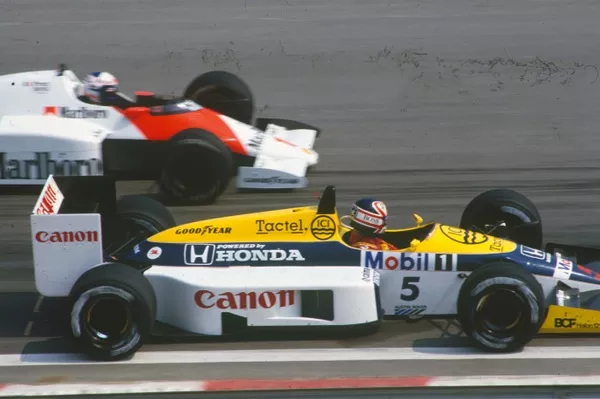
Top 10 F1 cars of the 1980s
Formula 1
By Kevin Turner
Top 10 F1 cars of the 1980s
Subscribe and access Motorsport.com with your ad-blocker.
From Formula 1 to MotoGP we report straight from the paddock because we love our sport, just like you. In order to keep delivering our expert journalism, our website uses advertising. Still, we want to give you the opportunity to enjoy an ad-free and tracker-free website and to continue using your adblocker.
You have 2 options:
- Become a subscriber.
- Disable your adblocker.
Subscribe now Already subscribed? Sign in here
Already disabled your adblocker?
Reload page
Manage Alerts
Subscribe