Analysis
Formula 1 Hungarian GP
How teams chased 'dirty downforce' gains in Hungary
Formula 1 teams were willing to pay the price for having draggy cars in their pursuit of 'dirty downforce' for the Hungarian Grand Prix weekend.
Giorgio Piola Matt Somerfield
Edited: Jul 31, 2018, 1:40 PM
Copy link
Share on Viber
Giorgio Piola's F1 technical analysis
Giorgio Piola is the preeminent Formula 1 technical journalist. View our full selection of Giorgio's technical illustrative content
The Hungaroring is a challenging place for both drivers and engineers alike, and is often described as 'Monaco without the walls'.
It is indeed a high-downforce circuit, very much like other street circuits, but it rubbers in much more like a traditional track.
To further add to the complications, temperatures are often high and that means cooling the brakes and the power unit become a critical factor, resulting in aerodynamic efficiency being sacrificed.
It is a track where extra grip pays off more than straightline efficiency – which is why teams focus more on finding what is known as ‘dirty downforce'.
Here we look at how a few teams approached the challenge.
Williams updates

Williams FW41 Rear Wing, T-Wing and Cooling, Hungarian GP
Photo by: Giorgio Piola
The Williams FW41 may still be lacking some performance, but the front wing introduced at the last round in Germany has at least made the car more predictable for its drivers.
Keen to push on and add some more performance, the team arrived in Hungary with a new, rather large, T-wing (blue arrow).
The winglet featured two main horizontal surfaces either side of the engine cover, which are hooped together by endplates.
The lower of these two surfaces helps to drive the performance of the airflow travelling over the top of the sidepod’s surface, and the hot air exiting the enlarged cooling outlet that was last used in Bahrain (lower left inset, red arrow).
The upper surface works the airflow a little harder, sitting in relatively the same position as the regular T-wing, and features a slot along its length.
The rear wing also had changes. The mainplane swapped out for a conventional shaping, rather than the ‘spoon’-shaped wing seen elsewhere (green arrow).
This drive to create more downforce had the consequence of more drag, so the team added an extra open-end style louvre to alter the tip vortex being created (purple arrow), reducing drag.
Red Bull gains

Red Bull RB14 rear wing monkey seat
Photo by: Giorgio Piola
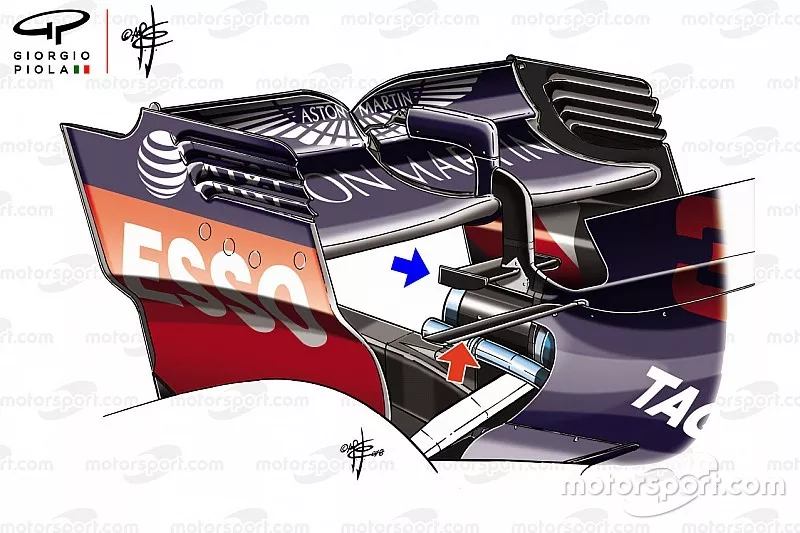
Red Bull more usually has to think about its aero efficiency ratio more than the others, given its power deficit to the other frontrunners, but when it comes to the high-downforce tracks we see the team throw caution to the wind.
Just like in Monaco, the RB14 was fitted with a high downforce rear wing and complemented by a T-wing (red arrow) and a small monkey seat winglet (blue arrow).
The role that the monkey seat can play has been drastically curtailed by the FIA for 2018, with the governing body keen to reduce the impact that aerodynamic devices can have on the exhaust, which lies in close proximity.
Nevertheless, Red Bull has, when the need arises, turned back to the aerodynamic appendage in order to overcome any instabilities that may occur when running such an aggressive rear wing.
Most of the field runs a T-wing in one form or another at the majority of the races, teasing a little more downforce and stability from the surface for a negligible quantity of drag.
Eyeing any straightline boost in its quest to beat Mercedes and Ferrari, Red Bull only opts to run one when absolutely necessary.
Force India keeps up the fight

Force India VJM11 high downforce rear wing comparison
Photo by: Giorgio Piola
Starved of budget in the opening phase of this season, Force India has slumped back a little, especially when compared with the success it has enjoyed over the last two seasons.
A lack of budget can have a significant impact on the delivery of updates at key points in the season and so it has had to be more cautious about the timing of bringing new parts that help performance.
With aerodynamic efficiency less worrisome at the high-downforce circuits, the team bolted on a pair of double T-wings in Monaco and Hungary, whereas elsewhere it has opted to use just a single element (inset, red arrow).
It also toyed with, but never raced, a small monkey seat winglet hung from the rear wing centre pillar over the exhaust (inset, blue arrow).
We want your opinion!
What would you like to see on Motorsport.com?
Take our 5 minute survey.
- The Motorsport.com Team
Read and post comments
Read also :
Share Or Save This Story
Copy link
Share on Viber
Previous article Bell steps down as Renault tech chief for part-time role
Next article Mercedes admits strategy asked too much of "valiant" Bottas
Top Comments
There are no comments at the moment. Would you like to write one?
View More & Comment
More from
Giorgio Piola
The fascinating story behind McLaren's most iconic F1 car
Formula 1
Formula 1 Apr 3, 2024
The fascinating story behind McLaren's most iconic F1 car
Emilia Romagna GP: F1 technical images from Imola's pitlane
Formula 1
Formula 1
Emilia Romagna GP
Apr 21, 2022
Emilia Romagna GP: F1 technical images from Imola's pitlane
The F1 downforce choices that proved key at the Saudi GP
Formula 1
Formula 1
Saudi Arabian GP
Mar 29, 2022
The F1 downforce choices that proved key at the Saudi GP

More from
Red Bull Racing
Max Verstappen feels a “disconnect” as Red Bull looks to solve “massive limitation” in Qatar GP practice
Formula 1
Formula 1
Qatar GP
21 h
Max Verstappen feels a “disconnect” as Red Bull looks to solve “massive limitation” in Qatar GP practice
Max Verstappen without Gianpiero Lambiase at Qatar GP as Tom Hart steps in
Formula 1
Formula 1
Qatar GP
1 d
Max Verstappen without Gianpiero Lambiase at Qatar GP as Tom Hart steps in
Latest news
Pedro Acosta explains Valencia sprint struggles after disappointing finish
MotoGP
MGP MotoGP
Valencia GP
3 min
Pedro Acosta explains Valencia sprint struggles after disappointing finish
LIVE: F1 Qatar GP updates - Qualifying
Formula 1
F1 Formula 1
Qatar GP
17 min
LIVE: F1 Qatar GP updates - Qualifying
Marc Marquez brands Valencia GP sprint penalty as “not fair” after fiery incident
MotoGP
MGP MotoGP
Valencia GP
33 min
Marc Marquez brands Valencia GP sprint penalty as “not fair” after fiery incident
Why Marc Marquez was penalised for leaving the Valencia grid - although he did nothing wrong
MotoGP
MGP MotoGP
Valencia GP
1 h
Why Marc Marquez was penalised for leaving the Valencia grid - although he did nothing wrong
Feature
Discover prime content

Top 10 F1 cars of the 1990s
Formula 1
By Kevin Turner
Top 10 F1 cars of the 1990s
Subscribe and access Motorsport.com with your ad-blocker.
From Formula 1 to MotoGP we report straight from the paddock because we love our sport, just like you. In order to keep delivering our expert journalism, our website uses advertising. Still, we want to give you the opportunity to enjoy an ad-free and tracker-free website and to continue using your adblocker.
You have 2 options:
- Become a subscriber.
- Disable your adblocker.
Subscribe now Already subscribed? Sign in here
Already disabled your adblocker?
Reload page
Manage Alerts
Subscribe