Formula 1 Abu Dhabi Post-Season Testing
How F1's new cockpit scoop aims to avoid Qatar heat issues
The latest draft of Formula 1's 2024 technical regulations features an amendment that the FIA hopes will alleviate heat exhaustion issues the drivers faced at this year’s Qatar Grand Prix.

Matt Somerfield
Edited: Dec 13, 2023, 3:42 PM
Copy link
Share on Viber

Several drivers required medical attention after the race due to severe heat exhaustion symptoms, with Williams' Logan Sargeant even retiring from the race with heatstroke.
While Qatar's conditions were unusually extreme, the FIA pledged to find a rapid solution to avoid it from happening again.
The race itself has been shuffled further down the calendar from early October to the end of November for 2024, with cooler conditions easing concerns of a repeat.
However, in a bid to improve cooling to the cockpit, teams may now also add an additional scoop atop the chassis from next season.
This new driver cooling scoop, like the inlet that may be used in the tip of the nose, will be constrained in its dimensions to rule out any fringe aerodynamical benefits.
Given it’s another option for the teams and not one that’s only mandated for extreme conditions, they could even choose to use the scoop rather than the nose tip inlet, should it infer less aerodynamic sensitivity or reduce weight in a meaningful way to offset the more forward position.
Of course, they could also use a combination of both or pick and choose which options provide the best driver cooling versus aerodynamic performance for a given circuit.
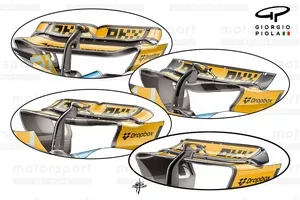
The last team in recent memory to use a driver cooling scoop atop the chassis was Mercedes in 2014, when occasionally its vanity panel featured a small scoop (pictured, above), as the regulations permitted it at the time.
Interestingly, some teams didn’t even have the optional driver cooling aperture in the nose tip during the Qatar Grand Prix, which begs the question whether or not every team should have a mandatory specification on hand should the need arise.
Photo by: Giorgio Piola
Red Bull Racing RB19 floor side detail
There are also changes within the regulations to limit the use of metal in the car’s floor, with components and inserts no longer permitted in the outer boundaries of the floor body, the edge wing and the fences. The obvious exceptions to this are the use of brackets or fasteners that are permitted between the floor and edge wing and any metallic components used for wear protection, providing they stay within the tolerances laid out within the new criteria.
Read Also:
Formula 1FIA formalises ban on 2026 F1 aero testing
Formula 1How the FIA/Wolff case could shape F1’s political landscape
Formula 1Mercedes F1 rivals all deny filing FIA complaint over Wolff allegations
The changes suggest that teams may have been using metal components and inserts as a means to control flexion and offer an aerodynamic benefit, but there might also be concerns about how this might create a debris issue in the event of an accident.
Another small but meaningful amendment will require teams to add physical stops to prevent the front wing flap from being adjusted beyond the 40mm laid out in the regulations. That tweak has likely been introduced as a mechanism to prevent the flaps being relaxed excessively when the car is in motion and falls beyond the scope of static tests.
We want your opinion!
What would you like to see on Motorsport.com?
Take our 5 minute survey.
- The Motorsport.com Team
Read and post comments
Read also :
Share Or Save This Story
Copy link
Share on Viber
Previous article Perez: Keeping up with car development key to new Red Bull F1 deal
Next article Vasseur: Japan F1 Ferrari upgrade left Leclerc in "much better shape"
Top Comments
There are no comments at the moment. Would you like to write one?
View More & Comment

More from
Matt Somerfield

Gallery: How F1 tech evolved during the 2024 season
Formula 1
Formula 1 Dec 31, 2024
Gallery: How F1 tech evolved during the 2024 season
How McLaren’s rear wing push changed the game in F1
Formula 1
Formula 1 Dec 20, 2024
How McLaren’s rear wing push changed the game in F1
How 2026 F1 rules will help avoid identikit designs
Formula 1
Formula 1 Dec 16, 2024
How 2026 F1 rules will help avoid identikit designs
Latest news
Chase Elliott's car chief leaves Hendrick for NASCAR Truck crew chief role
NASCAR Truck
NSTR NASCAR Truck
Homestead
25 min
Chase Elliott's car chief leaves Hendrick for NASCAR Truck crew chief role
“I was getting beat up” – How Daniel Ricciardo burned out on ‘humiliating’ F1 return
Formula 1
F1 Formula 1 4 h
“I was getting beat up” – How Daniel Ricciardo burned out on ‘humiliating’ F1 return
Myers Riley Motorsports adds Andretti alongside returning Fraga for 2027 IMSA GTD campaign
IMSA
IMSA IMSA 4 h
Myers Riley Motorsports adds Andretti alongside returning Fraga for 2027 IMSA GTD campaign
Feature
Discover prime content
Top 10 F1 cars of the 1970s
Formula 1
By Kevin Turner
Top 10 F1 cars of the 1970s

Subscribe and access Motorsport.com with your ad-blocker.
From Formula 1 to MotoGP we report straight from the paddock because we love our sport, just like you. In order to keep delivering our expert journalism, our website uses advertising. Still, we want to give you the opportunity to enjoy an ad-free and tracker-free website and to continue using your adblocker.
You have 2 options:
- Become a subscriber.
- Disable your adblocker.
Subscribe now Already subscribed? Sign in here
Already disabled your adblocker?
Reload page
Manage Alerts
Subscribe