Analysis
Formula 1 Belgian GP
How a 40-year-old rule turned F1 on its head at Spa
A seemingly innocuous paragraph that has sat unchanged in the Formula 1 regulations for over 40 years was the cause of much of the controversy that surrounded the Belgian GP.

Adam Cooper
Edited: Sep 2, 2021, 5:00 PM
Copy link
Share on Viber
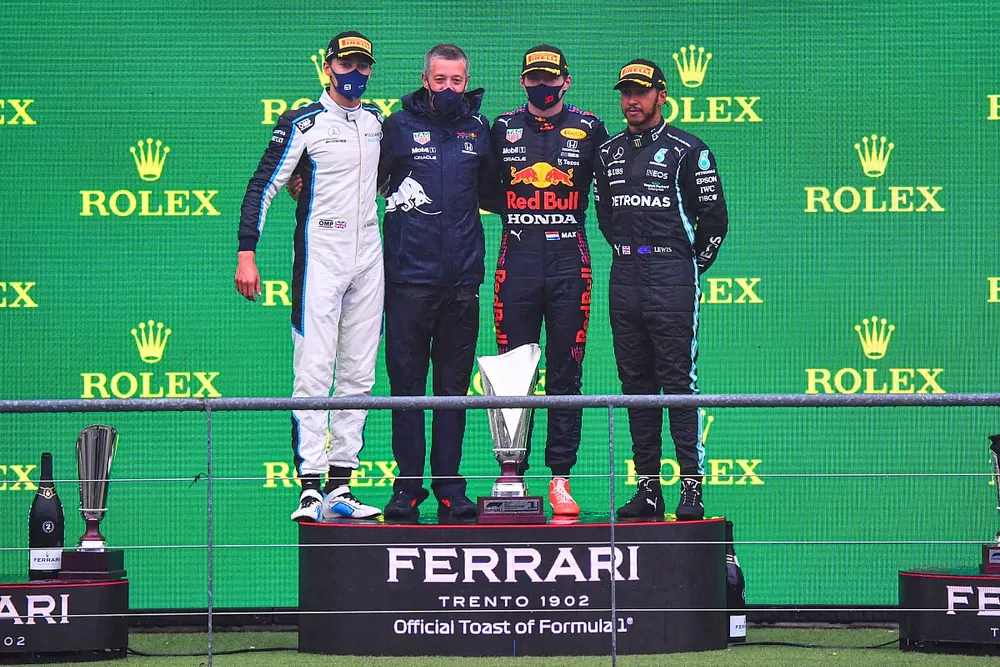
It kickstarted such a debate that on Tuesday FIA president Jean Todt confirmed that the subject will be discussed at the next Formula 1 Commission meeting, to be held on October 5.
The hitherto unremarked regulation specifies that only two laps of a Grand Prix need to be completed for half points to be awarded, and significantly there is no proviso that they have to be racing laps run under green flag conditions.
That’s why after completing two full laps behind the safety car at Spa on Sunday the top 10 drivers were given points.
The only change from the original grid was that seventh qualifier Sergio Perez was at the back after his reconnaissance lap accident, promoting those behind – and handing useful bonuses to Esteban Ocon, Charles Leclerc, Nicholas Latifi and Carlos Sainz.
Even some of those who scored points seemed embarrassed, admitting that they didn’t feel that they or anyone else had really earned them.
“I don't feel like I deserved any points today for what I've done,” said Pierre Gasly, who was classified sixth.
“I think the whole point of getting the points is based on the race. And yeah, I'm a bit surprised. I just feel like they put us out on track at the end to do these three laps behind the safety car, when actually it was worse than before, just to allow these points to happen.”
“That's a joke,” said fifth placed Sebastian Vettel. “I think if you want to get a reward for qualifying, you should get points for qualifying.
"What did we do today? I thought you had to do 25% of the race to get any points.”
Not surprisingly those who didn’t come away with any points were even more vehement.
“We didn't have the chance to score points,” said Fernando Alonso. “I'm P11, I didn't have any green light lap to score a point, so we didn't score.
“So that's shocking. But that is their decision. So there was no way we could race today, as we showed. It was only a red flag situation or behind safety car situation, as we did. So how you can give points to a non-race?”
“Was it worth points?,” Valtteri Bottas asked. “From my side, of course, I was out of the points, so I never had opportunity to fight for the points. So I don't think it was a race. But it is what it is. For sure a tricky call for F1, what to do.”
Like many others Vettel was under misapprehension that the relevant rule had changed at some point in the recent past, and the minimum requirement to count for half points had not previously been two laps. In fact it appears to have been there for over four decades.
I did some digging through my collection of FIA “yellow books” – the pocket-sized regulatory bible of that era. I don’t have every year, but the F1 section of the 1980 book states that if a race is stopped between two laps and 75%, half points would be awarded.
My next oldest copy is from 1976 (as an aside a few years ago I loaned it to the Rush production team, and it can briefly be seen in the hands of “Teddy Mayer” in the Spanish GP disqualification scene!)
At that time it didn’t yet include a detailed F1 specific section, and instead there was a set of rules that applied across all FIA championships. One paragraph states that half points would be awarded should a race be stopped between 30% and 60% distance.
That same regulation was used at the previous year’s Spanish and Austrian GPs, the first two F1 races in history that saw half points awarded.
By the next premature race conclusion, at Monaco in 1984, the rule specifying half points being awarded between two laps and 75% was already in place.
It is not clear exactly what year it changed, but it was obviously somewhere between 1977 and 1980, and thus the two-lap requirement is over 40 years old.
Why it was changed is lost to history. However, it was around then that Bernie Ecclestone was getting heavily involved in race promotion contracts, although he was not yet in the position of strength that he had later.
One could speculate that it might have been at Ecclestone’s behest that the rule was tweaked so that two laps constituted a race, and thus circuits wouldn’t have to be refunded if that’s all they got.
Indeed, many observers and drivers have suggested that we had those crucial laps on Sunday for financial reasons, and at least in part to satisfy a contractual requirement to provide the Spa promoter with a “race”.
Fans were left soaked and disappointed on Sunday, with many calling for refunds
Photo by: Mark Sutton / Motorsport Images
There’s also a question of how many races broadcast contracts specify before TV companies start getting a refund. Last year the magic number was 15 – however in at least some cases that was adjusted to 20 for this season after last year’s pandemic experience, which is why huge efforts are being made to keep the numbers up.
However at Spa F1 boss Stefano Domenicali vehemently denied that not having a race officially declared would have any commercial impact.
Other sources have suggested that a distinction should be made between an “event” and a “race.” A lot of documentation around F1 uses the former phrase, and given the event starts with practice and qualifying, one might conclude that an actual race doesn’t have to happen for contractual obligations to be fulfilled.
Whatever the truth of the legal situation, awarding points was an inevitable regulatory outcome of those crucial laps being run, even with a result declared on countback after just one official lap.
The bottom line is that in 40 years the minimum distance had never previously come into play. Prior to last weekend the result of the shortest Grand Prix in history, at Adelaide in 1991, was declared at 14 laps – all of them under racing conditions as the safety car did not exist in those days.
And that’s a key point. When the two-lap rule was first introduced nobody predicted that there could be a scenario where that requirement could be fulfilled without any actual racing laps taking place. And following the introduction of the safety car in 1994 no one appears to have said, “Hang on, what if?”
The rule thus sat there like a ticking time bomb before finally exploding last weekend.
“It’s not ideal but if you can’t reward someone for the race, reward them for the bravery in qualifying,” F1 managing director Ross Brawn said this week. “A lap like George Russell did in qualifying in the absence of a full race should be rewarded.”
Indeed the Russell factor took the sting out of the whole affair for many people – a podium and a haul of points for the Brit and his resurgent Williams team was a feel good story on a difficult day for the sport. Vettel, Ricciardo and Latifi were also unusually high up the order after brave efforts on Saturday.
It has to be said too that a Max Verstappen victory and five-point gain on third placed Lewis Hamilton went some way to placating tens of thousands of visiting Dutch fans who had spent all day standing in the rain to see so little.
Imagine their reaction and the impact on calls for refunds had Lewis Hamilton been on pole and Verstappen outside the top 10 after a difficult qualifying…
Consider too that we could easily have had a standard dry qualifying session with the usual suspects lined up at the front, and no outliers like Russell or Ricciardo or Vettel at the sharp end. The argument for rewarding qualifying would be somewhat diluted.
On the other hand we could also have had a scenario with the grid set by a Saturday sprint – and the case for handing out extra points would arguably be stronger.
The good news is that the FIA and F1 have reacted quickly, and like other aspects of last weekend, such as the three-hour rule and race starting times in countries known for bad weather, it will be discussed next month.
One obvious potential change is to adjust the two-lap requirement so that at least some green flag racing has to take place for a race to be declared and half points to be awarded.
Another option is to separate the race result from the allocation of points, so that if we had an exact repeat of last weekend Verstappen and Red Bull would be credited in the history books with a race win, but score no actual points that could impact the title battle.
Nothing like Spa had happened before in the history of the World Championship, and if the rules are tweaked, it may never happen again, at least in terms of points being earned behind the safety car.
Of course, we don’t yet know the real impact of last weekend, and it won’t be clear until after the Abu Dhabi finale in December.
Verstappen’s five-point gain, and that made by Red Bull in the constructors’ battle with Mercedes, could prove to crucial. There was also a potentially important 3.5 points swing in McLaren’s favour in the fight with Ferrari for third place.
Further down the order there was an even bigger change in the contest for eighth. Prior to Spa it was Williams 10 points, Alfa Romeo 3 – and at the end of the afternoon the score was 20-3.
It will take a lot of hard-earned ninth and 10th places to make up that deficit over the balance of the season, and understandably, the Hinwil team is not happy.
With millions of dollars at stake for each constructors’ championship position what unfolded at Spa could prove to be very expensive for some teams…
Read Also:
- F1 working with promoter on options for Belgian GP ticket holders
- Hamilton would like to see F1 hold ‘free’ Belgian GP for fans
We want your opinion!
What would you like to see on Motorsport.com?
Take our 5 minute survey.
- The Motorsport.com Team
Read and post comments
Read also :
Share Or Save This Story
Copy link
Share on Viber
Previous article The ups and downs of Raikkonen's 2007 F1 title triumph
Next article Kimi Raikkonen to retire from F1 at end of 2021 season
Top Comments
There are no comments at the moment. Would you like to write one?
View More & Comment
More from
Adam Cooper

RB: Tsunoda “mentally on a different level” in 2024
Formula 1
Formula 1
Japanese GP
Apr 10, 2024
RB: Tsunoda “mentally on a different level” in 2024
Andretti planning F2 and F3 entries to promote US talent to F1 team
Formula 1
Formula 1 Apr 10, 2024
Andretti planning F2 and F3 entries to promote US talent to F1 team

Andretti F1 team formally opens new Silverstone facility
Formula 1
Formula 1 Apr 10, 2024
Andretti F1 team formally opens new Silverstone facility
Latest news
LIVE: F1 Las Vegas GP updates - FP3
Formula 1
F1 Formula 1
Las Vegas GP
25 min
LIVE: F1 Las Vegas GP updates - FP3
NASCAR set to incrementally increase horsepower as part of 2027 Cup rules
NASCAR Cup
NAS NASCAR Cup 3 h
NASCAR set to incrementally increase horsepower as part of 2027 Cup rules
Hollywood star Christian Bale wants to portray MotoGP’s “gods” in a movie
MotoGP
MGP MotoGP
Portuguese GP
4 h
Hollywood star Christian Bale wants to portray MotoGP’s “gods” in a movie
Marc Marquez's body felt "stiffer" in Portimao practice: "I’m the only one who can lose”
MotoGP
MGP MotoGP
Portuguese GP
4 h
Marc Marquez's body felt "stiffer" in Portimao practice: "I’m the only one who can lose”
Feature
Discover prime content

Top 10 F1 cars of the 1980s
Formula 1
By Kevin Turner
Top 10 F1 cars of the 1980s
Subscribe and access Motorsport.com with your ad-blocker.
From Formula 1 to MotoGP we report straight from the paddock because we love our sport, just like you. In order to keep delivering our expert journalism, our website uses advertising. Still, we want to give you the opportunity to enjoy an ad-free and tracker-free website and to continue using your adblocker.
You have 2 options:
- Become a subscriber.
- Disable your adblocker.
Subscribe now Already subscribed? Sign in here
Already disabled your adblocker?
Reload page
Manage Alerts
Subscribe