Formula 1 Miami GP
F1 Miami GP: Tech images from the pitlane explained
Join us as we delve into the Formula 1 technical features on display at the Miami Grand Prix, courtesy of Giorgio Piola and Sutton Images.
Matt Somerfield Giorgio Piola
Published: May 3, 2024, 12:00 PM
Copy link
Share on Viber
Giorgio Piola's F1 technical analysis
Giorgio Piola is the preeminent Formula 1 technical journalist. View our full selection of Giorgio's technical illustrative content
As the RB20 is prepared for action we are able to see the front and rear brake assemblies in various states of undress.
Disc fairings are used at both ends of the car to help control the passage of airflow and transfer of heat, with a window employed at the front end to allow some of that heat to migrate to the secondary nest within the drum, as seen on the left-hand side of the car.
Notably some of the assembly has a silver coating to help reduce heat transfer between each nest.
There’s a new paint job on the front wing of the Ferrari SF-24 this weekend, but the main structure remains the same. The nose is sat on the secondary element, whilst the mainplane dips around the central section. The endplate has been angled outward whilst the upper two elements are pushed away from the endplate and only attached by a couple of slender spars, as the team looks to generate more outwash.
A collection of front wings wait outside the Mercedes garage as the team prepares its W15 for action. Mercedes was the first to use the semi-detached flap and endplate arrangement, something that still remains in place today. There also appears to be a different trim level on some of the upper elements, with the team likely planning to assess what downforce level works best for it alongside its rear wing choices.
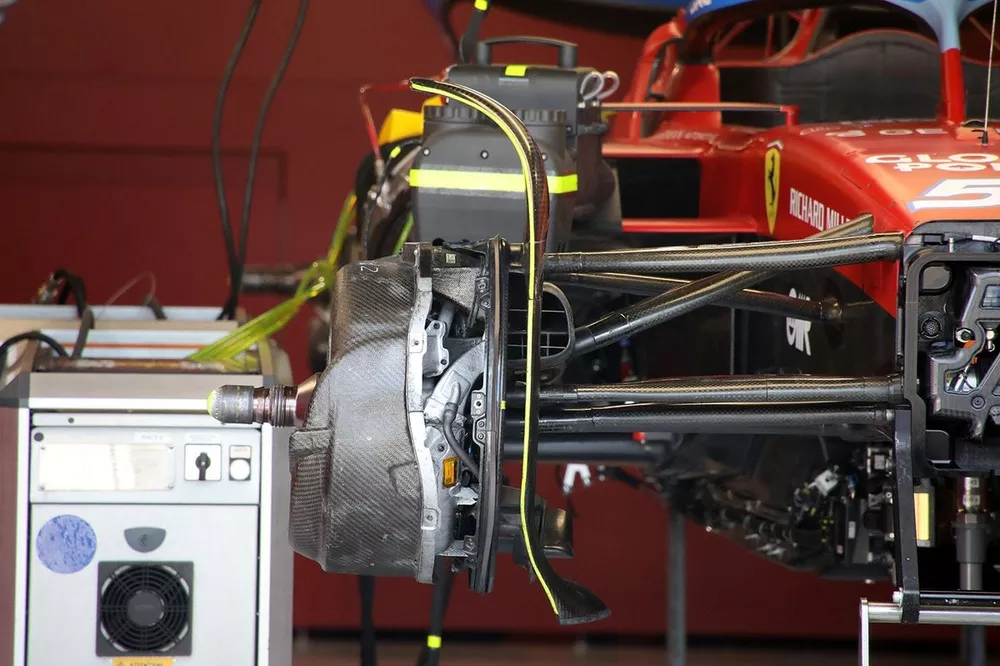
Ferrari is also employing a disc fairing to reduce heat transfer into the main brake drum, which in-turn passes that heat into the wheel rim and tyre. All of the teams are keen to control this heat transfer, given how sensitive the Pirelli tyres can be and especially as heat transfer from the brakes would create peaks and troughs in how the bulk temperature would be changed.
A close up of the rear brake duct’s inner fence. The snorkel exit is employed to reject heat and the cascade of winglets is stacked up below.
McLaren’s internal front brake pipework consists of numerous, torturously routed channels that deliver cool air to the disc and caliper, whilst reducing the transfer of heat into the main brake drum. Also note the internal configuration at the rear of the car, with an expanding chute that traverses the forward face of the assembly to deliver some of the airflow to the outer flank.
An overview of the Mercedes W15’s rear end, with the deep spoon-shaped rear wing employed, along with a double beam wing arrangement. Also note the flared upper corner of the diffuser, whilst a double stepped arrangement is favoured on the lower brake duct deflector winglet.
To help deal with the temperatures in Miami, Mercedes has a more open cooling set up, with a generous louvre arrangement employed on the bridge of the engine cover shelf, whilst another louvred panel has been deployed on the upper surface of the sidepod to help with heat rejection.
Ferrari, meanwhile, has opted for just three generously sized louvres on its engine cover for FP1.
A look at the Mercedes W15’s deep spoon-shaped rear wing from the front, with the team utilising the semi-detached flap and endplate arrangement, which helps to alter the vortex structure at the wingtip.
A close up of the VCARB 01’s rear end, which features just a single beam wing element, whilst the lower rear brake duct deflector winglet has an interesting stepped arrangement. The lower section features a half-moon shape that reverses the lower tip back upon itself.
A close up of the RB20’s front end gives us a view of the shark mouth horizontal sidepod inlet, while Red Bull has also set up the car with the two additional driver cooling nostrils on top of the chassis.
Haas has a combination of solutions on its front wing as it searches for the maximum amount of flow conditioning whilst trying to retain the right downforce performance window. This includes a double kick diveplane on the endplate, three semi-detached flaps in the endplate connection, along with an additional outwashing winglet hung from the uppermost flap and outwashing slot gap separator brackets.
Read Also:
Formula 1Verstappen: Performance, not money will steer F1 future
Formula 1Sainz: No assurance of future Audi F1 seat amid Hulkenberg deal
We want your opinion!
What would you like to see on Motorsport.com?
Take our 5 minute survey.
- The Motorsport.com Team
Read and post comments
Read also :
Share Or Save This Story
Copy link
Share on Viber
Previous article 2024 F1 Miami Grand Prix session timings and preview
Next article Alonso: Newey exit doesn't mean Red Bull F1 team is imploding
Top Comments
There are no comments at the moment. Would you like to write one?
View More & Comment

More from
Matt Somerfield

Gallery: How F1 tech evolved during the 2024 season
Formula 1
Formula 1 Dec 31, 2024
Gallery: How F1 tech evolved during the 2024 season
How McLaren’s rear wing push changed the game in F1
Formula 1
Formula 1 Dec 20, 2024
How McLaren’s rear wing push changed the game in F1
How 2026 F1 rules will help avoid identikit designs
Formula 1
Formula 1 Dec 16, 2024
How 2026 F1 rules will help avoid identikit designs
Latest news
Maverick Vinales withdraws from the Portuguese GP
MotoGP
MGP MotoGP
Portuguese GP
29 min
Maverick Vinales withdraws from the Portuguese GP
Toyota, M-Sport weigh in on the WRC 2027 Rally1-vs-Rally2 debate
WRC
WRC WRC
Rally Saudi Arabia
1 h
Toyota, M-Sport weigh in on the WRC 2027 Rally1-vs-Rally2 debate
Fernando Alonso returns to Dakar: Why his first rally-raid experience was a shock to the system
Dakar
DAKR Dakar 3 h
Fernando Alonso returns to Dakar: Why his first rally-raid experience was a shock to the system
How the F1 2026 regulations neutered Oscar Piastri's "real strength"
Formula 1
F1 Formula 1
Las Vegas GP
3 h
How the F1 2026 regulations neutered Oscar Piastri's "real strength"
Feature
Discover prime content

Top 10 F1 cars of the 1980s
Formula 1
By Kevin Turner
Top 10 F1 cars of the 1980s
Subscribe and access Motorsport.com with your ad-blocker.
From Formula 1 to MotoGP we report straight from the paddock because we love our sport, just like you. In order to keep delivering our expert journalism, our website uses advertising. Still, we want to give you the opportunity to enjoy an ad-free and tracker-free website and to continue using your adblocker.
You have 2 options:
- Become a subscriber.
- Disable your adblocker.
Subscribe now Already subscribed? Sign in here
Already disabled your adblocker?
Reload page
Manage Alerts
Subscribe