Feature
Formula 1
Opinion
Explaining the push and pull factors of Formula 1 suspension
Why has push-rod suspension become most teams’ layout of choice this year over the pull-rod format? And what are the strengths and weaknesses of each option? Our columnist explains…

Pat Symonds
Edited: Jun 25, 2026, 10:40 AM
Copy link

Share on Viber
Autosport Explains
Our experts decode the most important stories in motorsport.
One of our readers, Fabien Gautier, has asked for an explanation of push-rod and pull-rod suspension systems and asks what the pros and cons are of each. Perhaps before getting into the details, it is worth looking at both the motivation and history of these types of suspension.
It was quite common in single-seater racing cars from the 1960s onward to adopt variations of the classic double wishbone suspension. This is a design where the wheel hub is attached to the chassis by upper and lower arms that are shaped like the wishbone from a chicken, hence the name. The wider part of the wishbone, with two pivots, is attached to the frame and the single ball joint at the other end attaches to the upright, which carries the axle.
Generally, in these early designs, a coil spring would be mounted coaxially with the suspension damper, with the lower end of the damper attached to an outboard point of the lower wishbone and the top anchored to the chassis. This very simple design could give a good ratio between the vertical movement of the wheel and the compression of the spring and damper. For many reasons it is good to keep this ratio reasonably high in order to get good movement of the damper.
The trouble with such a design is that the spring damper unit is stuck in the airstream and in those early cars, which did not rely on downforce for performance, the drag associated with this position was detrimental to top speed.
Designers therefore wanted to keep this area free of obstruction, particularly at the front. The common way of doing this is exemplified by the 1961 Lotus 21 Formula 1 car, which mounted the front spring damper unit inside the chassis operated by a rocker arm that also served as the top wishbone.
Now any engineer needing to transfer load from one part of a mechanism to another will be reluctant to do it with something that puts the load transferring member in bending. It is a very inefficient way of transferring forces.
The advanced 1964 Honda RA271 was a pull-rod pioneer (this is Ronnie Bucknam’s car receiving attention at the Italian GP)
Photo by: David Phipps
Think of a tower crane at a building site. The horizontal boom is an enormous lattice of steel but the cables carrying the same load are relatively thin. This is because the boom has a bending moment applied to it while the cables are in pure tension.
This led to clever designers realising that a pull-rod would always be lighter than a rocker in a suspension system. I believe that the first use of this was at the rear of the 1964 Honda RA271. This was an amazingly advanced car for its time, and it was claimed that it had 10% less drag than its predecessor.
Over the decades to come, the pull-rod suspension came into, and went out of, fashion several times at both the front and the rear of various cars. Its advantage came from being lighter for a given installation stiffness than a rocker system or even a push-rod design. It also allows the inboard suspension – that is the springs, dampers, rockers and anti-roll bars – to be mounted lower in the car, thereby lowering the overall centre of gravity.
You must remember that aerodynamic rules all aspects of F1 car design, and in the mid-1990s designers were realising that a high nose was good for aerodynamics
This would seem the ideal solution, but you must remember that aerodynamic rules all aspects of F1 car design, and in the mid-1990s designers were realising that a high nose was good for aerodynamics. This led to wider adoption of push-rod front suspensions.
The idea was not new. It had been used at the front of both the Brabham BT52 and the McLaren MP4/1C in 1983. Even before this, the Lola Mk5 Formula Junior car of 1962 employed a push-rod front suspension. The 1983 adoption was in response to the banning of ground effect and the introduction of flat-bottomed cars. The push-rod suspension now cleaned up flow to the new underbody designs.
Structurally, the push-rod design is not as elegant as a pull-rod. Again structures, particularly slender rods, are better in tension (pull-rod) than compression (push-rod). Slender structures tend to buckle under compressive loads and therefore the cross-section needs increasing to mitigate this.
Williams has bucked this year’s trend by opting for a pull-rod set-up
Photo by: Alastair Staley / LAT Images via Getty Images
This comes at a cost of increased mass. A push-rod suspension also puts the springs and dampers higher up in the chassis or gearbox, with an associated raising of the centre of gravity.
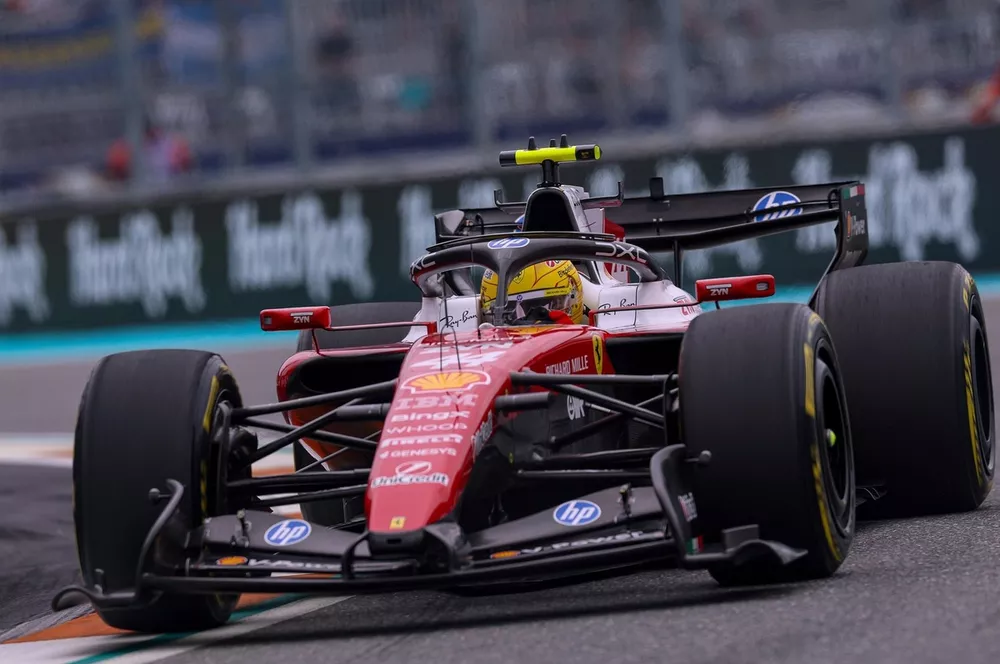
This year push-rod suspension is used by the majority of cars both at the front and the rear. So why is this if it has disadvantages of mass and centre of gravity height? The answer is twofold. Remembering that suspension design is largely driven by aerodynamics, the trend at the front is to use the suspension members to produce a down-washing wake that loads the front of the floor in the so-called bib area, thereby producing more downforce.
At the rear the reason is rather different. The maximum wheelbase allowed in 2026 is 3400mm. This is 200mm shorter than was allowed in 2025. This brought about a packaging problem. Last year it was common for much of the inboard rear suspension to be packaged in the bellhousing between the engine and gearbox.
In trying to shorten the cars, designers were forced to mount components outside this area, which meant putting them above the bellhousing and gearbox, which in turn led to the use of push-rods rather than pull-rods.
So once again we find engineering design to be a compromise. Structural efficiency has been sacrificed for aerodynamic efficiency at the front and packaging efficiency at the rear. One of the skills of design is choosing the right compromises, because compromises there will always be.
The selection of the mechanism to operate the springs and dampers as outlined here is a perfect example of this sometimes exasperating skill.
This article is one of many in the monthly Autosport magazine. For more premium content, take a look at the July 2026 issue and subscribe today.
Brabham and McLaren adopted push-rod front suspension for 1983
Photo by: LAT/Getty Images
We want to hear from you!
Let us know what you would like to see from us in the future.
Take our survey
- The Autosport.com Team
Read and post comments
Read also :
Previous article Top 10 F1 drivers of the 1990s
Next article FIA declares Heat Hazard for F1 Austrian Grand Prix
Top Comments
There are no comments at the moment. Would you like to write one?
View More & Comment
More from Pat Symonds
How F1’s rules got to be so complex
Formula 1
F1 Formula 1 10 d
How F1’s rules got to be so complex
How levelling the playing field isn’t antithetical to the principles of F1
Formula 1
F1 Formula 1 29 d
How levelling the playing field isn’t antithetical to the principles of F1

Explaining the complicated art of F1 braking
Formula 1
F1 Formula 1 2 mo
Explaining the complicated art of F1 braking

What an engineer with four decades of F1 experience would choose as the ideal engine rules
Formula 1
F1 Formula 1 2 mo
What an engineer with four decades of F1 experience would choose as the ideal engine rules

How F1 teams prepare for the British GP at Silverstone
Formula 1
F1 Formula 1
British GP
4 mo
How F1 teams prepare for the British GP at Silverstone
How to simplify the complex subject of F1's electrical rules
Formula 1
F1 Formula 1
Monaco GP
5 mo
How to simplify the complex subject of F1's electrical rules

The big change for F1 2026 that has been largely ignored
Formula 1
F1 Formula 1 6 mo
The big change for F1 2026 that has been largely ignored
How the F1 2026 cars produced some nice surprises amid the noise
Formula 1
F1 Formula 1 8 mo
How the F1 2026 cars produced some nice surprises amid the noise
Latest news
Norris: Las Vegas GP would be "scary" with current F1 wet tyres
Formula 1
F1 Formula 1
Las Vegas GP
35 min
Norris: Las Vegas GP would be "scary" with current F1 wet tyres
Aprilia's 2027 MotoGP bike front 'wing' aero explained
MotoGP
MGP MotoGP 1 h
Aprilia's 2027 MotoGP bike front 'wing' aero explained
The features set to define Formula E’s Gen4 era
Formula E
FE Formula E 2 h
The features set to define Formula E’s Gen4 era
What has Cadillac got to lose by picking Herta?
Formula 1
F1 Formula 1
Las Vegas GP
3 h
What has Cadillac got to lose by picking Herta?
Subscribe and access Autosport.com with your ad-blocker.
From Formula 1 to MotoGP we report straight from the paddock because we love our sport, just like you. In order to keep delivering our expert journalism, our website uses advertising. Still, we want to give you the opportunity to enjoy an ad-free and tracker-free website and to continue using your adblocker.
You have 2 options:
- Become a subscriber.
- Disable your adblocker.
Subscribe now Already subscribed? Sign in here
Already disabled your adblocker?
Reload page
Manage Alerts
Subscribe