Analysis
Formula 1
Analysis: Why starts have become F1 drivers' biggest headache
When Formula 1 included tweaks to the race start procedures as part of a clampdown on driver aids last year, few could have imagined the impact that they would have on this season’s championship.

Jonathan Noble
Edited: Oct 18, 2016, 10:39 AM
Copy link
Share on Viber


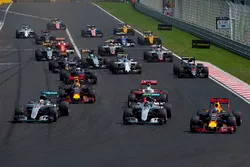


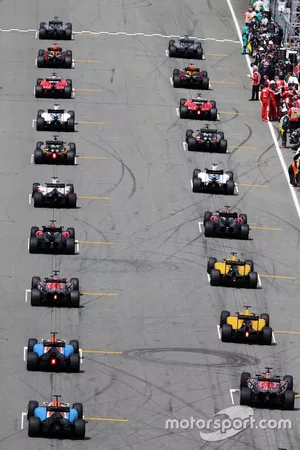


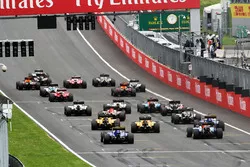


For as the campaign enters its decisive final phase, it is becoming increasingly clear that the points battle between Nico Rosberg and Lewis Hamilton is getting influenced perhaps more by how the first seconds of the race goes than almost any other time they are out on track.
Pace wise there has been very little separating the pair but when it has come to on-track tussles, but stumbles in the charge to the first corner have meant that they are rarely fighting wheel-to-wheel on a Sunday afternoon.
And worse than that for Hamilton in particular is that he has seen good opportunities in the post-summer break phase of the championship slip through his fingers thanks to botched starts – with Monza and Suzuka two clear examples that cost him victory chances.
Why then, so late in to the season, are F1's title contenders still struggling with starts?
New rules
Mercedes pair Rosberg and Hamilton are not alone though in finding it hard to make consistently good starts – look at how Max Verstappen struggled in Spa, Monza and Singapore – but they perhaps are most in the public spotlight because they are at the front of the grid.
The perception issue is something that Mercedes boss Toto Wolff has been eager to point out – that Mercedes' starts looks so much worse than its rivals because all eyes are at the front row.
"Our system is complicated, maybe more than the others," said Wolff. "But we are more in the spotlight if it goes wrong.
"If we look at the real clutch performance versus the perceived clutch performance and you compare this data, the perceived clutch performance is worse because we are out in front."
Bigger challenge
Making things harder for drivers was of course the aim of the rule changes that fully came into force for the start of this season.
In basic terms the changes seemed quite simple: drivers would only be allowed a single clutch paddle for the starts, and there would be a ban on them getting engineering feedback from the garage after their formation lap to help with clutch bite points.
The changes did not seem dramatic but from an engineering perspective they were – and just look at the way Ferrari came up with an all-new clutch paddle arrangement.
Williams performance chief Rob Smedley explains: "In the old days we could tell the drivers to set the clutch bite point to a certain place.
"[When the start lights when out] they would then let the first clutch paddle out. That would move to the perfect clutch bite point and the car would move away.
"Then they waited for a beep in their ear and they dropped the second clutch paddle. They would keep their foot in, and that was the start. Things no are very different."
Judging grip levels
The changes have had a double whammy effect: for the limit of a single clutch paddle means it has to cope with the initial standing getaway and then the subsequent period of acceleration before the wheels stop spinning.
Furthermore, drivers can no longer be told the perfect clutch bite point settings to maximise their getaway based on how their practice start was ahead of the formation lap.
Now they have to judge all alone how much grip there will be on the grid – based on the track surface, and tyre temperatures.
Get any of those aspects wrong and they will end up either bogging down or getting too much wheelspin – both scenarios that will cost them positions on the run to the first corner.
Starts have, according to Felipe Massa, become an area where small details make a big differences – and there is very little drivers can do to prepare in advance for what they find out on track.
"Before, your engineer was doing the start," said the Williams driver. "The clutch was already fixed and you would go on the grid.
"The engineer would see the grip on the tyres and he says 'go to clutch 5' because he believes that is best – so you would have the right grip for the grid
"You were also using two clutches, which meant it was much more difficult to get it wrong. Now everything is different because you have only one paddle.
"You need to modulate in a more manual way compared to how it was before, and you don't know the grip by doing the start on the grid, how is it. It has to come from your mind."
Reflecting on why starts go wrong, Massa's teammate Valtteri Bottas said: "Either you have not managed to get enough temperature in the rear tyres in the formation lap, then you have wheelspin, or the clutch can behave slightly differently in different temperatures.
"When you do the practice start on the formation lap it brings the temperature up, and then sometimes it can bite a bit more because of the temperature – so it depends on the clutch. It is not always behaving and it is not always behaving 100 percent consistently.
"Or you make a miscalculation yourself. You think you have less grip than you have actually have on the grid or more than you actually have.
"There are many things that can go wrong. You need to try to keep it simple. Feel the grip, analyse your formation lap, and have a guess how much you have grip on the start."
Inconsistency
That reference to clutch inconsistency is something that has been mentioned many times by Mercedes – which has been chasing a cure to its start issues since Hamilton's poor getaway in Australia cost him so badly there.
Remember too in Singapore that Red Bull knew on Saturday night that the clutch in Verstappen's car was not working as consistently as they had hoped – but a request to the FIA to change it was not accepted because it was not actually broken.
The Mercedes clutch inconsistency has made it extremely difficult for both Hamilton and Rosberg to judge perfectly where they need to balance the clutch and throttle for the start – because how the clutch behaves on one getaway may not be how it behaves for the next one. Each time is almost a step into the unknown.
Mercedes knows that a permanent fix to its clutch issues is not something that can be done during the course of the season – and it means no matter how much Hamilton and Rosberg work to improve things, there remains scope for trouble.
The team has of course been doing everything in its power to try to help its drivers – and that has included a scientific look at how the drivers' fingers are placed on the clutch paddle and where the seams are on their gloves.
Wolff added: "The clutch system is not perfect we are giving to them. It is difficult to handle the clutch in the right way, both have worked on it and going as far as changing the way the glove is done to release it [the clutch].
"Someone has even studied the length of Nico's middle finger for the biting point and how the glove is being sewn.
"It is a question of how you release it and the revs. Then there is the random factor of getting all that right and it is not very easy with the clutch."
What is clear is that Mercedes does not yet have a foolproof system and a better clutch will only come for 2017.
So everything points to the potential for decisive championship moments happening within seconds of the lights going out at the final races of the year – starting at Austin this weekend – and likely further frustrations for Rosberg of Hamilton.
We want your opinion!
What would you like to see on Motorsport.com?
Take our 5 minute survey.
- The Motorsport.com Team
Read and post comments
Read also :
Share Or Save This Story
Copy link
Share on Viber
Previous article A new teenager in F1: Lance Stroll Williams announcement due in early November
Next article Magnussen: "Nothing to IndyCar rumours"
Top Comments
There are no comments at the moment. Would you like to write one?
View More & Comment

More from
Jonathan Noble

Brundle awarded OBE in King’s New Year’s honours
Formula 1
Formula 1 Dec 31, 2024
Brundle awarded OBE in King’s New Year’s honours
The new rules dilemma that will define the 2025 F1 season
Formula 1
Formula 1 Dec 31, 2024
The new rules dilemma that will define the 2025 F1 season
Verstappen issues Red Bull title warning in push for RB21 progress
Formula 1
Formula 1
Australian GP
Dec 28, 2024
Verstappen issues Red Bull title warning in push for RB21 progress

More from
Lewis Hamilton
Lewis Hamilton: Ferrari’s top-speed deficit was “brutal” at F1 Las Vegas GP
Formula 1
Formula 1
Las Vegas GP
1 d
Lewis Hamilton: Ferrari’s top-speed deficit was “brutal” at F1 Las Vegas GP

Why Ferrari believes written rules won't help manage Charles Leclerc and Lewis Hamilton
Formula 1
Formula 1
Las Vegas GP
1 d
Why Ferrari believes written rules won't help manage Charles Leclerc and Lewis Hamilton

More from
Red Bull Racing
Isack Hadjar frustrated – What really happened on Red Bull's team radio in Las Vegas
Formula 1
Formula 1
Las Vegas GP
21 h
Isack Hadjar frustrated – What really happened on Red Bull's team radio in Las Vegas

Max Verstappen reveals he is considering 2027 Daytona 24 Hours entry
Formula 1
Formula 1
Las Vegas GP
1 d
Max Verstappen reveals he is considering 2027 Daytona 24 Hours entry
Latest news

Joe Gibbs Racing constructs timeline of Chris Gabehart's alleged theft
NASCAR Cup
NAS NASCAR Cup 8 h
Joe Gibbs Racing constructs timeline of Chris Gabehart's alleged theft

IndyCar adds Kansas Speedway to 2027 schedule in joint NASCAR weekend
IndyCar
Indy IndyCar 12 h
IndyCar adds Kansas Speedway to 2027 schedule in joint NASCAR weekend
Decision time looms for Colton Herta after 2027 Cadillac F1 snub
Formula 1
F1 Formula 1
Las Vegas GP
13 h
Decision time looms for Colton Herta after 2027 Cadillac F1 snub
Kalle Rovanpera: New 2027 WRC cars will see "everybody start from zero"
WRC
WRC WRC 14 h
Kalle Rovanpera: New 2027 WRC cars will see "everybody start from zero"
Feature
Discover prime content


Subscribe and access Motorsport.com with your ad-blocker.
From Formula 1 to MotoGP we report straight from the paddock because we love our sport, just like you. In order to keep delivering our expert journalism, our website uses advertising. Still, we want to give you the opportunity to enjoy an ad-free and tracker-free website and to continue using your adblocker.
You have 2 options:
- Become a subscriber.
- Disable your adblocker.
Subscribe now Already subscribed? Sign in here
Already disabled your adblocker?
Reload page
Manage Alerts
Subscribe