Formula 1
Analysis: Why F1 drivers will struggle to get it right with new rules on starts
The F1 drivers will be under pressure at this weekend's Belgian Grand Prix, as new rules regarding how the clutch can be prepared for the start wil...
Edited: Aug 19, 2015, 8:43 AM
Copy link
Share on Viber

Motorsport Blog
Motorsport Blog
The F1 drivers will be under pressure at this weekend's Belgian Grand Prix, as new rules regarding how the clutch can be prepared for the start will come into force. It is bound to make the starts more variable, due to the nature of the way an F1 clutch works.
What we are likely to see from the Belgian Grand Prix is more variability of starts, where drivers get away at different rates - making for more exciting getaways like Silverstone and Budapest. Up to now, starts like those were less common, instead the field tended to get away in a uniform block, with some variability on occasions.
So what exactly does it all mean and why will it make it harder for the drivers? With the help of JA on F1 technical adviser Dominic Harlow, former chief operations engineer at Force India, we will explain.

It's all about the bite point
Anyone who has driven a car or motorbike with a clutch, knows that as you release the clutch and feed in the throttle there is a point at which you start to feel drive and the vehicle begins to move. This is called the clutch "Bite Point".
The new rules say that on race day, F1 drivers have to prepare the clutch bite point settings for the start themselves without help from their team engineers in the vital moments before the race. So the chances of getting it wrong increase.
But there is a built-in variable here and this has to do with the material the clutch is made from. F1 cars have carbon clutches, which are very strong, but they are also sensitive to temperature. That makes them inconsistent and as a result the bite point isn’t always predictable.
So the complex procedures that the drivers and teams used to go through before the start were designed to iron out those inconsistencies.
An F1 car has two clutch paddles. For the race start, the driver holds the master paddle in fully while the other is set to the exact bite point which will get the car moving. This is the point which teams go to great lengths to establish during the weekend and especially on the dummy grid.
To start the car, the driver revs to around 6,000 rpm, releases the master clutch and then releases the second one, which is set at the chosen bite point - the car should get away smoothly.
That part will still be the same. What changes is that the driver has to find that bite point himself on race day and the team cannot help him once he leaves the pit lane to go to the grid. So inevitably some will get it right and some will get it wrong.
We have seen some drivers have problems even with the measures which used to be in place to minimise the inconsistency. Now that it is up to the drivers again, it will certainly mix things up and that in turn will make for more interesting races as drivers try to recover using a mixture of aggressive overtakes and race strategy.

What are the potential problems?
F1 Teams go to great lengths to get the bite point right because they are trying to avoid three bad things from happening - wheelspin, the car bogging down on getaway and also clutch slip, all of which lose vital time and track positions.
This is why drivers do many practice starts at the pit lane exit during practice; so the engineers can monitor the clutch's performance on the telemetry and work out the best bite point for the race. In the past, before the procedures which have now been banned, monied teams used to try out multiple clutches in a weekend and discard the ones which seemed less consistent, which was wasteful.
We may well see a return of this practice, as teams with more cash will find a solution to the consistency question.
The crucial final check is when the driver pulls away from the dummy grid for the formation lap; the team closely monitors the clutch’s performance on the telemetry and it is also the first opportunity to get a read on the grip level on the tarmac where his grid slot is on the track. They then used to instruct the driver precisely where to set the clutch for the actual race start.
This will no longer be allowed from Belgium onwards; the driver will have to work it all out for himself.

One one level it's a vital skill that is being returned to the driver, rather than controlled from the pit wall, which is a positive step in the campaign, after team radio restrictions, to make the drivers more autonomous and less visibly reliant on team instructions.
So we should see more mixed up race starts and that will lead to more interesting races, as the fast cars attempt to make up lost ground.
But inevitably it is an area where the teams with more money are likely to reduce the variability more quickly than those without the resources.
What do you think? Will it shake things up in F1 or will the same drivers still win? Leave your comments below

We want your opinion!
What would you like to see on Motorsport.com?
Take our 5 minute survey.
- The Motorsport.com Team
Read and post comments
Read also :
Share Or Save This Story
Copy link
Share on Viber
Previous article Analysis: Verstappen and Sainz pass Toro Rosso's 'crash test'
Next article Haas could open up US market for F1 - de Ferran
Top Comments
There are no comments at the moment. Would you like to write one?
View More & Comment
Latest news
Cadillac scraps V6 F1 engine, delays entry as PU manufacturer
Formula 1
F1 Formula 1
Las Vegas GP
40 min
Cadillac scraps V6 F1 engine, delays entry as PU manufacturer
LIVE: F1 Las Vegas GP updates - Lap times tumble in FP2 with track now fit for inters
Formula 1
F1 Formula 1
Las Vegas GP
1 h
LIVE: F1 Las Vegas GP updates - Lap times tumble in FP2 with track now fit for inters
F1 Las Vegas GP: Rain ruins FP1 running
Formula 1
F1 Formula 1
Las Vegas GP
2 h
F1 Las Vegas GP: Rain ruins FP1 running

Nike joins F1 as apparel partner
Formula 1
F1 Formula 1
Las Vegas GP
4 h
Nike joins F1 as apparel partner
Feature
Discover prime content
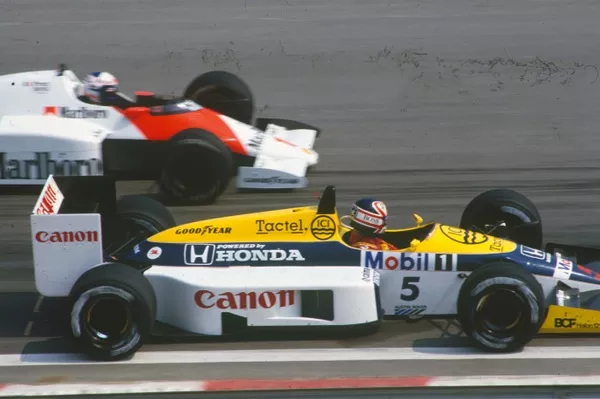
Top 10 F1 cars of the 1980s
Formula 1
By Kevin Turner
Top 10 F1 cars of the 1980s


Subscribe and access Motorsport.com with your ad-blocker.
From Formula 1 to MotoGP we report straight from the paddock because we love our sport, just like you. In order to keep delivering our expert journalism, our website uses advertising. Still, we want to give you the opportunity to enjoy an ad-free and tracker-free website and to continue using your adblocker.
You have 2 options:
- Become a subscriber.
- Disable your adblocker.
Subscribe now Already subscribed? Sign in here
Already disabled your adblocker?
Reload page
Manage Alerts
Subscribe