Analysis
Formula 1 Malaysian GP
Analysis: Mercedes 'open-ended' front wing a sign of 2017 aggression
Mercedes arrived in Malaysia with one eye on 2017, as it tested a new front wing solution that we understand has more to do with next year's car than this.
Giorgio Piola Matt Somerfield
Edited: Oct 13, 2016, 7:56 PM
Copy link
Share on Viber
Giorgio Piola's F1 technical analysis
Giorgio Piola is the preeminent Formula 1 technical journalist. View our full selection of Giorgio's technical illustrative content
It wouldn't be the first time that Mercedes has shown some of its hand a little early, with the team assessing a new suspension and 'S' duct configuration in Brazil last season, ahead of a more complex design integrated in this year's W07.
The new front wing was used briefly during practice by Lewis Hamilton, as the team looks to establish if it is moving in the right direction with its development of the W08.
It will not only be keen to gain driver feedback but also examine data gathered by the various pressure sensors mounted within the wing too.
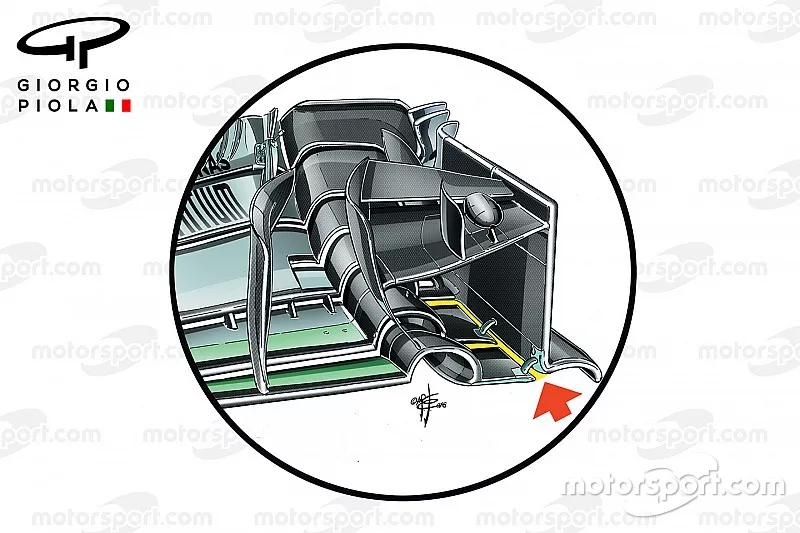
The new design takes a leaf from the open-ended louvre design that several teams, including Mercedes, have adopted on the rear wing, with the leading edge of the surface exposed to the oncoming airflow, changing the way in which the airflow behaves in relation to other pressure gradients.
In the case of the front wing, Mercedes has detached the mainplane from the endplate and footplate, while the numerous flapped surfaces that follow remain attached.
It's understood that these changes have been identified as ways of improving the wings sensitivity to pitch and yaw, not only improving localised performance but the control they're trying to assert downstream too.
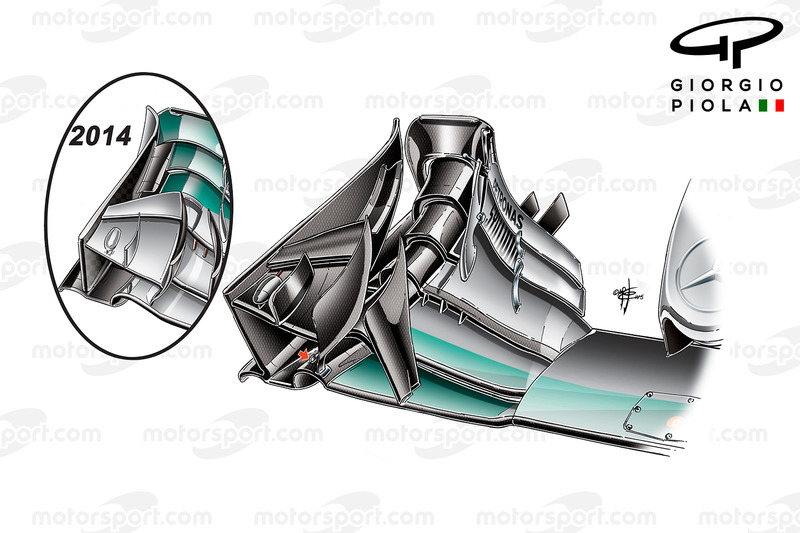
Mercedes W06 front wing, Chinese GP
Photo by: Giorgio Piola
Paramount to this is the 'tunnel', a concept that the team first introduced in Malaysia 2015 (above, with older design inset) and has since been copied by other teams intent on improving the front wing's relationship with the tyre behind.
The tyre represents a significant challenge in the aerodynamic battle for superiority as it rotates, deforms and moves in yaw numerous ways during a corner, let alone a lap. Controlling the air it sheds is essential to the amount of downforce that can be made by the entire car, while the tyres also contribute to a significant proportion of the car's drag if left untreated.
These are both characteristics that a team wish to hone in on and exploit, with the front wings proximity essential to gaining performance. The tunnel created by Mercedes is but one of the devices the front wing devices used by the team to restructure how airflow moves around the tyre and is something it will be eager to improve.
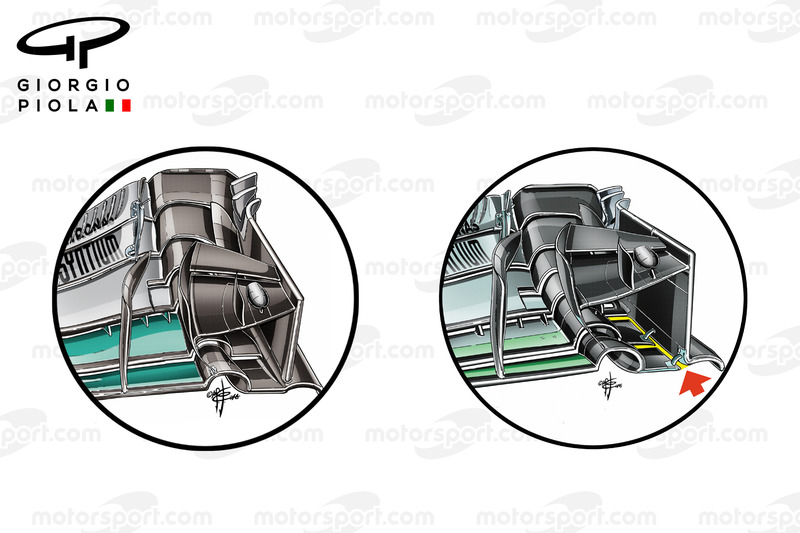
Mercedes W07 Canadian GP and Malaysian GP endplates comparison
Photo by: Giorgio Piola
As such, the wing's slots normally continue outward past the tunnel toward the endplate (left) to inject airflow into the tunnel under conditions where, ordinarily, it may be starved of airflow and lose performance.
This new design goes one step further, shedding some of the flap's bulk and isolating the endplate and footplate, so as not to interfere with the tunnel and further improve its performance as the car transitions.
Small metal bridges (arrowed) are used to prevent the wing from flexing unduly under load, something that must have posed quite a challenge given the load tests conducted by the FIA in this area of the wing.
Turning our attention to why this might be important, changes to the regulations see a revised relationship between the front wing and tyre for 2017.
The tyre is 60mm wider, up from 245mm to 305mm, while the front wing's relationship with the outer section of the tyre is also revised, with front track up from 1800mm to 2000mm the front wing dimensions are askew.
This is due to the fact that the front wing will be 1800mm rather than 1650mm, giving the teams an extra 75mm either side of the centreline to work with.
While this may seem like a small concession, we have to understand that they also have to deal with the new deltoid shaping too as the wing is effectively moved forward to accommodate it.
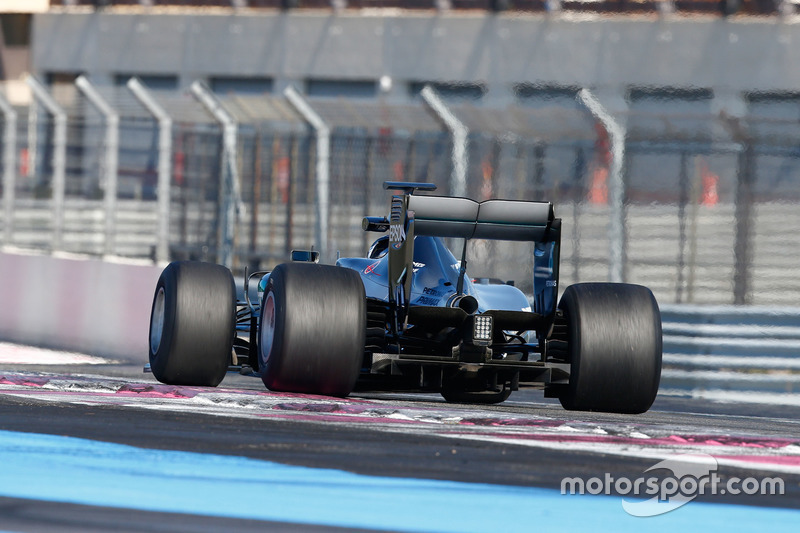
Pascal Wehrlein, Mercedes AMG F1 W06 Hybrid with 2017 Pirelli tyres
Photo by: Daimler AG
Mercedes is one of only three teams to have gone to the expense of creating a mule car to help Pirelli with the testing of next year's tyres.
It has been argued by many of the other team principals that, while they'd have loved to build mule cars, they couldn't afford to. It was simply too much strain in terms of both cost and development resources, given that would mean three development projects - the remainder of 2016, a mule car and the 2017 design.
However, these same team principals are well aware of the advantages that Mercedes, Red Bull and Ferrari may gain, as even though they're restricted in the parts they can use, it's still possible to learn from the time on track.
With such a significant shape change for 2017, the front wing is going to be a hotbed for development in the early stages of next season, and so it's interesting that Mercedes has decided to show its hand in regard to this open-ended mainplane solution, given the time it now affords others to assess and adopt it should they think it bears fruit.
Or is it simply Mercedes gaming the opposition into a development that it has already discovered doesn't yield significant gains?
We want your opinion!
What would you like to see on Motorsport.com?
Take our 5 minute survey.
- The Motorsport.com Team
Read and post comments
Read also :
Share Or Save This Story
Copy link
Share on Viber
Previous article Bottas blames engine mode error for missing Q3
Next article Palmer says qualifying performance “depressing”
Top Comments
There are no comments at the moment. Would you like to write one?
View More & Comment
More from
Giorgio Piola
The fascinating story behind McLaren's most iconic F1 car
Formula 1
Formula 1 Apr 3, 2024
The fascinating story behind McLaren's most iconic F1 car
Emilia Romagna GP: F1 technical images from Imola's pitlane
Formula 1
Formula 1
Emilia Romagna GP
Apr 21, 2022
Emilia Romagna GP: F1 technical images from Imola's pitlane
The F1 downforce choices that proved key at the Saudi GP
Formula 1
Formula 1
Saudi Arabian GP
Mar 29, 2022
The F1 downforce choices that proved key at the Saudi GP

More from
Mercedes
Zak Brown rules out McLaren engine programme for F1 2030
Formula 1
Formula 1
Las Vegas GP
17 h
Zak Brown rules out McLaren engine programme for F1 2030

Latest news

Judge denies Joe Gibbs Racing an injunction against Spire
NASCAR Cup
NAS NASCAR Cup 10 h
Judge denies Joe Gibbs Racing an injunction against Spire
Five things to look out for at F1’s Qatar GP
Formula 1
F1 Formula 1
Qatar GP
13 h
Five things to look out for at F1’s Qatar GP
AF Corse USA steps up to full-season IMSA GTD campaign in 2027
IMSA
IMSA IMSA 14 h
AF Corse USA steps up to full-season IMSA GTD campaign in 2027
Williams, Alpine fall foul of F1's 2025 cost cap
Formula 1
F1 Formula 1 14 h
Williams, Alpine fall foul of F1's 2025 cost cap
Feature
Discover prime content
Top 10 F1 cars of the 1990s
Formula 1
By Kevin Turner
Top 10 F1 cars of the 1990s


Subscribe and access Motorsport.com with your ad-blocker.
From Formula 1 to MotoGP we report straight from the paddock because we love our sport, just like you. In order to keep delivering our expert journalism, our website uses advertising. Still, we want to give you the opportunity to enjoy an ad-free and tracker-free website and to continue using your adblocker.
You have 2 options:
- Become a subscriber.
- Disable your adblocker.
Subscribe now Already subscribed? Sign in here
Already disabled your adblocker?
Reload page
Manage Alerts
Subscribe