Formula 1
The S-duct divide between Mercedes and Red Bull
The 'S' duct has been a staple of Formula 1 since 2012, when Sauber introduced the solution to help overcome aerodynamic inefficiencies triggered by the step nose regulations.
Giorgio Piola Matthew Somerfield
Edited: Oct 3, 2021, 6:59 AM
Copy link
Share on Viber
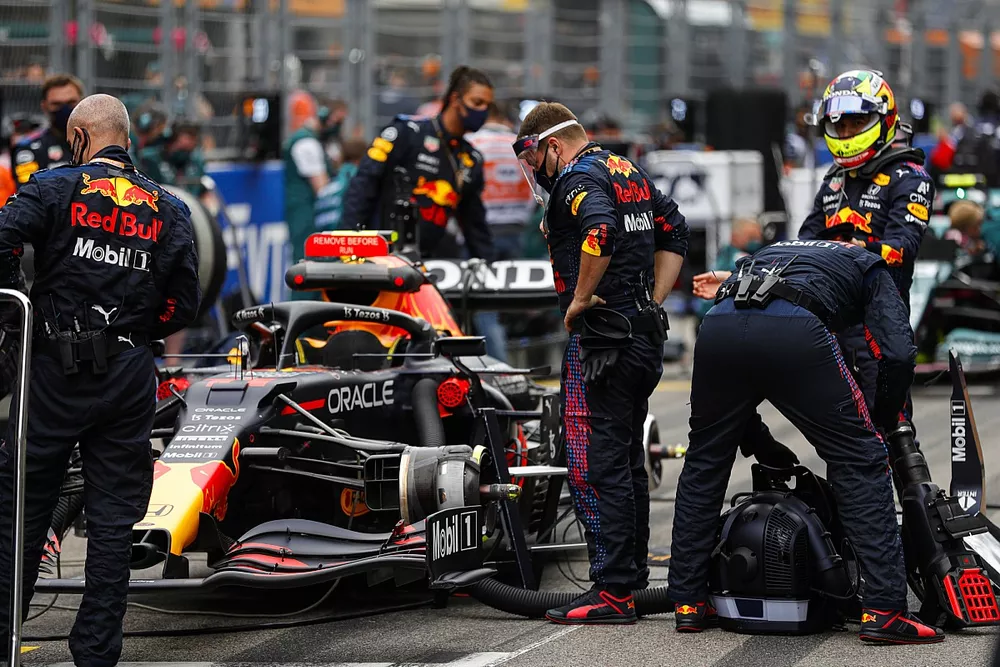
Giorgio Piola's F1 technical analysis
Giorgio Piola is the preeminent Formula 1 technical journalist. View our full selection of Giorgio's technical illustrative content
It became known as the 'S' duct due to the shape of the ductwork housed within the 150mm space that it was allowed to occupy ahead of the front wheel centreline.
And whilst the design still bears that exact same name nearly a decade on, the complexities have increased somewhat over the years.
Sauber C31 S duct
Photo by: Giorgio Piola
The turning point came in 2016 when both Toro Rosso and Mercedes both came upon solutions that allowed them to place the inlet much further forward, as had been the case with Ferrari's earlier nose duct interpretation in 2008.
This was made possible by an interpretation of the single section rules, meaning that the inlet isn't truly a hole but was rather a clam shell-like opening.
A cut was taken through the assembly, which still provided the single section required by the regulations.
This is why, when you look into the inlet of many of the solutions, you'll see dividers which help teams to maintain that legality.
Only one team on the grid doesn't currently have an 'S' duct on its car – McLaren – with everyone else having spent the last few years fine tuning theirs.
At the front of the grid, Mercedes and Red Bull are similar in having nose assemblies with a 'cape' attached to the main body of the nose.
However, the internal and external make-up of their 'S' duct solutions are still vastly different, as can be seen here in Giorgio Piola's latest illustrations.
Both have inlets on either side of the nose in the forward position, to help draw the air in earlier.
But whilst Mercedes maintains separate right and left channels to feed the airflow to the outlet housed on the vanity panel that's then mounted on the chassis, Red Bull has its merged into a single channel that feeds its much narrower outlet.
There's a variety of reasons why a team might opt for one design format over the other for the internal pipework of the 'S' duct.
However, the most obvious is the make-up of the internal structure of the nose, which must be able to pass the FIA's stringent crash test requirements.
Whilst discussing Red Bull's nose, it's also interesting to note the changes that the team has made to its assembly to improve flow under the chassis.
You'll note that whereas most teams, such as Mercedes, create a narrow boat tail under the nose toward the central section of the cape, Red Bull has opted for a wider opening.
This opening now boxes in the section under the chassis where the team used to house its turning vanes, and it provides a controlled passageway for the airflow captured under the nose.
Red Bull Racing RB16B front nose comparison
Photo by: Giorgio Piola
We want your opinion!
What would you like to see on Motorsport.com?
Take our 5 minute survey.
- The Motorsport.com Team
Read and post comments
Read also :
Share Or Save This Story
Copy link
Share on Viber
Previous article Norris put in two-day sim session to help analyse Russian GP errors
Next article How McLaren's 'united' culture is feeding its F1 charge
Top Comments
There are no comments at the moment. Would you like to write one?
View More & Comment
More from
Giorgio Piola
The fascinating story behind McLaren's most iconic F1 car
Formula 1
Formula 1 Apr 3, 2024
The fascinating story behind McLaren's most iconic F1 car

Emilia Romagna GP: F1 technical images from Imola's pitlane
Formula 1
Formula 1
Emilia Romagna GP
Apr 21, 2022
Emilia Romagna GP: F1 technical images from Imola's pitlane
The F1 downforce choices that proved key at the Saudi GP
Formula 1
Formula 1
Saudi Arabian GP
Mar 29, 2022
The F1 downforce choices that proved key at the Saudi GP
Latest news

NASCAR set to incrementally increase horsepower as part of 2027 Cup rules
NASCAR Cup
NAS NASCAR Cup 1 h
NASCAR set to incrementally increase horsepower as part of 2027 Cup rules

Hollywood star Christian Bale wants to portray MotoGP’s “gods” in a movie
MotoGP
MGP MotoGP
Portuguese GP
2 h
Hollywood star Christian Bale wants to portray MotoGP’s “gods” in a movie
Marc Marquez's body felt "stiffer" in Portimao practice: "I’m the only one who can lose”
MotoGP
MGP MotoGP
Portuguese GP
2 h
Marc Marquez's body felt "stiffer" in Portimao practice: "I’m the only one who can lose”

'Marco Bezzecchi is fastest at Portimao,' says Alex Marquez - after going fastest
MotoGP
MGP MotoGP
Portuguese GP
3 h
'Marco Bezzecchi is fastest at Portimao,' says Alex Marquez - after going fastest
Feature
Discover prime content



Top 10 F1 cars of the 1980s
Formula 1
By Kevin Turner
Top 10 F1 cars of the 1980s
Subscribe and access Motorsport.com with your ad-blocker.
From Formula 1 to MotoGP we report straight from the paddock because we love our sport, just like you. In order to keep delivering our expert journalism, our website uses advertising. Still, we want to give you the opportunity to enjoy an ad-free and tracker-free website and to continue using your adblocker.
You have 2 options:
- Become a subscriber.
- Disable your adblocker.
Subscribe now Already subscribed? Sign in here
Already disabled your adblocker?
Reload page
Manage Alerts
Subscribe