Analysis
Formula 1 Styrian GP
F1 technical update: Ferrari, Red Bull, McLaren & Williams
In the ongoing development war between Formula 1’s teams, keep up to date with what’s new with our regular technical updates. Today, let’s look at three outfits at the Styrian GP – Ferrari, Red Bull Racing, McLaren and Williams.
Giorgio Piola Matthew Somerfield
Edited: Jul 13, 2020, 7:03 PM
Copy link
Share on Viber
Giorgio Piola's F1 technical analysis
Giorgio Piola is the preeminent Formula 1 technical journalist. View our full selection of Giorgio's technical illustrative content
The second Grand Prix in as many weeks again delivered on the upgrades front, as the teams push hard to recover from time lost during lockdown. A number of teams had new parts in a quest to not only improve performance this week but to get ahead of the game for the Hungarian GP and beyond.
Read Also:
- Explained: Why Renault launched a Racing Point protest
- Mercedes and Bottas agree new deal for 2021 F1 season
Ferrari
The Scuderia has been adrift of its primary rivals for some time now, with the winning streak between Belgium and Singapore last season seeming like a distant memory. The subsequent sanctions over its operation of the power unit has clearly hit them hard but it also appears to have headed in the wrong direction with the aerodynamic package too.
The team rushed through some of the new parts updates originally scheduled for the Hungarian GP to the second race in Austria in an effort to arrest the slide and help get a real handle on where it has gone wrong. The update included a new front wing and floor, both of which look to alter the way in which the aerodynamic surfaces cater for the wake turbulence created by the tyres.
Ferrari SF1000 front wing, Styrian GP
Photo by: Giorgio Piola
The changes made to the front wing (inset) include a new footplate, as the team return to an arched design, rather than the flat version used for some time now. Several changes were made to the upper flaps, with the outermost section now joined to the endplate at a lower point and the inboard geometric shape altered too.
Read Also:
- Binotto: Results 'not good enough for a team named Ferrari'
- Vettel and Leclerc "mature enough" to move on from clash
Ferrari SF1000 floor comparison, Styrian GP
Photo by: Giorgio Piola
Teams have been using the slots on the edge of the floor as a means of controlling the wake turbulence created by the front tyre, limiting how much is ingested by creating flow structures that ‘seal’ the edge of the floor. Ferrari had settled on using three longitudinal fully-enclosed holes ahead of four angled holes just in front of the rear tyre.
The new design shortens these longitudinal holes in favor of more holes angled at 45 degrees ahead of the rear tyre. These holes help to limit the effects of tyre squirt on the diffuser, with airflow pushed laterally into the diffusers path, robbing it of performance, if left unchecked.
The horizontal flap that Ferrari mounted above the floor has been altered too, with a more twisted profile used where it connects to the vertical strake, amplifying its effect. These changes suggest that Ferrari had gone too far in its quest to control the front tyre wake, which resulted in a loss of performance and stability at the rear of the car.
Red Bull
Red Bull Racing RB16 rear wing endplate comparison
Photo by: Giorgio Piola
Red Bull had a new rear wing available for the second race of the season which was not only significantly more complex than its predecessor (which was very similar to that on last year's RB15, see inset), it also featured several distinguishing features already seen elsewhere up and down the grid.
Read Also:
- Mercedes advantage mostly on straights, says Red Bull
- Horner: Everyone should be "worried" by Racing Point's pace
Haas F1 Team VF-19 rear wing detail
Photo by: Giorgio Piola
Mercedes AMG F1 W10 rear wing detail
Photo by: Giorgio Piola
Haas (above left) and Mercedes both introduced fresh ideas at the German Grand Prix in 2019, Haas with its sinuously shaped hanging vanes and Mercedes with its serrated upper rear cutout, both of which have found their way into the RB16’s design package.
Toro Rosso STR14 rear wing detail
Photo by: Giorgio Piola
Alfa Romeo Racing C38 rear wing detail
Photo by: Giorgio Piola
A design concept first seen on the sibling STR14 (above left), and subsequently on the Alfa Romeo, is also present. The designers fold the upper front corner of the endplate to deliberately influence the airflow in a different way and, just like the sinuous hanging vanes, serrated rear cutouts and new upwash strikes that have been added, all of these are used to alter the strength of the tip vortex and the overall drag-to-downforce ratio of the wing.
Red Bull RB16 rear wing detail
Photo by: Andy Hone / Motorsport Images
It appears that Red Bull has to work on the structural integrity of the new hanging strake design though, as both drivers ended up finishing the race without them and likely suffering from an imbalance due to it. It appears that the team was not convinced by the updates introduced at the first race in Austria, as neither driver raced the new nose or floor (below).
Red Bull Racing RB16 front wing Austrian GP
Photo by: Giorgio Piola
Red Bull Racing RB16 floor
Photo by: Giorgio Piola
McLaren
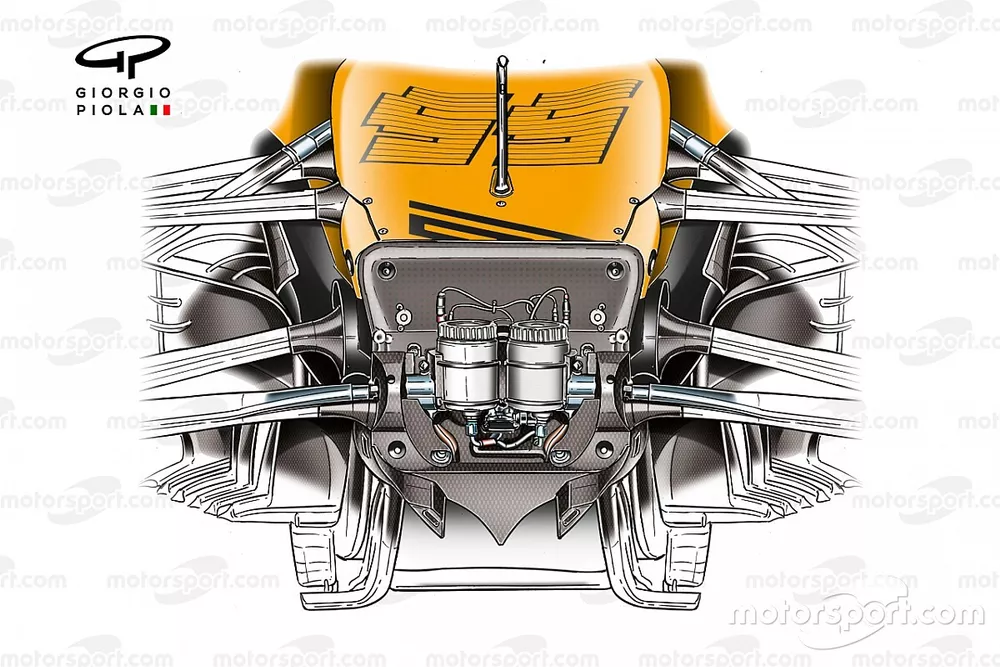
McLaren MCL35 chassis front
Photo by: Giorgio Piola
McLaren continues to impress, with the MCL35 proving to be even handier than perhaps the team imagined, relative to its competitors. This illustration above highlights a novel solution, as the team uses a triangular-shaped chin spoiler beneath the chassis that undoubtedly helps to guide the airflow toward its intended target.
McLaren MCL35 floor detail
Photo by: Giorgio Piola
McLaren MCL35 engine cover detail
Photo by: Mark Sutton
The team also used some Free Practice time at the second race in Austria to test out some experimental parts and cooling solutions it’ll use in Hungary. The image (above left) shows the new floor solution trialled by McLaren, which is similar to the one run by Ferrari, with a flap mounted above the floor ahead of the rear tyre which connects to the vertical floor strake.
With temperatures expected to have an impact on performance in Hungary, the team evaluated a solution we’ve seen from previous years, whereby a flap is placed on the trailing edge of the cooling outlet to act much like a Gurney flap to extract heat from the outlet beneath.
Read Also:
- Norris has "made next step" as a driver - McLaren
- McLaren to keep "open book" approach with Sainz through 2020
Williams
Another team that impressed during the wet weather on Saturday was Williams, with a collection of smaller parts used on the FW43 to advance its performance. Although it slipped back during the race, the signs are encouraging that the team is beginning to turn a corner.
Williams FW43 bracket detail
Photo by: Giorgio Piola
Tested during Free Practice during the first race weekend in Austria, the team once again evaluated a new, slimmer suspension upright extension this weekend, as it looks to make aerodynamic gains without losing structural integrity.
George Russell, Williams FW43 downwash fin & T-Wing detail
Photo by: Andy Hone / Motorsport Images
Both drivers had a new T-Wing available to them (blue arrow), with an extended endplate employed to influence the surrounding airflow that the previous looped variant didn’t feature.
At the front of the car, a new chassis fin could be found on just the right-hand side of George Russell’s FW43 (red arrow), which is an interesting asymmetric feature given they have an air-to-air intercooler on one side of the car and a normal engine coolant radiator on the other.
Read Also:
- Williams frustrated that Russell missed Q3 slot
- Williams in talks with "high quality" potential investors
We want your opinion!
What would you like to see on Motorsport.com?
Take our 5 minute survey.
- The Motorsport.com Team
Read and post comments
Read also :
Share Or Save This Story
Copy link
Share on Viber
Previous article Mercedes and Bottas agree new deal for 2021 F1 season
Next article Explained: Why Renault launched a Racing Point protest
Top Comments
There are no comments at the moment. Would you like to write one?
View More & Comment
More from
Giorgio Piola
The fascinating story behind McLaren's most iconic F1 car
Formula 1
Formula 1 Apr 3, 2024
The fascinating story behind McLaren's most iconic F1 car
Emilia Romagna GP: F1 technical images from Imola's pitlane
Formula 1
Formula 1
Emilia Romagna GP
Apr 21, 2022
Emilia Romagna GP: F1 technical images from Imola's pitlane
The F1 downforce choices that proved key at the Saudi GP
Formula 1
Formula 1
Saudi Arabian GP
Mar 29, 2022
The F1 downforce choices that proved key at the Saudi GP

More from
Ferrari

Max Verstappen on Ferrari clashes: "I would never sign two number-one drivers"
Formula 1
Formula 1
Sao Paulo GP
1 d
Max Verstappen on Ferrari clashes: "I would never sign two number-one drivers"
Latest news
“I was getting beat up” – How Daniel Ricciardo burned out on ‘humiliating’ F1 return
Formula 1
F1 Formula 1 2 h
“I was getting beat up” – How Daniel Ricciardo burned out on ‘humiliating’ F1 return

Myers Riley Motorsports adds Andretti alongside returning Fraga for 2027 IMSA GTD campaign
IMSA
IMSA IMSA 3 h
Myers Riley Motorsports adds Andretti alongside returning Fraga for 2027 IMSA GTD campaign

Las Vegas GP reveals neon sign-inspired trophy design
Formula 1
F1 Formula 1
Las Vegas GP
3 h
Las Vegas GP reveals neon sign-inspired trophy design
Feature
Discover prime content


Top 10 F1 cars of the 1970s
Formula 1
By Kevin Turner
Top 10 F1 cars of the 1970s

Subscribe and access Motorsport.com with your ad-blocker.
From Formula 1 to MotoGP we report straight from the paddock because we love our sport, just like you. In order to keep delivering our expert journalism, our website uses advertising. Still, we want to give you the opportunity to enjoy an ad-free and tracker-free website and to continue using your adblocker.
You have 2 options:
- Become a subscriber.
- Disable your adblocker.
Subscribe now Already subscribed? Sign in here
Already disabled your adblocker?
Reload page
Manage Alerts
Subscribe