Analysis
Formula 1
How similar are the Racing Point and Mercedes brake ducts?
While a number of Formula 1 teams have been uneasy for months about the similarities between this year’s Racing Point and last season’s Mercedes, the matter has now escalated after Renault protested the team.

Matt Somerfield
Edited: Jul 13, 2020, 12:41 PM
Copy link
Share on Viber

Rather than complain about the general cloning of the Mercedes, Renault has instead opted to focus on the specifics of the team’s front and rear brake ducts.
It is clear that rivals have closely observed the similarities between the RP20 and last year’s Mercedes W10, and Renault feels that there are enough similarities with the brake ducts to consider them a copy.
Here we take a look at the two designs.
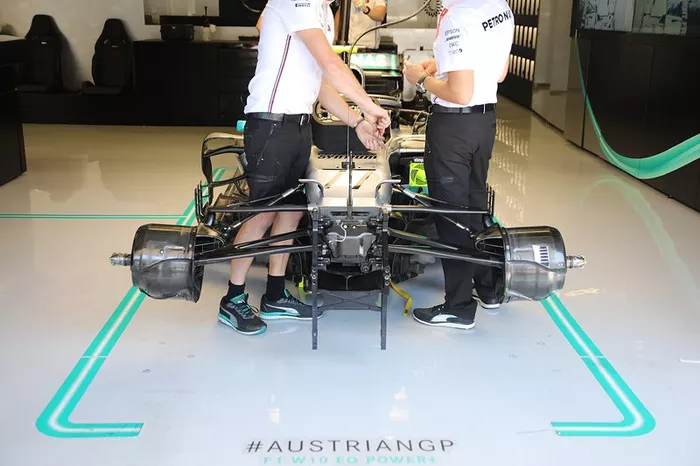
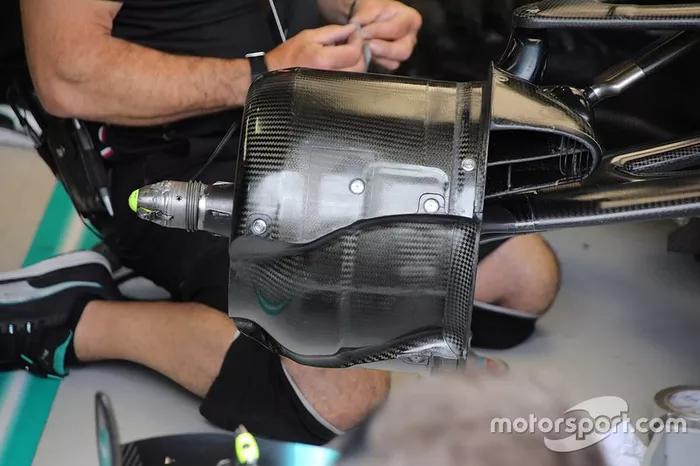
At the rear of the car, the overall design of the brake drum, inlet scoop, vertical end fence and associated winglets is uncanny.
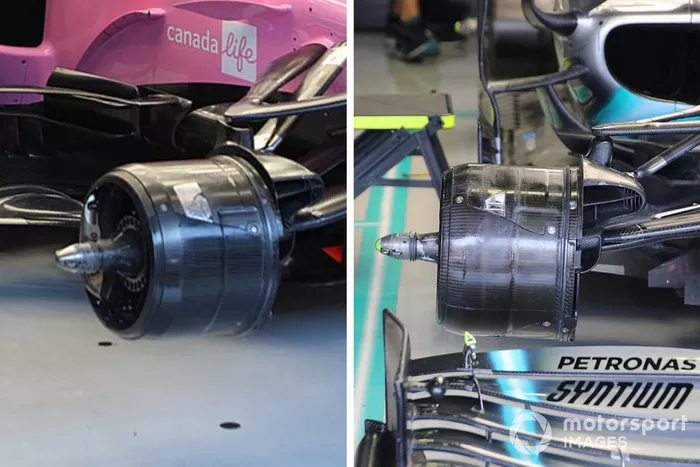
Meanwhile, at the front of the car, there will generally be more changes made throughout the course of a season, with the amount of cooling altered to suit the characteristics of the circuit.
This also means that the teams often have to change the configuration of the drum to offset the cooling capacity with their aerodynamic demands. The W10 sported at least four distinctly different designs throughout the course of the season.
You can see from this comparison image above that it had at least one design which is similar, if not the same, as the ones used on the W10.
Small geometrical differences between the Racing Point and Mercedes ducts on the outside may be sufficient to placate the FIA’s technical representative, however.
But should they be identical on the inside with channelling – something which can only be copied with inside knowledge – then that will only strengthen Renault’s case,
Marrying the internal flow structures will have a significant aerodynamic and thermodynamic impact, a gap that would be difficult to bridge for any of the smaller teams.
It will also be interesting to see if Mercedes has been requested to supply just one of its brake duct designs, or all of them that were raced throughout 2019, as there were discernible differences between them.
Read Also:
- Renault lodges protest against Racing Point
- Horner: Everyone should be "worried" by Racing Point's pace
Listed parts
Brake ducts on F1 cars are incredibly complex, and is especially important because under the 2020 Formula 1 regulations they fall under the category of ‘Listed Parts’.
This means that unlike suspension and brake assemblies that teams are allowed to purchase from one another, the design of the brake ducts must be their own and not sourced from another competitor or third party.
Any ‘Listed Parts’ designed by a competitor or third party means it also retains exclusive rights over the design, as long as it competes in Formula 1. That cannot then be used by another team.
Based on Renault’s protest, the FIA has sealed and impounded the relevant parts from Racing Point’s cars and has asked a representative of the Technical Department to conduct a thorough analysis and report back to the stewards.
The representative is also authorised to call upon outside technical assistance, including representatives of Racing Point, Renault and Mercedes.
The stewards have also ordered Mercedes to provide the front and rear brake ducts used on the W10 during 2019 in order that the FIA Technical Department may use them for their comparative analysis.





10
We want your opinion!
What would you like to see on Motorsport.com?
Take our 5 minute survey.
- The Motorsport.com Team
Read and post comments
Read also :
Share Or Save This Story
Copy link
Share on Viber
Previous article Renault protest "misconceived, poorly informed" - Racing Point
Next article Verstappen's damaged endplate got lodged in bargeboard
Top Comments
There are no comments at the moment. Would you like to write one?
View More & Comment

More from
Matt Somerfield

Gallery: How F1 tech evolved during the 2024 season
Formula 1
Formula 1 Dec 31, 2024
Gallery: How F1 tech evolved during the 2024 season
How McLaren’s rear wing push changed the game in F1
Formula 1
Formula 1 Dec 20, 2024
How McLaren’s rear wing push changed the game in F1

How 2026 F1 rules will help avoid identikit designs
Formula 1
Formula 1 Dec 16, 2024
How 2026 F1 rules will help avoid identikit designs

More from
Mercedes

The Kimi Antonelli you don't know: Inside the Mercedes garage with F1's new world champion
Formula 1
Formula 1
Mexican GP
3 h
The Kimi Antonelli you don't know: Inside the Mercedes garage with F1's new world champion
Toto Wolff reflects on Mercedes’ non-title years: ‘We weren’t complete losers’
Formula 1
Formula 1
Sao Paulo GP
20 h
Toto Wolff reflects on Mercedes’ non-title years: ‘We weren’t complete losers’

Latest news

Sebastien Bourdais hopes latest WEC success will remind teams of his value
WEC
WEC WEC
Monza
4 min
Sebastien Bourdais hopes latest WEC success will remind teams of his value
"It's horribly painful" - Williams drops 2026 car upgrades to benefit 2027
Formula 1
F1 Formula 1
Sao Paulo GP
1 h
"It's horribly painful" - Williams drops 2026 car upgrades to benefit 2027

Iker Lecuona felt significant differences between Ducati's GP25 and GP26
MotoGP
MGP MotoGP
Qatar GP
2 h
Iker Lecuona felt significant differences between Ducati's GP25 and GP26
Feature
Discover prime content

Top 10 F1 cars of the 1970s
Formula 1
By Kevin Turner
Top 10 F1 cars of the 1970s


Subscribe and access Motorsport.com with your ad-blocker.
From Formula 1 to MotoGP we report straight from the paddock because we love our sport, just like you. In order to keep delivering our expert journalism, our website uses advertising. Still, we want to give you the opportunity to enjoy an ad-free and tracker-free website and to continue using your adblocker.
You have 2 options:
- Become a subscriber.
- Disable your adblocker.
Subscribe now Already subscribed? Sign in here
Already disabled your adblocker?
Reload page
Manage Alerts
Subscribe