Analysis
Formula 1
Why F1’s fuel flow clampdown means even heavier cars
The FIA’s clampdown on fuel flow has contributed to 2020 Formula 1 cars being the heaviest since a minimum weight was introduced in 1961, with a late rule change set to add an extra kilo to the originally-agreed figure.

Adam Cooper
Edited: Mar 5, 2020, 2:57 PM
Copy link
Share on Viber
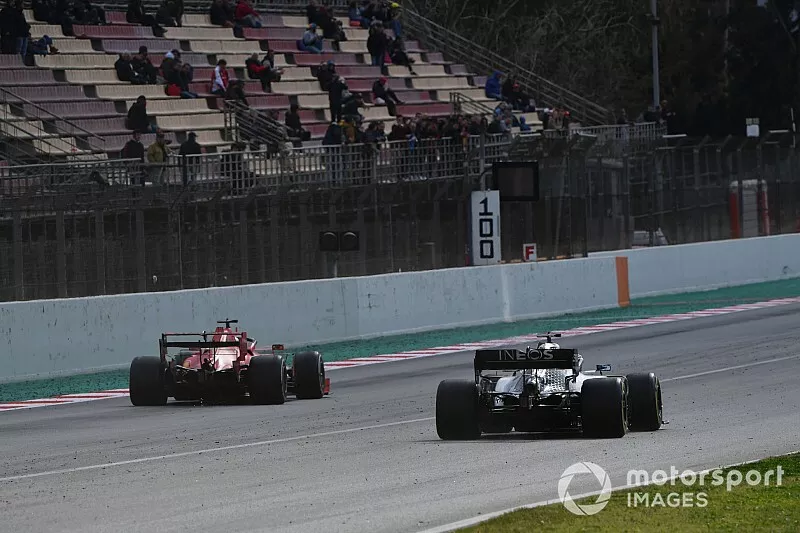
In 2019 the minimum weight was 743kg, and that was initially pushed up to 745kg for 2020 because technical directors wanted a little more leeway while trying to address costs, despite the figure having risen steadily since the start of the hybrid era.
Subsequently the FIA mandated the addition of a second fuel flow meter for 2020 to help the governing body monitor fuel usage. Along with that came an extra 1kg added to the previously agreed minimum weight, bring it up to 746kg.
Because the change came after the April cut-off for next year’s regulations it had to be agreed by all the teams. The new number was approved several weeks ago, but has had to pass through the formal process of the Strategy Group and F1 Commission, before finally being ratified by the World Motor Sport Council.
The increase, which should be officially confirmed on Friday, continues the recent trend of F1 cars become heavier than ever before on a steady season-by-season basis.
Read Also:
- What testing told us about F1 2020’s formbook
- The rules behind the Ferrari F1 settlement that enraged rivals
A dry car-only weight limit of 450kg was first introduced in 1961, at the start of the 1.5-litre formula. That increased to 500kg when 3-litre engines were introduced in 1966, and had risen to 575kg by 1973 – a number that stayed in place all the way to the turbo years in the 1980s.
In the modern era the minimum weight figure includes the driver, with a formal allowance of 80kg for driver plus seat having been introduced for the first time last year.
Remarkably, the minimum weight has risen by a total of 55kg over the seven seasons of the hybrid regulations – and it will jump even further when all-new rules are introduced in 2021.
How F1's minimum weight has increased since 2013:
Year Weight (kg) Notes 2013 642 Last year of V8 engines 2014 691 First year of hybrid V6 engines 2015-16 702 Adjustment for second hybrid year 2017 728 Wider wheels and tyres 2018 734 Halo introduced 2019 743 80kg driver/seat allowance; halo 'correction'; new wing regulations; rear wing lights 2020 746 Agreed-upon adjustment, plus second fuel flow meter 2021 768 New rules, including heavier standard parts
The extra fuel flow meter for this season has been welcomed by teams concerned by possible loopholes in the previous monitoring arrangements, and especially the suspicions that surrounded Ferrari in 2019.
The FIA now has an extra method of monitoring fuel flow in each car in real time.
“It’s a change to the regulations to ensure that the rule that is most pertinent to power delivery, which is the maximum fuel flow rate of 100 kilograms per hour, is not breached,” said Mercedes engine chief Andy Cowell.
“The FIA did some great work developing the fuel flow meter in time for the first race in 2014, and year-on-year they have done more work to make sure that the maximum fuel flow rate is firmly policed.
“The introduction of a second fuel flow meter is a very robust step forward in policing to make sure no team goes over 100 kilograms per hour. The second meter uses the same principle as the first one and sits in the same location, the fuel cell of the car.
“But there’s one crucial difference – while the teams can see the output of the first meter, they can’t see the output of the second one, that is only to be viewed by the FIA.”
We want your opinion!
What would you like to see on Motorsport.com?
Take our 5 minute survey.
- The Motorsport.com Team
Read and post comments
Read also :
Share Or Save This Story
Copy link
Share on Viber
Previous article FIA “not fully satisfied” that Ferrari power unit was legal
Next article Verstappen: Zandvoort banking will encourage different lines
Top Comments
There are no comments at the moment. Would you like to write one?
View More & Comment

More from
Adam Cooper

RB: Tsunoda “mentally on a different level” in 2024
Formula 1
Formula 1
Japanese GP
Apr 10, 2024
RB: Tsunoda “mentally on a different level” in 2024

Andretti planning F2 and F3 entries to promote US talent to F1 team
Formula 1
Formula 1 Apr 10, 2024
Andretti planning F2 and F3 entries to promote US talent to F1 team

Andretti F1 team formally opens new Silverstone facility
Formula 1
Formula 1 Apr 10, 2024
Andretti F1 team formally opens new Silverstone facility
Latest news

Hollywood star Christian Bale wants to portray MotoGP’s “gods” in a movie
MotoGP
MGP MotoGP
Portuguese GP
47 min
Hollywood star Christian Bale wants to portray MotoGP’s “gods” in a movie

Marc Marquez's body felt "stiffer" in Portimao practice: "I’m the only one who can lose”
MotoGP
MGP MotoGP
Portuguese GP
50 min
Marc Marquez's body felt "stiffer" in Portimao practice: "I’m the only one who can lose”

'Marco Bezzecchi is fastest at Portimao,' says Alex Marquez - after going fastest
MotoGP
MGP MotoGP
Portuguese GP
1 h
'Marco Bezzecchi is fastest at Portimao,' says Alex Marquez - after going fastest

Formula 1 set for V8 turbo return in 2030
Formula 1
F1 Formula 1
Las Vegas GP
1 h
Formula 1 set for V8 turbo return in 2030
Feature
Discover prime content

Top 10 F1 cars of the 1980s
Formula 1
By Kevin Turner
Top 10 F1 cars of the 1980s
Subscribe and access Motorsport.com with your ad-blocker.
From Formula 1 to MotoGP we report straight from the paddock because we love our sport, just like you. In order to keep delivering our expert journalism, our website uses advertising. Still, we want to give you the opportunity to enjoy an ad-free and tracker-free website and to continue using your adblocker.
You have 2 options:
- Become a subscriber.
- Disable your adblocker.
Subscribe now Already subscribed? Sign in here
Already disabled your adblocker?
Reload page
Manage Alerts
Subscribe