Special feature
Formula 1
Banned: How Formula 1 outlawed flexi-wings
One of the most tricky areas that rule makers have found to police in Formula 1 is flexible bodywork and wings, for there can be no such thing as a zero tolerance approach.
Matt Somerfield Giorgio Piola
Edited: May 12, 2021, 10:02 AM
Copy link
Share on Viber
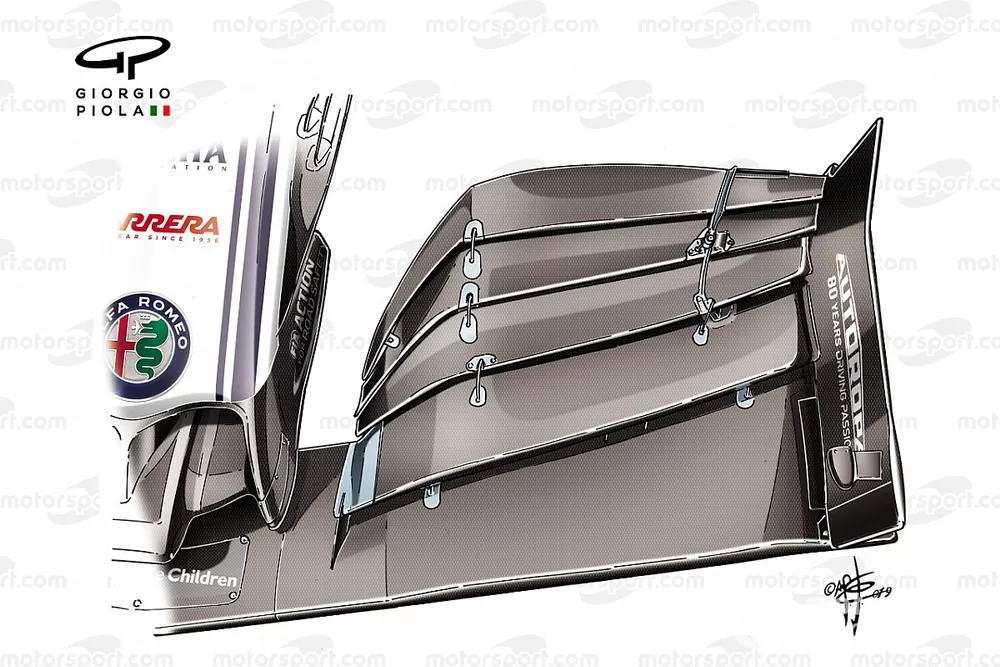
The nature of physics mean parts have to bend otherwise they shatter as soon as a load is applied. For teams, such aeroelasticity offers opportunity for aerodynamic benefits.
This area has therefore been a constant battle ground between the FIA on one side and teams on the other.
In the lead up to and during 1999, there were a number of high profile accidents with teams trying to create an effect whereby the rear wing would tilt rearwards under load - giving required downforce at lower speeds but reducing it and, more importantly drag, as speed built up.
In response, the FIA incorporated a stringent load test on the rear wing during scrutineering in order that it could detect any adverse rear flex on the wing.
Rear wing flap pullback test
Photo by: Giorgio Piola
Straight-line speeds began to increase again during the 2005/6 seasons with it becoming clear that teams were once again using aeroelasticity to make gains.
This time it wasn't being done in the same way as before though. This time they had designed their rear wing planes in such a way that the gap between the main plane and top flap would close up.
Read Also:
This had the effect of 'stalling' the rear wing, as the airflow couldn't circulate around the wing in the usual manner. This served the same purpose of reducing downforce, drag and increasing straight line speed. As the car slowed, the gap would reopen and downforce would be restored.
Formula 1's technical working group had already conceived a method to prevent this sort of manipulation, and had proposed it be introduced in 2007. But, with an explosion of the practice causing concern it may get out of hand during the 2006 season, the FIA introduced slot gap separators from the Canadian GP (as seen on the illustrations from 2007, above).
These separators were seen as a simple way of preventing the gap from closing as more load was applied.
Front wing deflection test loads
Photo by: Giorgio Piola
The next big F1 talking point regarding flexible bodywork seemed to have Red Bull in the dock at every conceivable turn.
The Milton Keynes-based outfit often seemed to be the ones singled-out over flexi-wings, as it appeared to have the best handle on how to best apply aeroelasticity to the front wing, whilst also being able to defeat the FIA's load tests.
Teams began looking at ways to circumvent the load tests in a way that allowed the outer tips of the front wing to reach toward the ground.
This effect would magnify the downforce being generated and, as a consequence, also change how the airflow was pushed across and around the face of the tyre, altering the shape of the wake created.
Consequently this would improve downforce over the rest of the car. For example, the floor was now able to produce more downforce, as the wake wasn't impinging on its performance as much.
The rules were changed throughout the next few years as the FIA tried to peg back any advances being made by the teams, all of which were dead set against losing any ground on their rivals.
2014 Regulation change overview, using Red Bull RB9 to compare
Photo by: Giorgio Piola
There was no one size fits all way of banning flexi-wings though, although the practice did hit more of a snag when the regulations regarding the width of the wing were altered for 2014, as this obviously magnified how the loads were put through the wing at the measuring point.
Ferrari SF70H and SF16-H top view comparison
Photo by: Giorgio Piola
The front wing's entire make-up and load profile were altered further still for 2017, as F1 ditched the conventional straight leading edge design of the main plane in favour of the arrowhead design.
This altered the wing's relative position with the nose, and also the distance from the leading edge of the front wing to the front edge of the floor – an important area for connecting up air flows.
Valentino Rossi tests the Ferrari F2008
Photo by: Ferrari Media Center
Undeterred Red Bull appeared to have found another way around the changes, as its front wing footplates were seen to be rotating at a different rate to the rest of the wing and thus altering the effect on the vortex shed from it.
Red Bull RB15 top view
Photo by: Giorgio Piola
In the end, the teams' push on flexible bodywork appears to have been stalled by the simplified front wings used since the 2019 regulation changes.
However, fresh opportunities will likely open up in the future and we will almost certainly have another chapter in this fascinating area of car development.
We want your opinion!
What would you like to see on Motorsport.com?
Take our 5 minute survey.
- The Motorsport.com Team
Read and post comments
Read also :
Share Or Save This Story
Copy link
Share on Viber
Previous article Leclerc a mix of Raikkonen and Schumacher - Alfa
Next article How Zoom helped change Formula 1 forever
Top Comments
There are no comments at the moment. Would you like to write one?
View More & Comment

More from
Matt Somerfield

Gallery: How F1 tech evolved during the 2024 season
Formula 1
Formula 1 Dec 31, 2024
Gallery: How F1 tech evolved during the 2024 season
How McLaren’s rear wing push changed the game in F1
Formula 1
Formula 1 Dec 20, 2024
How McLaren’s rear wing push changed the game in F1
How 2026 F1 rules will help avoid identikit designs
Formula 1
Formula 1 Dec 16, 2024
How 2026 F1 rules will help avoid identikit designs
Latest news
F1 Las Vegas GP: Rain ruins FP1 running
Formula 1
F1 Formula 1
Las Vegas GP
1 h
F1 Las Vegas GP: Rain ruins FP1 running

Nike joins F1 as apparel partner
Formula 1
F1 Formula 1
Las Vegas GP
2 h
Nike joins F1 as apparel partner
LIVE: F1 Las Vegas GP updates - FP1 finished as rain affects running
Formula 1
F1 Formula 1
Las Vegas GP
3 h
LIVE: F1 Las Vegas GP updates - FP1 finished as rain affects running

New WRC challenger set for public debut at Spa Rally
WRC
WRC WRC
Rally Saudi Arabia
4 h
New WRC challenger set for public debut at Spa Rally
Feature
Discover prime content
Top 10 F1 cars of the 1980s
Formula 1
By Kevin Turner
Top 10 F1 cars of the 1980s


Subscribe and access Motorsport.com with your ad-blocker.
From Formula 1 to MotoGP we report straight from the paddock because we love our sport, just like you. In order to keep delivering our expert journalism, our website uses advertising. Still, we want to give you the opportunity to enjoy an ad-free and tracker-free website and to continue using your adblocker.
You have 2 options:
- Become a subscriber.
- Disable your adblocker.
Subscribe now Already subscribed? Sign in here
Already disabled your adblocker?
Reload page
Manage Alerts
Subscribe