Breaking news
Formula 1
Are F1 2021's targets for downforce in dirty air achievable?
The FIA admits Formula 1 cars are unlikely to retain as much downforce as its 2021 research suggests, but hopes the new rules will still produce a "very big step".

Scott Mitchell
Edited: Nov 12, 2019, 4:10 PM
Copy link
Share on Viber
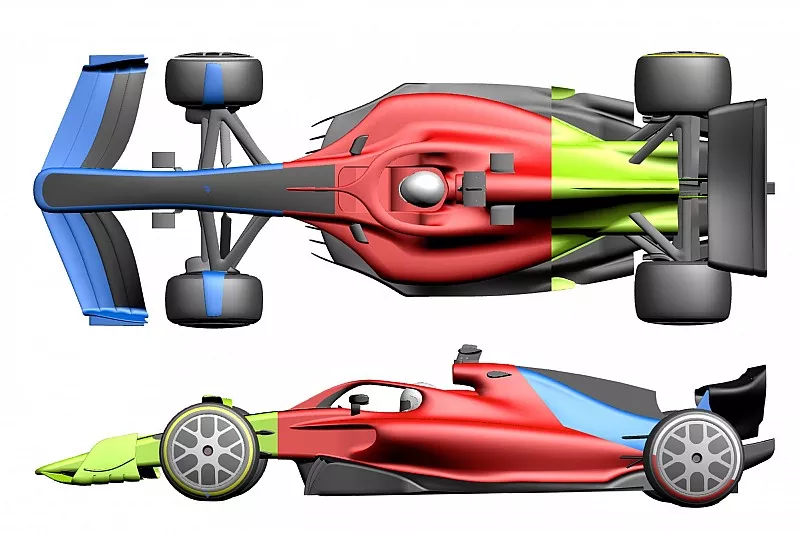
At the unveiling of new technical, sporting and financial regulations last month, the governing body and F1 chiefs revealed how new aerodynamic rules will target wake performance to improve close racing from 2021.
Read Also:
- Top things you might've missed in F1's 2021 rules
- F1 expects 2021 cars to be 3.5s slower
- F1 cars will look more different to each other in 2021
To help achieve this objective, parts of the car such as the front wing will be simplified and 'desensitised', while bargeboards will be eliminated completely and ground-effect will be employed via a long diffuser.
According to the rulemakers, research conducted while creating the new rules found that current F1 cars only have around 55% of their downforce when one car length behind another.
When presenting the new regulations, the rulemakers claimed that this number could rise to 86% on a 2021 F1 car, with 94% of the downforce available at three car lengths (compared to 68% at present) and 98% when seven car lengths behind (79% currently).
2021 rules downforce
Photo by: Motorsport.com
However, these are baseline percentages that represent an estimated current value based on data supplied to the FIA by an F1 team, and a 2021 prediction that does not take into account how teams interpret the new rules themselves.
FIA head of single-seater matters Nikolas Tombazis told Motorsport.com that while it is unlikely for the numbers presented last month to completely match reality.
"Clearly the teams, when they develop the cars, they don’t care at all about whether they make the following car worse," said Tombazis.
"That is not part of their objectives. They just concentrate on getting their cars as quick as possible. So, invariably, some things they do may hurt the following car a bit."
He added: "I would certainly expect that curve to be a bit lower than what it is on that graph. I'm speculating, it's anybody's guess, but maybe it'll lose a third of the advantage or something like that.
"But it will still maintain a big chunk."
Tombazis said that another significant factor would be that the highest-performing cars on the grid, for example the Mercedes or the Red Bull, would be more sensitive and so are likely losing more downforce when following other cars than the baseline figures in the FIA's research.
He hopes that the "net effect will be a very big step gained, probably not quite as big as what was on that graph", boosted by efforts made by the FIA to tailor the rules to help achieve its objectives.
Teams should be less able to control front wheel wake under the new rules while the return of ground-effect area is intended to focus development underneath the car, which Tombazis claimed would actually help a car that is following.
"We have got a reasonably good view about which areas of the car are more sensitive, and there are some areas of the car where actually solutions that find more performance tend to actually improve the wake," he said.
"So, for example, we've noticed if a car finds more performance on the main diffuser, that by and large improves the wake characteristics.
"Therefore we've been a bit more relaxed about the freedoms in that areas.
"On the other hand the front-wing endplate, the interaction with the wheel, is an area where you can screw up those wake benefits easily.
"So that area has been more restrictive as a result. We've tailored the amount of freedom certain rules give to how sensitive certain areas are to the wake and to the gain."
We want your opinion!
What would you like to see on Motorsport.com?
Take our 5 minute survey.
- The Motorsport.com Team
Read and post comments
Read also :
Share Or Save This Story
Copy link
Share on Viber
Previous article Leclerc to take Brazil grid penalty for new Ferrari engine
Next article Honda just wants "clean, fair" F1 engine battle
Top Comments
There are no comments at the moment. Would you like to write one?
View More & Comment

More from
Scott Mitchell
Alfa Romeo must do better in "chaotic" races - Vasseur
Formula 1
Formula 1 Jan 3, 2020
Alfa Romeo must do better in "chaotic" races - Vasseur
Honda: Verstappen relationship 'like a young Senna'
Formula 1
Formula 1 Jan 3, 2020
Honda: Verstappen relationship 'like a young Senna'

Key team personnel shouldn't be F1 boss - Ferrari
Formula 1
Formula 1 Jan 3, 2020
Key team personnel shouldn't be F1 boss - Ferrari
Latest news
IndyCar 2026 season review: Chip Ganassi Racing
IndyCar
Indy IndyCar 8 min
IndyCar 2026 season review: Chip Ganassi Racing
MotoGP Portuguese Grand Prix: Alex Marquez fastest on Friday as title protagonists all make Q2
MotoGP
MGP MotoGP
Portuguese GP
48 min
MotoGP Portuguese Grand Prix: Alex Marquez fastest on Friday as title protagonists all make Q2

Formula E pre-season test ends early after car explodes and catches fire
Formula E
FE Formula E 1 h
Formula E pre-season test ends early after car explodes and catches fire
Inter Europol Competition expands to two-car LMP2 program for 2027 IMSA season
IMSA
IMSA IMSA 1 h
Inter Europol Competition expands to two-car LMP2 program for 2027 IMSA season
Feature
Discover prime content

Top 10 F1 cars of the 1980s
Formula 1
By Kevin Turner
Top 10 F1 cars of the 1980s
Subscribe and access Motorsport.com with your ad-blocker.
From Formula 1 to MotoGP we report straight from the paddock because we love our sport, just like you. In order to keep delivering our expert journalism, our website uses advertising. Still, we want to give you the opportunity to enjoy an ad-free and tracker-free website and to continue using your adblocker.
You have 2 options:
- Become a subscriber.
- Disable your adblocker.
Subscribe now Already subscribed? Sign in here
Already disabled your adblocker?
Reload page
Manage Alerts
Subscribe