Analysis
Formula 1 Canadian GP
Technical debrief: Mercedes's unparalleled development
Mercedes may be Formula 1's dominant force, but the way it continues to push with refinements for its car is unparalleled, as Giorgio Piola and Matt Somerfield explain.
Giorgio Piola Matt Somerfield
Edited: Jun 16, 2016, 4:41 PM
Copy link
Share on Viber
Mercedes
Mercedes continues to pour pressure on its opponents with yet another raft of updates presented in Canada.
Its development and refinement of the W07 is unparalleled this season and is astonishing considering how close to the end of a regulation set we are.
Front wing
The front wing development undertaken by Mercedes over the last few seasons can now be found ingrained in many of the other teams' designs.
As is ordinarily the case, the teams all monitor each others' progress and this leads to a period of convergence, at least until someone moves the goalposts once more.

Mercedes W07 front wing, captioned, Canadian GP
Photo by: Giorgio Piola
This new development by Mercedes follows its philosophy of complicated aerodynamic airflow structures used to punish the airflow rather than chasing efficiency.
Much like the serrated trailing edge at the rear of the penultimate flap that it has been running for some time now, the strakes added to the upper flap micromanage the airflow to improve how the air moves aft of the wing.

Mercedes W07 front wing, Canadian GP
Photo by: Giorgio Piola
The new strakes (highlighted in green) mirror the one that lines up with the adjuster (highlighted in yellow), possibly performing the same role at differing yaw angles to break up a specific high pressure spot on the tyres surface and push airflow inside the tyre.
Front brake duct

Mercedes W07 brake duct, Canadian GP
Photo by: Giorgio Piola
Mercedes' quest for braking efficiency seems to have stabilised, as the inlet design that has changed every round up until Canada reverted to the Spanish GP configuration.
That didn't stop the team from playing around with the internal inlet though, with an additional inlet (highlighted in yellow) opened up in the gap between the vertical fence and tyre to help cool the brakes on a circuit that has caused them issues in the past.
Turning Vanes, Nose and 'S' Duct

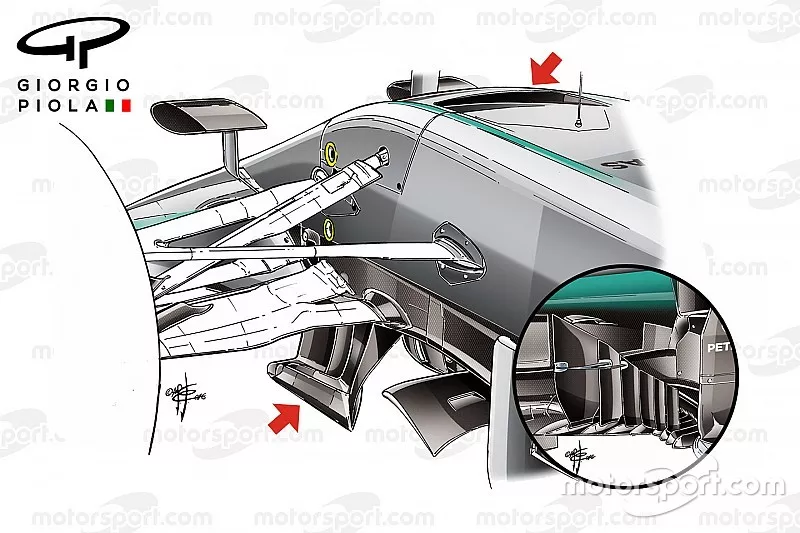
Mercedes W07 turning vanes comparison
Photo by: Giorgio Piola
The turning vanes (lower arrow) were updated only two races ago in Spain, when several longer slots were added to the footplate and extruded up the vertical elements too.
However, a totally revised and pioneering set of vanes hang from the underside of the W07 in Canada with the relatively small spanwise slots replaced by longitudinal slots that will undoubtedly change the shape of the airflow in that region and heavily influencing the Y250 vortex.
This is the first time we have seen such a design in this region, although it does bear a resemblance to both the tyre squirt slots we've seen McLaren and Force India use and the serrated floor strakes already in use on the Mercedes (inset).
Mercedes introduced a new nose in Spain, the tip of which has been slightly re-profiled, with a small point to be found right at the tip rather than the more bulbous design that previously featured.
A small change, you might argue, but it's one that seems to be considered circuit-specific, as it interacts differently with the neutral section of the mainplane below and changes the shape of the airflow as it moves under the nose.
This is likely of benefit to the 'S' ducts inlets which can then pass more airflow out through an enlarged outlet atop the chassis (arrowed in the illustration above).
Rear brakes
At the rear of the W07 the brakes will have been an area of focus for the Mercedes engineers, with the issues that befell both drivers back in 2014 still strong in the memory.
Mercedes is one of only four teams that run four-piston calipers at the rear of the car (Red Bull, McLaren and Sauber the others), as it puts emphasis on the recovery energy from the MGU-K.
When the MGU-K failed on both cars in 2014 it meant the rear brakes had to do more work, something the cooling configuration wasn't designed for, leading to the retirement of Hamilton and causing Rosberg to limp across the line as he desperately tried to manage the situation.

Mercedes AMG F1 W07 Hybrid brake detail
Photo by: Giorgio Piola
For 2016 the team opted to open up the brake drum above the disc, rejecting the heat into the gap between its surface and the wheel rim.
This trick also allows the heat to penetrate the rim and heat the gas within the tyre, changing its performance too. The sizing of these windows in the brake drum are therefore carefully selected in order to provide the best operating window for both the brakes and tyres.
Rear wing and monkey seat

Nico Rosberg, Mercedes AMG F1 W07 Hybrid
Photo by: XPB Images
It may not have raced it but Mercedes' dress rehearsal showed us a glimpse of its lower downforce rear wing package, which may feature again next time out in Baku, owing to the 2.2km straight.
The wing is a reworking of the 'spoon' design used at Spa and Monza last season and features a pair of curved elements.
The mainplane dips lower than the regulations intend, taking advantage of the 200mm central exclusion zone usually reserved for items like the mounting pylons or monkey seat.
Last year's design was compromised by a legacy from the previous regulations whereby the wing could only dip below 600mm from the reference plane 75mm from the cars centreline.
However, the regulations have been rectified for 2016, with that measurement increased to 100mm, like the regulations pertaining to the monkey seat, etc.
The spoon wing looks to maximise downforce in the central portion of the wing, where the additional chord length and angle of attack is overcome by the influence of the exhaust plume and monkey seat.
Meanwhile, the smaller footprint in the outer portions of the wing result in a different vortex being created as the pressure systems collide at the flap and endplate juncture, resulting in less drag.

Mercedes W07 monkey seat comparison, Spain GP/Canadian GP
Photo by: Giorgio Piola
Aside from the low-downforce 'spoon' wing, there was also a revision to the conventional wings upper flap, with notches taken out of the outboard section (arrowed) in order to change the vortex created as two pressure gradients collide at the wing and endplate juncture, reducing drag.
Mercedes also had an entirely new monkey seat available to it, with a hooped design utilised rather than the straight up-and-down winglet that preceded it. This hooped winglet, which also had a slot running around its profile, changes the shape of the exhaust plume and nearby airflow.
McLaren front wing

McLaren MP4/31 front wing, Canadian GP
Photo by: Giorgio Piola
McLaren continues to make changes to the MP4-31's front wing, which started a new design lineage in Spain.
In this exclusive 2D animation we take a look at the changes made to the front wing.
The new wing featured revisions to the outboard section of the flapped section (highlighted in yellow), whilst the endplate was also completely reshaped (highlighted in green), both of which change how airflow is moved outboard around the front tyre, reshaping the aero structure downstream for the difference in circuit characteristics.
We want your opinion!
What would you like to see on Motorsport.com?
Take our 5 minute survey.
- The Motorsport.com Team
Read and post comments
Read also :
Share Or Save This Story
Copy link
Share on Viber
Previous article Rosberg says Canada start risk was worth taking
Next article Compromised set-ups expected as F1 drivers get a first look at the Baku track
Top Comments
There are no comments at the moment. Would you like to write one?
View More & Comment
More from
Giorgio Piola
The fascinating story behind McLaren's most iconic F1 car
Formula 1
Formula 1 Apr 3, 2024
The fascinating story behind McLaren's most iconic F1 car

Emilia Romagna GP: F1 technical images from Imola's pitlane
Formula 1
Formula 1
Emilia Romagna GP
Apr 21, 2022
Emilia Romagna GP: F1 technical images from Imola's pitlane
The F1 downforce choices that proved key at the Saudi GP
Formula 1
Formula 1
Saudi Arabian GP
Mar 29, 2022
The F1 downforce choices that proved key at the Saudi GP

More from
Mercedes
George Russell impressed by "exceptionally fast" McLaren as rain delays Lando Norris' floor test
Formula 1
Formula 1
Las Vegas GP
2 h
George Russell impressed by "exceptionally fast" McLaren as rain delays Lando Norris' floor test
Five drivers set for grid penalties for engine changes at F1 Las Vegas GP
Formula 1
Formula 1
Las Vegas GP
7 h
Five drivers set for grid penalties for engine changes at F1 Las Vegas GP

Latest news
Fernando Alonso returns to Dakar: Why his first rally-raid experience was a shock to the system
Dakar
DAKR Dakar 4 min
Fernando Alonso returns to Dakar: Why his first rally-raid experience was a shock to the system
How the F1 2026 regulations neutered Oscar Piastri's "real strength"
Formula 1
F1 Formula 1
Las Vegas GP
49 min
How the F1 2026 regulations neutered Oscar Piastri's "real strength"

What Flavio Briatore takes from McLaren after Fernando Alonso "disaster"
Formula 1
F1 Formula 1
Las Vegas GP
1 h
What Flavio Briatore takes from McLaren after Fernando Alonso "disaster"
Feature
Discover prime content

Top 10 F1 cars of the 1980s
Formula 1
By Kevin Turner
Top 10 F1 cars of the 1980s
Subscribe and access Motorsport.com with your ad-blocker.
From Formula 1 to MotoGP we report straight from the paddock because we love our sport, just like you. In order to keep delivering our expert journalism, our website uses advertising. Still, we want to give you the opportunity to enjoy an ad-free and tracker-free website and to continue using your adblocker.
You have 2 options:
- Become a subscriber.
- Disable your adblocker.
Subscribe now Already subscribed? Sign in here
Already disabled your adblocker?
Reload page
Manage Alerts
Subscribe