Analysis
Formula 1 Hungarian GP
Hungarian GP tech debrief: Final push before the summer break
In part one of our Hungarian GP technical debrief, Giorgio Piola and Matt Somerfield look at the updates introduced by Mercedes, Red Bull and Ferrari at the Hungaroring.
Giorgio Piola Matt Somerfield
Edited: Jul 26, 2016, 3:03 PM
Copy link
Share on Viber
Giorgio Piola's F1 technical analysis
Giorgio Piola is the preeminent Formula 1 technical journalist. View our full selection of Giorgio's technical illustrative content
Ferrari
Ferrari continues to look for ways of improving the SF16-H as it battles with a resurgent Red Bull for second place in the championship.

Ferrari SF16-H rear wing detail
Photo by: Giorgio Piola
In Hungary, this led to the adoption of a new monkey seat design, very similar to one it had already used this season but different nonetheless.
The lower winglet's leading edge was less arched than the one used in Monaco but tapered all the way to the endplate, whilst the endplates (highlighted in green) were also revised, as Ferrari looked to improve the shape of the airflow so that it works in unison with the rear wing and diffuser to improve overall downforce.

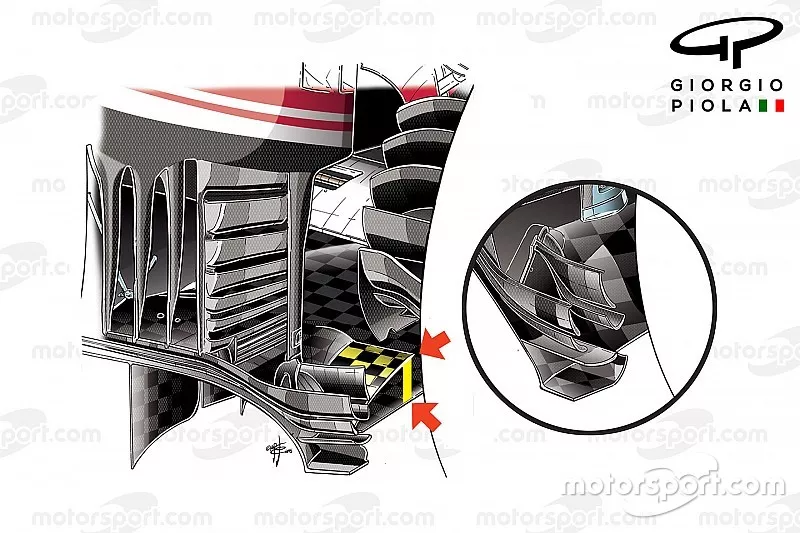
Ferrari SF16H diffuser, Hungarian GP
Photo by: Giorgio Piola
The upper surface of the diffuser and footplate has become ever more complex since the team fitted a winglet stack there in Spain 2015 (inset), with numerous changes to the winglet stack and diffuser profile since.
However, in Hungary, an extended flap appeared to stretch forward from this cluster of winglets toward the brake duct ahead (highlighted in yellow) enticing the airflow to interact.
This is a particularly sensitive area of the car with the deformation of the tyre and motion of the suspended parts constantly changing how the airflow moves.
This new flap should pinch the airflow and force it to accelerate toward the diffuser's footplate, improving not only the performance of the diffuser's outer channel but also provide a more efficient flow structure for the winglet stack too.
This should improve the overall performance of the diffuser as flow consistency is improved across the board.

Williams FW38 diffuser, Hungarian GP
Photo by: Giorgio Piola
Ferrari is not the only example of a team concentrating its efforts in this area of the floor to make aerodynamic gains, as we can see from the illustration above, Williams also placed a fin in the opposing direction to the airflow in Austria 2015 too, having likely studied the effect Ferrari's winglet stack had on diffuser performance.
Mercedes
After a relentless development drive so far this season, the updates abated a little for Mercedes in Hungary, with the cockpit louvre panel the only standout part on the W07 that we haven't seen before.
That's not to say we can't find things of interest, with many parts used in previous races returning to improve the downforce and stability available.
Keeping it cool

Mercedes W07 top exits, Hungarian GP
Photo by: Giorgio Piola
The panel that runs alongside the cockpit is changed at each circuit in order to maintain the correct thermal operating window.
In Hungary, the panel was increased in height and eight louvres used to displace the heat rejected from the sidepod, so that it doesn't impinge on both internal and external aerodynamic performance.

Mercedes AMG F1 W07 Hybrid rear detail
Photo by: Giorgio Piola
At the rear of the sidepod, the bodywork was opened up around the front leg of the upper rear wishbone, dissipating heat generated within.
This is not the first time we've seen the team employ this configuration, it having done similar at other circuits with high thermodynamic demands.
Winging it

Mercedes W07 monkey seats comparison, Hungarian GP
Photo by: Giorgio Piola
Having used the hooped monkey seat since its introduction in Azerbaijan, Mercedes returned to the square profile design last seen in Monaco.
This change highlights the emphasis the teams place on ensuring the rear wing and diffuser's airflow structures interact to improve performance, with the squared monkey seat improving spanwise distribution of the exhaust plume.

Mercedes W07 rear wing, Hungarian GP
Photo by: Giorgio Piola
The team also retained the rear wing that was introduced in Silverstone, which features the displaced endplate louvres pioneered by Toro Rosso at the start of the season, whilst upwash strakes were also added to the endplate to help break up pressure building across the surface and help connect the rear wing and diffuser aero structures as the airflow is guided upward.
Red Bull
The Hungaroring was always going to play to the strengths of the RB12 but the team made changes at the rear of the car in order to increase downforce even further still.
Strakes first added on the outer surface of the endplates in Russia to increase upwash made a reappearance, improving the aerodynamic connection between the rear wing and diffuser.
This was accompanied by a new monkey seat, which is the first time Red Bull has utilised one in a competitive session, not even applying the appendage in Monaco, something not seen for a number of years.
As we can see in the 2D animation above, Red Bull assessed several configurations during free practice to ascertain which would give the best performance, but in the end both drivers ran both the straked endplates and monkey seat for qualifying and the race.
We want your opinion!
What would you like to see on Motorsport.com?
Take our 5 minute survey.
- The Motorsport.com Team
Read and post comments
Read also :
Share Or Save This Story
Copy link
Share on Viber
Previous article Rosberg unfazed by loss of championship lead
Next article F1 teams should not decide Halo fate - Button
Top Comments
There are no comments at the moment. Would you like to write one?
View More & Comment
More from
Giorgio Piola
The fascinating story behind McLaren's most iconic F1 car
Formula 1
Formula 1 Apr 3, 2024
The fascinating story behind McLaren's most iconic F1 car

Emilia Romagna GP: F1 technical images from Imola's pitlane
Formula 1
Formula 1
Emilia Romagna GP
Apr 21, 2022
Emilia Romagna GP: F1 technical images from Imola's pitlane
The F1 downforce choices that proved key at the Saudi GP
Formula 1
Formula 1
Saudi Arabian GP
Mar 29, 2022
The F1 downforce choices that proved key at the Saudi GP

More from
Ferrari
Toto Wolff is not afraid of losing Kimi Antonelli to Ferrari
Formula 1
Formula 1 16 h
Toto Wolff is not afraid of losing Kimi Antonelli to Ferrari
Latest news
Oscar Piastri set for grid penalty at F1 Las Vegas GP
Formula 1
F1 Formula 1
Las Vegas GP
3 h
Oscar Piastri set for grid penalty at F1 Las Vegas GP

Rodney Childers pushes back on NASCAR CEO's claims about car comparisons
NASCAR Cup
NAS NASCAR Cup 6 h
Rodney Childers pushes back on NASCAR CEO's claims about car comparisons

“He’s beaten Alpine on his own” - Racing Bulls on why it kept Liam Lawson
Formula 1
F1 Formula 1
Las Vegas GP
11 h
“He’s beaten Alpine on his own” - Racing Bulls on why it kept Liam Lawson

Feature
Discover prime content


Subscribe and access Motorsport.com with your ad-blocker.
From Formula 1 to MotoGP we report straight from the paddock because we love our sport, just like you. In order to keep delivering our expert journalism, our website uses advertising. Still, we want to give you the opportunity to enjoy an ad-free and tracker-free website and to continue using your adblocker.
You have 2 options:
- Become a subscriber.
- Disable your adblocker.
Subscribe now Already subscribed? Sign in here
Already disabled your adblocker?
Reload page
Manage Alerts
Subscribe